
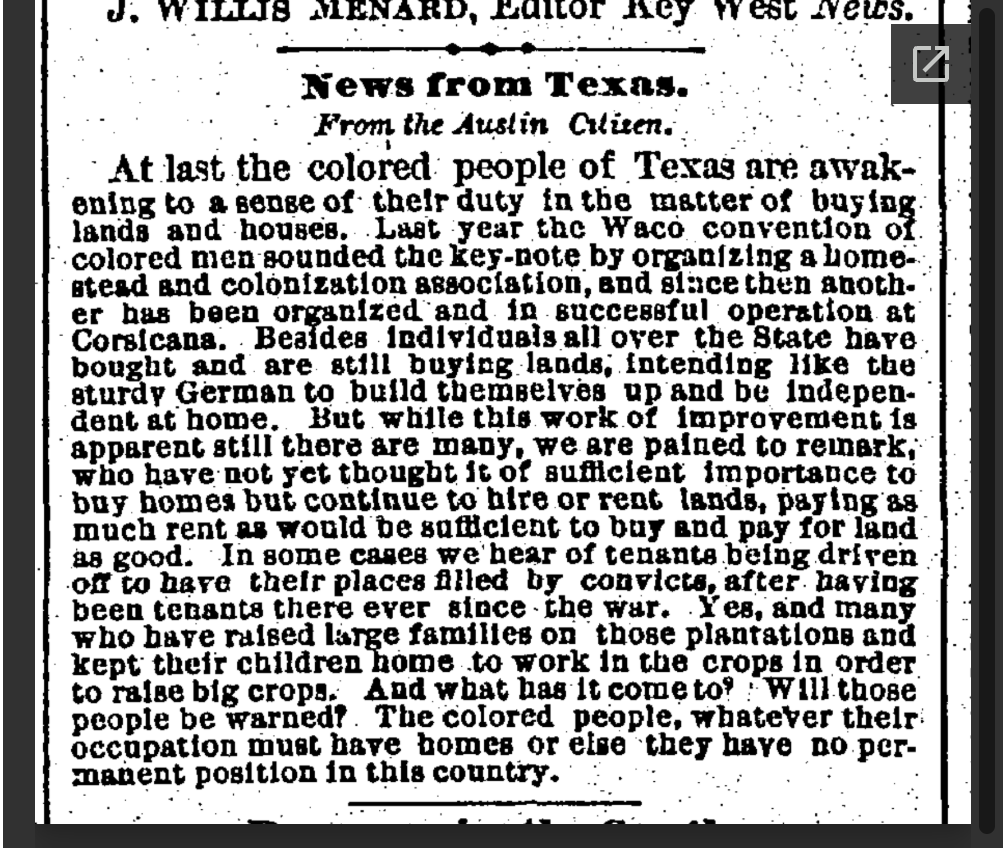
On Douglass Day, I transcribed multiple historical records to participate in the nationwide effort to come together as a community to engage with primary sources firsthand and help to preserve Black history. Before this experience, I didn’t know much at all about digitized archives at all or why and how transcribing these records has such an influential impact on the community in preserving Black history for future generations. I had never thought much about digitized archival documents. I knew that archives existed, but I didn’t necessarily picture them as accessible online documents, moreso just as physical old papers that were locked away. I also didn’t know what the Colored Conventions movement was- I had never learned about it in my history classes. I had always thought that most of the organized Black political activism began closer to the Civil Rights Movement. I didn’t realize that in the 1800s, free and formerly free enslaved Black Americans were already holding national and state conventions to advocate for several human rights, like voting, education, and equality. I did some further research and learned that this movement was extremely organized and intentional. These weren’t small, random meetings- they were very structured meetings with leaders, committees, speeches, and written proceedings. Douglass Day, and the Colored Conventions movement have changed my perspective on Black political activism in the 1800s, and made me realize that there are a lot of crucial events in history that aren’t taught or in textbooks.
When it was time to start transcribing, I was very unfamiliar with the process of transcription, but quickly caught on and was able to transcribe several different documents to better understand the realities of Black history. I learned that it actually requires a lot of work to be able to see digital archives. More specifically, I learned that it takes a lot of work to scan, upload, organize, and then transcribe these old documents so people can actually see and search for them. I would say that my major takeaway from this experience is that digital archives literally give us access to history, including students and the public. Especially for the fact that we live in a world that is becoming more and more online and digitalized, these documents are crucial in being able to have access to historical information. These documents hold power and importance- especially for marginalized histories.
One challenge I faced was really understanding the documents. While reading and transcribing may sound simple, there was a lot of 19th-century cursive and archaic language I wasn’t able to fully comprehend at times. The spelling wasn’t consistent, the ink was faded at times, and the grammar wasn’t always correct. I found myself needing a lot of patience and focus in order to pay attention to all the details and actually transcribe the documents. I learned that I wasn’t just copying words down, but preserving the integrity of the original document while making it readable for students and the public. I also learned that although it was tempting to fix, I needed to stay true to the original spelling and punctuation, and not fix it. I also learned I couldn’t keep second-guessing myself, as there were moments of frustration when I was unsure if I was reading the words correctly. I then realized that how fast I was able to transcribe didn’t matter- it’s about accuracy, patience, and respect for the old documents. Rushing would most certainly lead to mistakes and more second-guessing.
I found it both interesting and heartwarming how this truly is a community-wide effort; our professor joined a call with hundreds of people celebrating Douglass Day by transcribing documents and eating cake. We were actively able to see how many volunteers were participating and how many documents were transcribed as time went on. By the end of our class, I felt that my engagement with the archival documents made history feel more real and personal. Instead of learning about history in a textbook, I was reading words written by actual people who participated in these conventions. This experience made me feel more connected to the individuals behind this movement and much more aware of the effort and work it took to advocate for basic human rights during this time. This experience transcribing documents from the Colored Conventions movement has shifted history from something far away and abstract to something human and tangible that will stay with me.