Observing Thoreaus changes to The Ponds passage 5 between version D and E: By Grace Delisanti, Amaya Martin, Michael Crowley, Evan Shuryn, and Oliver Perkins

But How Many Inches is Walden Pond?: The Dueling Desires for Concision and Comprehensiveness in Thoreau’s Walden

Let us not presume to understand the mechanisms of a long-dead man’s mind — Henry David Thoreau passed beyond the vale over a century and a half ago; it would be folly to say we know what passed through his mind as he wrote his seminal novel. However, we are unusually gifted in this case — while with most authors we can only speculate based upon the final product, we can witness Walden’s revisions firsthand. Through this privilege, we can begin to speculate on some of the motivating drives behind Thoreau’s process. This blog post will focus on two equal opposites: comprehension and precision, and will do so by examining paragraph 5 of “The Ponds”, where the tension between them is quite clearly evident.

An Additional Introduction

Shows 5a-5c

Version E adds an introduction that describes Walden to the reader. The introduction contextualizes the pond before Thoreau begins to describe its measurements and surroundings. This addition shows the tension between concision and comprehensiveness in Thoreau.

Concision Versus Description

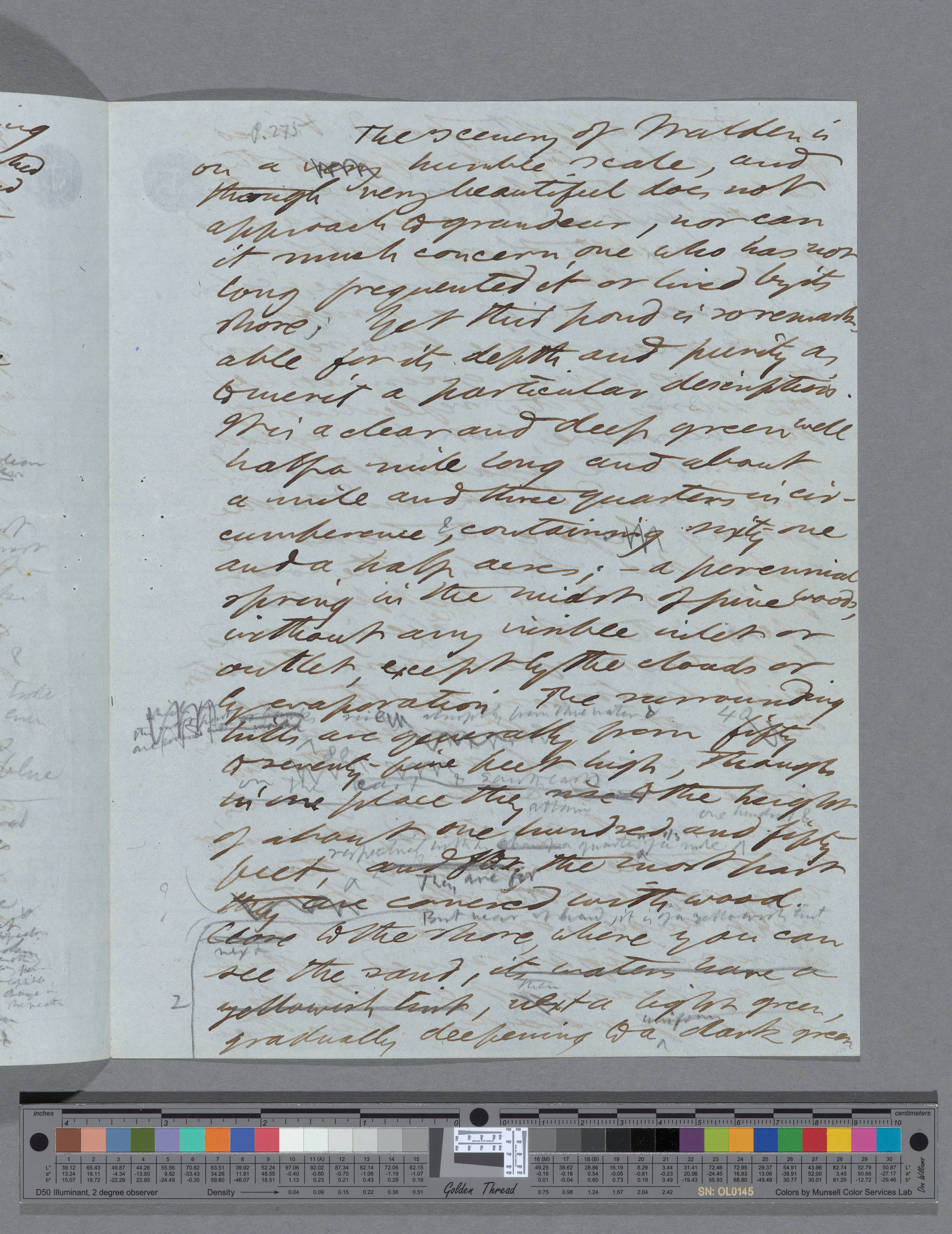
“The Ponds” paragraph 5 contains many examples of edits made in favor of descriptive imagery and precise detail. Version E of Thoreau’s Walden includes additions such as sections 5a, 5c, 5e, and 5g. These sections do not appear in Version D. Section 5a acts as an introduction, as aforementioned, the rest of the added sections are descriptions of Walden Pond’s differing colors and imagery relating to the beauty of the pond. Paragraph 5 also includes examples of intended concision, where Thoreau chooses succinctness over long-windedness. 5d is a good example of this as he removes and rewords certain phrases to shorten the overall description. Thoreau continues his battle between focused and precise writing with vivid imagery and layered description. He aims to provide in-depth imagery of the beauty of the pond and its connection to its viewers and its environment while also keeping the reader focused and interested throughout the chapter. The manuscript image from version E shows an entire passage originally written in pencil describing the color of water, which is deleted from paragraph 5 with a vertical line through it.

shows vertical deletion strike

Measurements

The sudden changes in measurements is a prime example of Thoreau attempting to be precise. Thoreau, in both versions D and E, either adds or refines measurements to make sure that readers can picture the ponds that Thoreau is describing. This precision with the measurements is possibly done to make sure that readers do not waste time trying to imagine what the pond might be, rather than trying to imagine what it could be like. In version D, it added more concise measurements by adding an accurate range and adding a more specific height when talking about the measurement of a hill. Then in version E, he edited version D by adding a different range with cardinal directions and adding miles for a distance. This is all at the beginning at 5c in the chapter “The Ponds”. On top of this, version 5a, as mentioned before, was added to version E out of the blue. Thoreau decides to add miles and acres measurements again to make sure that readers are able to envision the distance of the land. As a reader, looking at the difference in measurements and adding measurements seems like a slight detail, but the significance of these small changes shows Thoreau’s obsession with being precise, but this detail is not wasting readers’ time, as he wants to make sure they can witness the beauty of it. One difficulty we had with noticing the measurements was trying to figure out how it was important. This was one of the first changes that was noticed, and sparked the hypothesis that was created. It is still subjective on what it could mean, but it was one of the sparks that helped build up this project.

Transcribing with TEI

The biggest difficulty in transcribing the manuscripts in the XML file was marking the deletions in the correct order as they appear on the manuscript. Other than that, learning basic HTML was easy, and I was able to look up different tags if I didn’t understand them.

Color

Throughout section 5 between versions D and E, there are edits made having to do with color that are both added to the text, deleted from the text, and interlined in pencil. For example, in 5C version E, “But near at hand, it is of a yellowish tint next to the shore, where you can see the sand, then a light green gradually deepening to a uniform dark green in the bosy of the pond”. This section is added to enhance detail within the color of the pond and add more detail to emphasize the natural beauty and complexity of Walden Pond. This edition takes the reader on a journey of color throughout the physical pond. He starts with the shore, describing it as yellowish, then to light green, then to dark green seen in the deeper water, and finally describing the color reflecting from the sky. The word yellowish is used rather than simply yellow because it conveys subtlety and precision in observation. It humanizes the description rather than making it a scientific one.

The Ponds- Section 5- Catie Mcguire, Ali Dahl, Gabrielle Laughlin & Arlette Alvarez

Introduction

Our group picked the Ponds because he focused on the ever changing meaning of the water and nature around him which intrigued us and made us want to take a deeper look into that chapter. We chose to focus on paragraph 5 because it immediately stood out to us as it contained the most edits, it also started out as one or two sentences and then became one large paragraph. It ended up becoming one of the largest paragraph within The Ponds by the end of his last version.

Hypothesis

Our hypothesis is that Henry David Thoreau’s hard work that he puts into the water reflects the appreciation that he wants to pass onto other people to value nature. Thoreau’s continued edits of his own descriptions reflect an attempt to properly appreciate the purity of water and reach the same purity in his words.

Challenges

One of the challenges we faced when we first took a look at the different versions for The Ponds, was that versions A-C included no changes for paragraph 5. It only included section 5B in those versions which consisted of no changes, except for being retained. For us, we then decided to just take a look at versions D-G because these versions included the more crucial changes and additions that Thoreau made. Another challenge we faced was how version G had minimal to no change with the Princeton edition.

Comparing Versions

Version D to E

Between versions D and E of “The Ponds”, we see a good number of differences in section 5a-c. Thoreau made quite a few changes in each part of section 5, whether it was adding/taking away sentences or changing wordings and descriptions. While examining this section and its revisions, we are able to see the configuration of Thoreau’s piece, and make guesses as to why some text did or did not make it to the final copy. I focus on both the differences between versions D-E, and version D to the Princeton edition, both concentrating on section 5a-c. In version D, there is a section titled “5b”, almost as if 5a almost made the cut, but then last minute didn’t make it for this version, in which Thoreau decided to not change the name of the section. While in version E, there is a section with quite a bit of text labeled “5a”. Thoreau states in version D, “are generally from 50 to 75 feet high though in one place they rise to the height of about 150 feet”, when discussing the hills surrounding the woods. However, he decides to change up that wording in version E as he states, “The hills rise abruptly from the water & are from 40 to 8- feet high, though on the southeast & east they attain the height of about one hundred & fifty feet respectively within a quarter & ⅓ of a mile.”. This abrupt change makes the audience and myself wonder why Thoreau changed up this wording? Why did he change the measurements from 50-75 feet, to 40-8 feet? Why did he write the number out numerically in version D, but wrote it out as words in version E?

Version D to Princeton Edition

One thing that the Princeton edition has that version D of “The Ponds” does not include is a section of paragraph 5, titled “5a”. This was something that I first noticed when comparing the versions D and E together, and during the comparison of versions D to Princeton. While examining this section, and the revisions that made it into the Princeton edition, one finding was in section 5b. Version D states “in the midst of pine woods”. However, Thoreau changes it in the Princeton to, “in the midst of pine and oak woods”. Although this is not a dramatic change, it was still something that made us wonder why the few words and descriptions needed to be changed. Additionally, 5c also shows some changes, after analyzing some of the descriptions and formattings that were noticed when comparing versions D and E together. One of the major differences in D to E was the wording about the height of the hills, how the numbers changed and how Thoreau originally wrote the measurements numerically, but then wrote the number as words. In the Princeton edition, there is no description of the height of the hills, how far away they are from said location, and there are not as any descriptions of the surrounding environment as there is in version D. “in fair clear weathers” is what Thoreau describes the climate to be in version D in 5c, but the princeton states “in stormy weather”. As we analyze this we may wonder, what made Thoreau change the climate? Does he not remember and is just using made up information? However, the Princeton edition does describe water in more creative detail “vitreous greenish blue” and “crystalline purity” is what he uses to describe the water.

Shows 5a-5c

Version E to F

When looking at versions E and F, the most immediate feeling one may gather from looking over Thoreau’s edits, is one of uncertainty. In paragraph 5 Thoreau puts as much effort as he is capable of into attempting to describe Walden, a task that we see is no easy achievement. He goes from simple descriptions of colors, to these almost grand depictions of this body of water. An early example of this can be seen in an edit made while describing the Concord waters, in version E he presents them and states “All our Concord waters have one color viewed at a distance…” Yet, when we look over to Version F he now says “All our Concord waters have two colors at least…” This isn’t Thoreau correcting himself on a slight error, or misplacement of a word, it is him playing up the beauty of the bodies of water he’s attempting to properly appreciate. He further goes on to say that a bather jumping into the body of water would look “monstrous” and actively tarnish the beauty of the water. It is fair to say that this isn’t merely a compliment towards the inanimate blue liquid, this is a much deeper appreciation which we can see going forward in other versions. Each individual edit specifically from E to F speaks of frustration, and even moving forward into the Princeton edition, it is difficult to tell if he truly reached a point of satisfaction regarding the description of Walden.

Version E to Princeton Edition

It’s difficult to tell if the changes from version E to Princeton mean Thoreau found a final answer to the question of how to describe this area. One large issue though is that it is incredibly difficult to mark this end of journey moment as satisfactory. As provided to us by Professor Schacht, there are other pieces of writing by Thoreau which further add on to this same paragraph and only add on more descriptions! The leaves which we can’t find in the fluid text version mark other steps of the journey, and perhaps serve to show us that this journey isn’t one with a clear end. Thoreau is a writer that puts an incredible amount of thought into each description and values his clarity above all else. “Like the rest of our waters, when much agitated, in clear weather, so that the surface of the waves may reflect the sky at the right angle, or because there is more light mixed with it, it appears at a little distance of a darker blue than the sky itself…” This type of description and the love involved is part of why we find ourselves discussing Thoreau, it is a unique form of appreciation that we sometimes struggle to find. Regardless of if Thoreau’s attempt at describing Walden was truly successful, the effort put into reaching a satisfactory level of clarity is vastly important to appreciate. Walden, no matter if green or blue, or how it is affected by the weather, is to thank for some of the most direct and focused effort in describing nature.

Shows 5c

Version F to Princeton Edition

Many of Thoreau’s changes he makes tend to be for clarity and organization, which I noticed quite a lot in version F of paragraph 5. He is always adding and changing words out throughout this version, but in section A it was written in E but rewritten in F for that sense of clarity. For example in section A it only included one sentence that was a minor critique. I think the small critiques he made were to create that clarity. The change that was made was, “The scenery of Walden is on a very humble scale, and, though very beautiful, does not approach to grandeur….”. The word highlighted in red was a cancelled text in this section. I believe the word “very” being taken out made the sentence run more smoothly, as the emphasis it added before was unnecessary. Next thing I noticed was splitting a sentence in section “a” that became the entirety of section B . I wonder why the sentence was broken up to create another section because This section consisted of 1-2 lines that were describing the view he saw of nature during spring. It also consisted of minor changes like “or by”, that was cancelled out and changed with “and”. The “And” was interlinked with ink, so I think this change is where he went back to a word he wrote because it flowed much better than the “or by”. In this section that inlerinked word, along with the “and oak” are part of a missing leaf. Section C was a very long section that contained lots of edits and words that were interlinked with either ink or pen. This section was written in Version D and rewritten in both E and F. A major change I saw was a large paragraph being taken out, it contained descriptions of water, earth, and nature. Part of me was confused why he would do that at first because throughout Walden he always uses a descriptive choice of words which this section contained. This change was made in version D but it is said to be retained in version F. This cancellation could be for clarity as the sentences were very long and potentially it could have made it feel unnecessary because he continues to discuss the water right after, including the weather. I wonder if he felt as though he was repeating himself or even the way he wrote involved too many words and symbolic ideas that lost the true focus he was getting at. Even in the rest of section C, he took out many small parts of sentences which I want to believe is for clarity and descriptiveness of his writing because he did always take such care in that part of his writing. As well as parts being considered as interlinked with ink or pen but other than that no major things being changed except those smaller words being changed for clarity. He takes care and pride in his choice of words which is why in this version he continues to edit words to make sure it has 100% clarity and the focus is maintained.

Version G to D

Between versions D and G, several notable revisions reflect both stylistic refinement and deeper thematic development. Version D is missing the entirety of section 5a, a significant omission that is fully present in Version G. One major change is the more elaborate and nuanced description of the pond’s water in Version G, which emphasizes the gradation of color from the yellowish tint at the shore to a dark green in the deeper areas, with additional attention to how lighting alters its appearance. In contrast, Version D provides a simpler color contrast “blue in the depths and green near the shore” without the same depth of visual detail. G also deletes part of a sentence found in D, removing the phrase “Some have referred the more obvious greenness next the shores,” perhaps to streamline or reframe the observation. A new addition in G offers a speculative explanation for the green tint, suggesting it may result from the interplay of the prevailing blue water and yellow sand. Subtle changes in phrasing also emerge: “Like any water” in D becomes “like the rest of our waters” in G, and “The water of the river” becomes “The water of our river,” indicating a shift toward a more personal or communal relationship with the landscape. Version G further formalizes the text by spelling out ampersands (e.g., “and at such a time…”), though retains one instance (“being on its surface, &”) in ink as part of the drafting process. Interestingly, G later reverts to D’s original phrasing in the description beginning “It is well known likewise that,” suggesting a selective process of revision aimed at balancing new elaboration with the clarity of earlier expressions.

Version F to G

In this comparison of F and G, I noticed that section A and B were the same changes but there were lots of parts in G of those sections that had more of the words being highlighted as assumed to be retained. I wonder if because this was his last version he wrote, he just was writing minor changes for clarity or focus would mean he would not include every little detail of the last version. As all of the changes he made or words that are considered interlinked were the same in version G so maybe because this was his last version he had less changes to make from version F. With that it makes sense why more of verison G had retained because he didn’t need to make any more changes. With that being said G looked very much like the princeton version which makes sense why I couldn’t see much difference from F and G. I wonder why he would write another version if there were no major differences because he finished F in 1954 and also finished G in 1954. I wonder if he felt the need to do version G to make sure he had that clarity and focus for it to become the full version.

Version G to Princeton

There appeared to be no significant revisions between Version G and the Princeton edition. Most edits were minor punctuational revisions. Overall, the changes between these versions seemed to be motivated simply by the movement towards formal and finalized punctuation and structure.

Conclusion

What we can gather from our interpretation of the edits Thoreau made in this paragraph is a point we find somewhat commonly when regarding the majority of his writing. He values clarity, and when dealing with the beauty of the nature surrounding him, strives to describe it in a way which preserves that beauty. In this case specifically, we can see just how much he values Walden and how important a proper description of it is to him. Walden, in its beauty and purity, becomes such a strong focus for Thoreau, and as we’ve attempted to show–is something of an end-goal for him.

House-Warming 5a, Seven Years Apart: From Version A to Version G

Olivia Gaj, Aiden McConnell, Mykayla McCarthy, & Archer Maduro

Our group chose to analyze chapter thirteen of Walden, “House-Warming”, by comparing Versions A and G of paragraph 5a. Version A was written in 1847, and Version G was written in 1854. The original plan was to analyze paragraphs 5-7, but it was suggested that we narrow our selection down because there was so much content to go through. We focused on 5a by itself because this paragraph went through significant revision in the seven years Thoreau was writing it. Not only is the final paragraph significantly longer than the original draft, but Version G expands heavily on metaphorically connecting Thoreau’s chimney bricks to past civilizations.

The most notable revisions of paragraph 5a are the change in length and the thematic focus. Version A contains three sentences and 128 words, whereas Version G has seven sentences and 230 words. In Version A, Thoreau focuses on the physical bricks and the preparation behind them: he describes cleaning the bricks and making new mortar while emphasizing the strength of the aged mortar and steel. It’s a well-written paragraph, but it does more “telling” than “showing”. Version G connects the physical bricks to the ancient civilizations of Babylon and Mesopotamia. Thoreau sees his chimney as a personal, modern take on Mesopotamian utilizing second-hand bricks from Babylon; the bricks he uses have a rich history already within them, and they’re continuing to serve their purpose years later.

Paragraph 5a, Version A

Paragraph 5a, Version A

Paragraph 5a, Version G

Paragraph 5a, Version G

The first sentence of 5a receives a short addition by 1854, “I studied masonry.” It acts as a stronger, more complete introductory sentence that gives the reader a little more context on why Thorau is focusing this paragraph on the physical process behind preparing the bricks and building his chimney. This also ties into “I learned more than is usual of the qualities of bricks” in the second sentence by providing more foundation for this line, so it doesn’t seem like it’s coming out of nowhere. There’s a similar context change in the second sentence of Version A, with the line “manufacture of art of making,” replacing “art of making” with “qualities of” in Version G. This change shows that Thoreau is looking at this project from a more knowledgeable perspective now that he understands more about masonry by building this chimney.

The line “my bricks were old ones” in the second sentence is changed in Version G to instead refer to the bricks as “being second-hand ones.” This is significant to Thoreau shifting this paragraph to focus on the bricks’ thematic connection to ancient civilization. Using “second-hand” as a more specific descriptor subtly tells the reader that these bricks were something else before they were part of Thoreau’s chimney. This distinction is important to Thoreau, and it’s important to him that the reader sees this distinction as well.

The first half of sentence two in Version A (ending at the semicolon) has heavy additions and becomes sentences three to five in Version G. This is where he picks up the comparison of his bricks to ancient civilizations, telling the reader that “many of the villages of Mesopotamia are said to be built of second-hand bricks of a very good quality, obtained from the ruins of Babylon.” Thoreau isn’t saying that his bricks are literally the same ones that built the former foundations of Babylon or Mesopotamia. Instead, he’s thinking about the thematic similarities between his use of second-hand materials and the Mesopotamians’ use of second-hand materials. In both scenarios, the bricks carry the past civilization’s/peoples’ existence and history in their material, and they carry this existence into the structure of whatever its new purpose is. From there, these bricks now hold the history of their past and current use, and if used again in another structure, they will continue to carry those histories with them.

The second half of sentence 2 from Version A to Version G has little change in comparison to the first half. “However that may be” is added as a transitional phrase at the beginning of what becomes sentence seven of Version G. It shifts the focus away from the comparisons to Babylonian mortar and returns to describing his modern-day materials.

“As my bricks had been in a chimney before, though I did not read the name of Nebuchadnezzar [king of Babylon] on them” is added to the start of sentence three of Version A (which is now sentence seven of Version G). This brings the reader back to the link between Thoreau and ancient Mesopotamia. He is once again saying that his bricks haven’t literally come from Babylon, but thematically continues the same train of thought he used earlier when describing the “second-hand” Mesopotamian bricks in the second sentence.

The line “instead of the usual rubbish” in sentence three of Version A is removed in sentence seven of Version G. Our group debated Thoreau’s reasons for removing this line so late in the revision process when it was included in every draft up to Version G. It’s possible that Thoreau felt it no longer necessary to describe the bricks and stones he used as “rubbish”. Perhaps he felt more respect for his materials after reflecting on their history and his previously mentioned thematic connections to Mesopotamia and Babylon. He also could’ve decided it was unnecessary now that he had greater knowledge and experience with masonry. Thoreau also may have simply decided that this line no longer suited the tone of the paragraph. Another group member suggested that this was Thorau’s way of cutting the sentence short and cutting himself off from going on another metaphorical tangent.

Growing Pains

Niia Conklin, Maggie Kennell, Juli Mora, Aubrey Stout Peters, Adanna Wolf

Have you ever looked at someone’s handwriting and thought, “Can he, himself, even read that?” Well, after attempting to read Thoreau’s handwriting on the Walden manuscripts, you will definitely be considering this question. Thoreau wrote many versions of Walden, editing each one before settling on the final copy. As a result, numerous manuscript pages exist from Walden. Through a class project, my group studied a couple of his manuscripts from “Sounds,” with help from the fluid text edition of Walden, and concluded that Thoreau ultimately edits his work for clarity, meaning he tries to weed out all unnecessary passages. First, we examined the lengthy first sentence of “Sounds” in Version A where Thoreau is trying to gather his thoughts. Afterwards, we moved on to comparing Version A to Version D where we noticed Thoreau paring down the first section for readability and clarity. Our story begins with Version A.

Version A

First Sentence

Version A Sounds First Sentence Showing Thoreau's Additions and Deletions to the Text

The first sentence of “Sounds” in Version A, shown above, is significantly long and–partly due to its length–has numerous edits throughout, including deletions and additions as Thoreau was figuring out what he wanted to say. Since the deletions are the most noticeable, let’s begin there.

Deletions

The first deletion is easy to understand. “Or rather the expression” is removed from “we are apt to forget the language, or rather the expression….” Simply put, using the word “language” implies communication, which is how people express themselves. Because of this, using “language” and “expression” becomes repetitive, making one unnecessary. At the bottom of the manuscript, is the second deletion: “and speech itself is partial.” This phrase is unclear and underdeveloped. The original piece reads, “for the tongue is only an accidental organ of speech even of this written language which it has helped to establish serving equally the palate, and speech itself is partial….” Adding “and speech itself is partial” does not connect to or develop the previous discussion surrounding the tongue. Instead, the phrase introduces a new point that feels out of place, so Thoreau decided to take it out. In addition, on the manuscript page the word “uttering” only has two little pencil marks at the end of it instead of a blatant strike-through, as recorded in the fluid-text version. It is hard to determine Thoreau’s intentions. When the passage is read with the word “uttering,” it reiterates the act of talking, which does fit in with the “tongue” section since “uttering” emphasizes Thoreau’s point that speaking is the precursor to writing. However, when reading the passage without the word “uttering,” the transition into the next section is more abrupt. While “and still lips” continues to fit into the mouth imagery Thoreau is writing, “uttering” serves as a reminder to that image before moving on. To continue, the next set of changes to explore are Thoreau’s pencil additions.

Pencil Additions

The pencil additions in the first sentence tend to be small changes here and there. In fact, the first three occur in the very beginning of the sentence: “Yet after all, while we are confined to books though the most select & classic and study only particular written languages which are themselves but dialects or provincialisms, we are apt to forget the language….” Based on sequential order, “select &” is the first pencil addition in the text. By affixing “select &” to “classic,” Thoreau creates a more distinguished and sophisticated feeling. This is because “select” narrows the definition of what written works are considered classics by implying that age does not automatically secure classic status. Similarly, the addition of “written” to describe “languages” simply specifies what Thoreau is talking about. Because the word languages usually refer to spoken languages, Thoreau needed to specify that he was talking about written languages here. Furthermore, adding “which are themselves but dialects” goes hand-in-hand with Thoreau’s commentary of how verbal language preceded written language. For one thing, dialects vary by region and simply demonstrate how to say the same thing but in different ways, as alluded to by Thoreau writing “dialects or provincialisms.” Essentially, Thoreau is arguing that everyone has a different writing style, meaning that their language is the same in theory but different in practice. To end, the last pencil addition is whithin this section: “which only is copious, for the tongue is only an accidental organ of speech even of this written language which it has helped to establish serving equally the palate.” Again, it appears that Thoreau is purposely stressing the written language through the pencil addition “even of this written language which it has helped to establish.” If we read the full passage without the addition, it would only imply verbal communication as it mentions “an accidental organ of speech” and “the palate.” Thus, “even of this written language which it has helped to establish” is needed for clarification. While the pencil additions tend to be small, they are plentiful and powerful in changing the meaning of Thoreau’s writing. On the flip side, there is only one pen addition in the entire first sentence.

The Pen Addition

In pen, Thoreau added a section that can stand by itself: “and still lips were the methods which it had established necessary or sufficient for the silent expression of truth by instilling us.” By including this section, Thoreau is extending his mouth imagery, written just before, by going beyond the tongue to the lips. Instead of reporting that “silence is mirrored in closed lips,” Thoreau explains this concept in a longer, more flowery section to match the tone of the mouth part. Ultimately, by putting these two sections together, Thoreau is contrasting the difference between speaking and staying silent as demonstrated by the tongue being “an accidental organ of speech” while the lips are “the silent expression of truth by instilling us.” In the end, this pen part is added to contrast the mouth section, helping Thoreau to explore this concept between written and spoken language.

Therefore, we believe that the extensive first sentence of “Sounds” in Version A has numerous deletions and additions as Thoreau was trying to figure out what to say.

However, while the changes Thoreau makes in Version A make logical sense, Version D changes dramatically–-especially considering its length–-when comparing it to Versions A, B, and C. The first example of this is the “still lips” section.

Version D

Still Lips

Version A Close-Up of Still Lips Section Scrunched inbetween Lines

Nevertheless, before examining “still lips” in Version D, it must be looked at in Version A, shown above, since it is one of the largest revisions on that page. In addition, this line, which is in the middle of the first paragraph, carries over several versions: “…and still lips were the methods which it had established necessary or sufficient for the silent expression of the truth by instilling us.” Because this section is written tinily and messily, it is possibly the most difficult line to read on the physical manuscript page, which, in turn, makes it difficult to transcribe and understand what Thoreau is trying to convey. Even more confusing, he carried over this section from Version A to B to C, and finally, in Version D, this line was removed completely. Throughout “Sounds” Thoreau edits a lot; however, the jump from Version C to D shows the deletion of a large portion of material, including the omission of the “still lips” section. Furthermore, in Version D, there are no physical deletion marks of the “still lips” portion. In fact, that particualr part does not show up in this manuscript version at all. To explain this, we believe Thoreau’s goal was to make this chapter more concise and understandible for other readers, and this is why he outright deletes so much material. Replacing flowery language for straightfoward language automatically aids readers’ overall comprehension. As mentioned previously, the words “still lips” adds to the mouth imagery Thoreau was using, specifically the part where the tongue is described as an “organ of speech.” The “still lips” portion expanded on that idea artistically. Despite this, once Thoreau revised this paragraph of “Sounds” to create Version D, his goal shifted towards succinctness and clarity. Although his imagery is expressive, like “the language which the soul of a man hears rather than his ears,” in Version D Thoreau focuses more on how he can accurately portray his thoughts to his audience.

With a More Copious

“Sounds” Version A

Version A With a More Copious Section Written Sideways on the Right-Side Margin

“Sounds” Version D

Version D With a More Copious Section in a Box with Wavy Lines Crossing it Out

This mindset definitely carried over to his subsequent changes. One of the most important changes between Version A and Version D of “Sounds” is this sentence from Version A: “With a more copious hearing or understanding of what is published, the views ever fresh which the breezes waft to us, and all things exhale the present languages and all that they express or can express will be forgotten.” There are many times throughout Thoreau’s writing that he uses verbose language. After tweaking this part in previous versions, he deleted it in Version D by surrounding the section in a box with wavy lines down it as pictured above. On the Version D manuscript, there is no indication that the section was moved or reused in a different way. Be that as it may, it appears that Thoreau could delete this section so assuredly because he already touched upon these points earlier in the passage in a way that is more to the point and easier to understand. Here is that previous passage: “Which alone is copious and standard, and an adequate expression of the meaning with which the universe is fraught.” As a result, the Version A and Version D passages explain the importance of reading comprehension, but the passage in Version D is shorter and more seriously explained. Because Thoreau already discussed the points in the “with a more copious…” section, he could confidently delete the sentence in Version D. That way his overall writing would be more understandable to his readers.

Final Thoughts

Over the course of examining Versions A and D of “Sounds” it becomes clear that Thoreau edits his writing a lot. Just by looking at the first sentence in Version A demonstrates this as Thoreau was trying to figure out what he wanted to say. Then, when comparing Versions A and D with each other, specifically the “still lips” and “with a more copious” sections, Thoreau’s editing appears to have shifted from editing ideas to editing for clarity. Therefore, throughout Thoreau’s manuscripts, it becomes clear that he ultimately edits for succinctness and clarity by deleting unnecessary passages. While completing this project, the most important takeaway for our group were the obstacles and triumphs we encountered. The first challenge was finding the chapter we wanted to focus on. Originally, we considered working on a passage from “Reading,” but “Sounds” ended up being a better fit since it had the most changes of the two, which we discovered by looking at the fluid-text edition of Walden. All in all, transcribing Thoreau’s handwriting was the hardest obstacle to overcome because his handwriting is loopy cursive that is not commonly used today. In addition, Thoreau would add sections inbetween lines, making them cluttered. From working on the transcription, we ran into another problem–the TEI file. Since we were not accustomed to its specific formatting and how to properly record Thoreau’s edits, it was difficult to complete. However, the first triumph we had was determining how to record the box with wavy lines in the TEI file, as suggested by our professor. Over everything else, our most significant triumph is how we were able to work together smoothly. To our relief we worked well together in our respective jobs, and everyone was willing to help others with any extra tasks. In this way, we were able to manage the different aspects of the project efficiently despite the growing pains along the way.

Surveying Changes Across Brute Neighbors 9: From Deposits of Information to Philosophically and Logically Organized Text

Ashley Ames & Haley Hoyt

Version E is the point at which Thoreau is beginning to make meaning out of and logically organize his Brute Neighbors chapter, compared to what used to be deposits of information in Version A. This section shifts from being majorly information-based to being equally philosophical and observational. Brute Neighbors paragraph nine in Version A seems to be a deposit of information about his direct surroundings, the phoebe and the mice, but he spreads out the information he observes in different sections so that he can make more meaning from the text. His decision to spread out the information and physically make more room in each section makes way for his additions of philosophical and meditative content. We observe these changes specifically in the following areas—in version A, the removal of the content that would become Spring 25b that surrounded Brute Neighbors 9; in version E, the addition of eight paragraphs, featuring the Hermit and the Poet, and the subsequent “bumping” of the ninth paragraph up to its final spot in the text; and in version E, the removal of what would eventually become “Winter Animals” from the text following Brute Neighbors 9. Overall, the changes Thoreau makes to Brute Neighbors from version A to E move away from Brute Neighbors as a deposit of information. Overall, they contribute to an increased sense of philosophical indulgence and strengthened logical flow.

In version A, Brute Neighbors 9 in the manuscript, this section starts with a description of phoebe which is believed to be a bird with the consistent use of phrases like “eggs”, “humming wings”, “talons”. This section changes into Spring 25A in later drafts which is evident in the manuscript by the light pencil marking that can be seen in the top of the page reading number 157. Although, on this page of the manuscript there appears to be different pencil markings in light blue pencil that has a page number of 357. The difference in the colors of the pencil markings indicate that Thoreau reflected on these sections during the revision process and decided to move the opening paragraph to Spring 25A. In the next paragraph, the section that remains in Brute Neighbors 9 he begins describing a mouse that he has encountered living in his house. These descriptions of the animals connect these two paragraphs.

These paragraphs both describe the wildlife that surrounds Thoreau during his time at the pond so why did he move this section to Spring 25A? The answer to this question appears in later drafts as he continues to add and make changes to the Brute Neighbors section. In these additions, which first appear in Version E he adds sections that appear to be more philosophically based in order to balance the in-depth observations he examined. In the manuscript the detailed filled paragraphs are next to each other, which needed to be broken up to fit his philosophical writing style.

Thoreau finishes off section 9 of Brute Neighbors with more description of the mouse. He uses sharp details to depict his interactions with this mouse. Since Version A did not consist as much of Thoreau’s philosophical writing style these long sections read as a bunch of details without a clear understanding of why we need to know about the interactions with the bird and mouse. With the removal of the opening of Brute Neighbors 9 this long section can remain and as a reader, we get clarity on the significance of the mouse which is shown in later versions with the additions of paragraphs 1-8.

Thoreau finishes off section 9 of Brute Neighbors with more description of the mouse. He uses sharp details to depict his interactions with this mouse. Since Version A did not consist as much of Thoreau’s philosophical writing style these long sections read as a bunch of details without a clear understanding of why we need to know about the interactions with the bird and mouse. With the removal of the opening of Brute Neighbors 9 this long section can remain and as a reader, we get clarity on the significance of the mouse which is shown in later versions with the additions of paragraphs 1-8.

In version A, Brute Neighbors 9 was the very first paragraph in Brute Neighbors. In version E, it is the ninth paragraph in the chapter. At this point in the manuscript drafting, Thoreau has had four full rounds of revisions, has sorted out, added, and deleted a lot of information, and this is the point at which Walden becomes more of a philosophical and meditative text. Thoreau invents a bunch of space in this version, which operates as a more intentioned preface to the descriptive pieces of information in Brute Neighbors 9. Version E includes a dialogue between a Poet and a Hermit, which ends with the questions and meditations:

“Why do precisely these objects which we behold make a world? Why has man just these species of animals for instance for his neighbors & no others? as if nothing but a mouse could have filled this crevice? They must be very significant though we fail to perceive their significance. I suspect that Pilpay & Co. Have put them to their best use, for they are are they not all beasts of burden, in a sense, made to carry some portion of our thoughts?” (Walden: A Digital Fluid Text Edition, Version E, para. 8).

This was not included in our TEI file because it is not directly concerned with the content and adding it would have confused the TEI content, but it is relevant in this narrative of change because it pertains to the overall arc of Thoreau’s Brute Neighbors. Thoreau seems to be activating the philosophical potential of this section more obvious to his readers by connecting the observations about, for example, the mice, to questions about (very broadly) why mice, for example, as opposed to any other possible existence, exists.

Manuscript page 785 of *Walden* Version E Manuscript page 785 of Walden Version E

Manuscript page 786 of *Walden* Version E Manuscript page 786 of Walden Version E

In version E, what follows this content is a description of a “long-eared red bellied field mouse” (Walden, or, life in the woods 785). The field mouse that Thoreau spends many lines describing runs over his clothes, ascends the walls of the room he is in, and, to Thoreau, moves like a squirrel (Walden, or, life in the woods 785). Thoreau describes this mouse’s readiness to nibble at a piece of cheese Thoreau holds, its “visiting” Thoreau’s hand, and cleaning its face (Walden, or, life in the woods 786). This section, if it had been constructed before, like Version A, to be in the beginning, preceded by no obviously philosophical or non-descriptive content, would have read as a deposit of information. Now surrounded by questions pointed at the existence of creatures, of “brute creations as were my neighbors” (Walden, or, life in the woods 784), the mouse seems more like a specifically meaningful observation. It’s as though no other observation could have filled that crevice. His questions that now precede Version E’s Brute Neighbors, paragraph 9, color the reading of the mouse, which could be just a deposit of information and observation, as a special, meaningful, and philosophical meditation. The movement of the mouse, its similarity to a squirrel, its nibbling of the cheese, its visiting of the hand, are all singularly important, now that they are preceded by the questions before Brute Neighbors 9, to philosophical questions about existence and belonging. The preservation of the content about the long-eared red bellied mouse and the addition of the philosophical questions that immediately precede in this section. By contrast, in version E, Thoreau’s removal of text also contributes to the logical movements and cohesion of the chapter.

The content that follows Brute Neighbors 9 is also an important change to track in Version E, as it removes the slightly crowded deposit of information. He removes a lot of information that follows paragraph 9 in version E and shifts it to a logically more consistent section. In the last few lines of the TEI file of version E, there is writing that describes “scores of hitch pines,” which “had been gnawed by mice” and describes their existence through the winter (Walden, or, life in the woods 786). The content that immediately surrounds it in version E is the description of the field mouse that nibbled at the cheese and visited Thoreau’s hand. Thoreau’s shift from this to the description of the pines is very sudden. This description of the winter pines does not have a ton of relation to the content that exists before it in Brute Neighbors 9. Thoreau indicates in the manuscript images that this section, while it existed at some point in version E, moves to a different section by boxing it in and with lateral markings (Walden, or, life in the woods 784-5). The section he moves this content to is Winter Animals (Walden: A Fluid Text Edition, Version E, para. 13a) which makes the overall logic and arc of both Brute Neighbors and Winter Animals more logically consistent. With this change, Brute Neighbors reads much more straightforwardly as just one unit of information and philosophical observations about the mouse that he has long described, since version A, in this section. It seems like Thoreau has at this phase in the drafting a better idea of the arc and primary focus of Brute Neighbors 9 in this section. Transferring this part of Brute Neighbors to a different section seems to have been Thoreau’s attempt at making this section more precise and more focused on this specific meditation about the field mouse. He removes some information, steadies it, and makes it more explicitly meaningful by adding questions that prompt his reader to consider the specific significance of the singular object—neighbor—that he describes in Brute Neighbors 9.

Thoreau’s attention to Brute Neighbors and the careful editing and movement–the coming and going of sections that are usually preserved elsewhere–demonstrate much care in the content of the Brute Neighbors chapter. The form of this chapter and the structural or technical revisions that Thoreau makes are, of course, important to pay attention to, but it is the effects of those edits that we, as observers of Thoreau’s work and as readers of Thoreau’s work, care about most. The technical and structural changes that Thoreau carries out in this chapter ultimately makes it a more philosophical and logically organized part of Walden, solidifying to us the importance of the long-eared, red-bellied field mouse and the meaning he brings into the world just by existing.

In the making of this Blog Post, TEI file, and presentation, we faced many challenges. Having a smaller work made the workload a little harder to handle than perhaps was normal, so we had to split the work in such a way that we knew we could each handle what we were doing. Applying the lessons and other practice we learned in class, additionally, was a bit of a challenge and learning curve too. Despite these challenges, Haley and I enjoyed the process of learning Thoreau & Walden through a new angle.

There’s So Much Life on the Trail

During a morning walk around her neighborhood, my partner and I find ourselves roaming a nature trail. The easiest path down there is to follow the cul-de-sac driveway. If you stick to the edge of the loop, eventually the pavement stops at a half-hill/half-stepping-stone slope that bleeds into a path of dirt and woodchips.

We turn left at the fork in the path and come to a bridge crossing over a stream. Crumbling concrete pillars jut out of the water on either side of the bridge, from where another stood before it. She says the eroding mound of mud and twigs just below the wooden planks used to be larger. Her sisters often leapt from the railing onto the little island when they were young, skipping from muddy stone to muddy stone to reach a tiny island in the middle of the rushing current. Tangled in the weeds of the former isle is an empty bottle of Fireball.

A sleek, waterlogged mat of hair glides through the water beneath us. My partner and I debate back and forth what this creature could be. We consider the possibility of a rat when its thick, scaly tail waves through the water behind it. Our camera’s view is obscured by drooping branches when the creature crawls ashore. From this spot on the bridge, I see a flash of brown and black scurry through the brush for just a moment before it vanishes. We watch the clip three times over as we walk, and her father later confirms it: a muskrat.

Dandelions occasionally dot the trail. They’re tiny, not big enough to spill pollen when plucked; somewhere in between peeking their neon petals out and shedding them for florets. We smear the buds along our arms like we used to as children, laughing at the bright lemons and honeys that stain our skin.

At the bottom of a soggy slope, we find a respite beside a more lively edge of the river. A tree stretches its branches nearly halfway across the water, and holding tight to a thicker limb is a wooden swing. The rotting plank is knotted in place by two fat, fraying ropes and looks as though it would collapse should a child in the summertime become a bit too daring. If you tuck your foot under just the right tree root and stretch a loose branch as far as you can reach, the tip can brush against the fraying rope. If you stretch the tiniest bit further, you can successfully hook the rope and bring the swing into arm’s reach.

Amidst the cattails and scummy water, the bones of the bones of a rotting hut appear when we turn back and cross the bridge again. Her finger in the air traces the caving roof and the blackhole of what could have once been a window pane. Maybe it was a hermit’s den or a children’s hideout ravaged by storms and sunstroke. If the marsh had a stronger carpeting, I might have suggested wading out to the bones.