Discoveries

How my brain processes

Throughout this class, I’ve learned how to understand my computer more easily. However, I have figured out that my brain doesn’t process things that don’t make sense to me as quickly as something that does. So, it takes me a lot longer to understand the commands and what I’m typing into the terminal. The commands also don’t stick in my head, so something I just heard will go in one ear and out the other which makes it difficult for me to focus

What I have discovered

It has taught me to discover how to do things by myself and a way in which I have changed is not being afraid to ask for help. I struggled throughout my college career and within this class to ask for help as I fear that I will be the dumb one in class . However, I have realized that it’s probably not just me who feels that way and it’s better if I ask for everyone as someone may have the same question even if it’s dumb.

History of computers

Another thing I’ve learned that I hadn’t ever thought of before this class is how many people go into creating one item such as computers or the systems that had to be created in order to get to the point of the computers we use now. I never really considered how complicated the systems would’ve been back when Grace Hopper or the Eniac 6 were designing and running the programs all by themselves. I find myself wanting to be in their world and seeing how they worked and created the systems. I would love to see each of their systems because I would imagine they didn’t all have the same way in which they designed the programs. They were all different and therefore able to work together. So, I would love to pick all of their brains and maybe understand how they used to do things and how that was able to translate into the computer systems we have today.

What I have overall learned

Overall, I do think that what I have learned from this class, my peers and my friends is to be more confident in what I’m doing in this class and not diminish how smart I am because once I know how to do it, I feel on top of the world. If I ever feel lost, it’s not because I’m not smart or able to catch up. It’s because I’m tired or I lose interest as It’s not coding is not something that has ever interested me. However, I’ve learned how to do different things with my computer that I didn’t think I would be able to accomplish and not only has that increased my confidence and how I go about learning, it’s also given me the confidence to help my peers or teach others on how to code your computer.

Broadened horizions

Women’s role in the development of Computer Science as a discipline

After reading most of “Broad Band” by Claire. L. Evans, I learned about women’s large role in the history of computers and the internet. First, I learned how women were accidentally placed at the forefront of computer science because computing and programming were originally viewed as secretarial, feminine jobs. Additionally, women were put in these roles because they could be paid less than men for the same work. However, as the importance of computation and then programming were realized, women were pushed out of the field; their accomplishments were largely unmentioned. Learning about the all-women teams of programmers that greatly advanced computer science who were then ignored bothered me. I imagined my mother or sisters going unappreciated in their careers and made me think everyone who uses a computer should have to read Broad Band. Currently, the computer science discpline is male-dominated and most people assume it has always been male-dominated. The role that women like Grace Hopper played in creating computers and the internet, as we know it, is unreplacable. Much of what I knew about the development of Computer Science as a discipline came from a intro to philosophy class I took over intercession; specifically the AI unit our professor taught. In that class we read the Turing Paper and Searle’s response, the Chinese Box Arguement, and these two papers made me think that men had always been at the forefront of computer science. I will say though that Ada Lovelace: collaborater of Charles Babbage, is mentioned with an admonishing tone in the Turing Paper, but only so Turing can refute her. Otherwise, I was left completely ignorant of women’s role in Computer Science.

The development of the internet

The general history of computer science and the internet was also a mystery to me before taking Lit and Lit Study in the Digital Age. I did not realize the affect the countercultural movement had on the development of the internet.Although it makes sense that a cultural movement emphasizing a collectivist lifestyle would create networks of communication to help others in their community. It was interesting to learn about the tech-commune in San Fransisco that created their own network of communication, using computers, between social service groups in the area. While the internet is largely commercialized now, in the beginning it was supported by the government and academia, e.g, “.net”, “.edu”, “.gov”. I was very surprised to learn that the internet as we know it, was first viewed as a flawed, antequated approach to networking. The internet we rely on today uses one way links, that if changed at all become unusable.

Computer Software and how to navigate my computer

I have also learned how computers are organzied and how they store information. I grew up familiar with computer hardware, e.g, cpu, gpu, ram, ssd, etc, but knew nothing about software or coding. This course has taught me how to navigate my computer through the terminal line. I know how to create files manually and edit them using Visual Studio Code. The way that computers store information also was beyond my understanding before taking this course. Computers store information hierarchically, “users/michaelcrowley/journal/my-blog-post”. The name of the file is also its location, which reminds me of how libraries are organized by number: each respective genre to its own number. As someone who grew up enjoying video games: the product of massive coding projects, it is really interesting to advance my own understanding of computers.

Moving from Self-Taught to Formal Computer Education

Introduction

To understand where one has come from, one must first know where one began. I have almost a decade of experience in programming (JavaScript, HTML/CSS, SQL, Python, Twinery Harlowe, and Twinery Sugarcube, among other, shorter ventures) and just as long in computer science classes. I’ve participated in robotics and coding competitions; I’ve made my own hypertext games from scratch and I maintain my own webpage, which I programmed from scratch in HTML. I’m familiar with my device down to the root level and often offer tech support to my less techy friends. In short: I started off already a computer nerd with a decent background in the history of computing.

Part I: Mismatched Experience

While I do have quite a background in computer science, almost all of my programming knowledge is self-taught, and that poses a problem. None of my code follows style guides, and it is almost never done in an efficient way (Python users would call my code “non-pythonic”, which is to say “not aligned with the core values of Python despite being written in Python”). It was only last week I learned what a dictionary was or how to use lists, and those were only learned after I had bodged together a program using recursive if loops that had a decent chance of dumping the entire output and restarting itself due to a validity check. Every discussion I’ve had with someone who’s had even a modicum of formal experinence ends with them in terrified awe of my bodges.

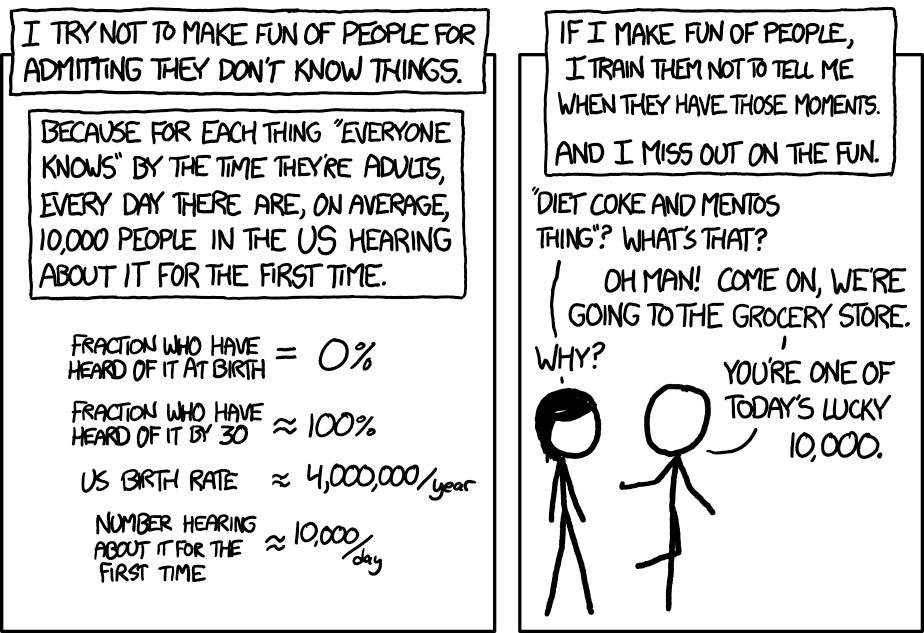
This is my first formal computer science class in years, despite its ENGL prefix, and therefore my first brush with formal computer science in years. What have I learned? Well… patience, first and foremost. No matter how obvious something seems, there will always be someone who does not know it.

A black-and-white comic strip showing math that roughly 10,000 people per day learn something "everyone knows" by age thirty, then two stick figures discussing the "diet coke and mentos thing" and agreeing to go to the grocery store

Fig. 1. “Ten Thousand”. Digital comic by Randall Munroe, 2012. XKCD.

Because I taught myself, I’m prone to the impulse to feel everyone should know what I know, but that isn’t how it works; I had to learn this, and so too does every one of my classmates. I learned HTML when I was nine, sure; they might have learned how to tackle or fish or pirouette instead. I don’t know how to tackle/fish/pirouette and it would be unfair for someone to assume I would even if they taught themselves; likewise, it is rude for me to assume they ought to know code just because I learned it.

It may be an unintended consequence, but it’s a happy one.

Works Cited

Fig. 1. “Ten Thousand”. Digital comic by Randall Munroe, 2012. XKCD, https://xkcd.com/1053/.

The Impact of Computers

Changed and Grown

Signing up for this class I was not sure what to expect. After the first few classes I realized we were going to be using code. I took a coding class my sophmore year of highschool but I was never good at it. I did not feel comfortable at the beginning of this class. Over the last few months, I have learned so much not only about coding, but about my computer. I also have gained a new appreciation for Ada Lovelace, the first person to publish an algorithm intended to be executed by the first modern computer.

My eyes have opened to aspects of my computer that I haven’t noticed before this class. I had never heard of creating my own journal files on Visual Studios code. I had always used google docs to create journals and download them as PDF’s to submit my work. I love seeing how using differnt apps on my computer can create a journal file for me with a simple code. From what I’ve learned so far in our class with coding, I feel more confident in my computer skills.

Relation to My Major: Education

Manuscripts allow students to study the original drafts of literary works. Manuscripts also serve as primary sources, allowing students to engage directly with original materials and develop skills in primary source analysis. This realtes to my Education class Curr 317: Teaching social studies. In this class we are learning about primary sources and how to find/use them in a lesson. As an Education major, I go to my placement every Friday and am working on a Social Studies Unit Plan to teach to fourth graders that involves primary sources. We have learned how to find a true primary source and how it can increase involvement in a lesson plan. It is very interesting to see how my classes cross paths.

Another one of English classes I am taking this semester, English 366 Lit: Chaucer to Milton, we have started to talk about manuscipts. Throughout our class in English 340, we have learned about manuscripts and how to read them. I now feel more comfortable in my other English class when we talk about them. Although these are both English classes, it is interesting to see how they cross paths and how I can use my knowledge from one class to help me in another.

Digital Archives

Something I found interesting is how digital archives of historical records, artwork, and other cultural objects are created and stored by computers. Researchers and the general public may more easily access and examine these materials thanks to these online collections. Digital archives and primary sources are protected from physical degradation by digitization. Digital copies can be kept forever, while original records, images, and artifacts can deteriorate over time.

ENGL 340: The Practical Concepts I’ve Learned

Throughout the semester I feel like I’ve learned a great amount of information about computers, the history behind the invention of the internet, and AI. At the beginning of the semester, I was very skeptical of this class because I am not very knowledgeable with computers beyond saving to Google Drive. I didn’t know if I would enjoy the class, however, I have thoroughly enjoyed this class and the different concepts we’ve learned so far. I’m also excited about what’s to come later in the semester.

I think the most practical thing I’ve learned for my job field, education, is the information about Henry D. Thoreau. I had never read much of his work before this class, and our readings and analysis of Walden have been the easiest part of this class for me so far. I think especially seeing the many different drafts of Walden and reading the various manuscripts has been useful to me for seeing the editing process. I’ve learned that even the slightest change to the manuscript can have a big impact on the meaning of a text after seeing how the manuscript changes over time.

Learning about the history behind the invention of the Internet has been eye-opening for me. I had watched the movie Hidden Figures which details the involvement of women in America’s journey to space, so I knew we, as a country, had a history of asking women to solve problems and then denying them the credit they deserved. However, I didn’t know this same system is what was used to create the Internet. Learning about this has reinforced the idea of the importance of representation in all fields of work. Giving credit where it’s due is definitely important for creating an equal playing field for job fields such as computing/technology.

I think the most valuable information I’ve learned that I will be able to apply to my personal life is the knowledge of the terminology and the use of things like Git Bash, PowerShell, the GUI, and other such components. My boyfriend is a Masters student at RIT in Information Technology and Analytics, and I have thoroughly enjoyed talking with him about what we’ve done during this class. Admittedly he has helped me to better understand some of our class concepts better if I’m having trouble with something we learned during the week. I feel like after only a few weeks of this class, I can actually understand what he does during his day to day life at school, and what he aspires to do outside of college. I’m thankful for that understanding so I don’t have to make guesses anymore as to what he does.

My Life: A Series of Unlocked and Re-Opened Doors

Unlocked Doors

Everyone’s life goes through changes via opening, closing, or sometimes re-opening imaginary doors. These could be events such as high school graduation, to reminiscing about a time gone by. Throughout this semester, I have done the same, by learning things that otherwise I never would have known, and applying what I’ve learned and read in high school to my new college life. For instance, snce the start of the semester, I have learned how to code, and have been reminded of a book I read during senior year through our in-class discussions.

Reading textbooks

One of the many things that I’ve realized while taking this class is that it is easier for me to concentrate on what I’m reading if I can visualize the words in my head. Most of the books I read, or write, outside of class are fantasy novels with pages of description, like Lord of the Rings for instance. The author wants to immerse their reader in their made-up world through descriptions, so while reading, one can visualize the palace walls and the tapestries hanging from them. However, nonfiction books, while some do have descriptions and/or footnotes explaining what they’re talking about, don’t need to rely as heavily on them as fictional books. This is because they are talking about real events, objects, people, and/or animals that have illustrations and/or photographs of them.

In one of my other classes, we are reading a book that is focused more on facts and the author’s opinions with a few detailed descriptions to go along with them. This is a completely different reality from Walden. In the section titled “The Village,” Thoreau spends the entire first paragraph describing his daily routine, the shops and buildings within it. He also explained the shops’ signs beckoning one to enter the store to buy their products were like the sirens in Greek Mythology; leading sailors astray with their hauntingly beautiful voices, and so on. These enthralling descriptions really helped me focus on what I’m reading.

Working with computers

I started this class very nervous about messing with my computer, especially since the syllabus stated that “we will write code!” The last time that I did something remotely close to that was during fifth grade when I took a typing class. We would sit in a giant computer lab to learn how to type properly. I had no idea what “VS Code,” “Git Bash,” or “a Graphic User Interface (GUI)” was. The differences between terms “xml”, “html”, and “tei” files were also completely foreign subjects to me. However, every time that I’ve been asked to mess around with the GUI, download something, or create something in Git Bash, I’ve been able to do it almost instantly provided I was given step-by-step directions. It felt as if a part of me that was previously locked is now accessible. I would like to learn more about what my computer can do and get skilled enough so I no longer need to rely as heavily on my professor’s step-by-step instructions.

Fahrenheit-451 Allusions

Fahrenheit-451 by Ray Bradbury is a dystopian novel describing a world in which books are completely banned from society, and if anyone is caught with them, their entire house would be burned with the owners inside it. The protagonist, Guy Montag, is a fireman with this harrowing job and at first, he is completely on-board with society’s view on these collections of paper. However, it isn’t until he meets a book-reader that he starts to see the world for what it really is, and how valuable books are. Instead of reading books, people consumed advertisements, podcasts, screens, and even have their own versions of ear-buds called “seashells.” Additionally, the city in which they resided in believed that it was the best in the world. No one, aside from a small band of outcasts, Montag, and Clarisse MaClennan, thinks differently about their world. Nor do they see the flaws in trying to consume pleasure by being the biggest, best, and shallowest city in the land.

When I first read this book, I was in my senior year of High School and it was one of the most striking readings from my college-level English class. A lot of what we have discussed in class has reminded me of this thought-provoking book; especially our in-class discussions about how fast-paced our lives are now with AI, the internet, and screens being almost everywhere.

This issue, while relevant, is not new. In his manuscript, written at least 100 years prior to Bradbury’s novel, Thoreau explained that “Our inventions are wont to be pretty toys, which distract our attention from serious things. They are but improved means to an unimproved end, an end which it was already too easy to arrive at; as railroads lead to Boston or New York. We are in great haste to construct a magnetic telegraph from Maine to Texas; but Maine and Texas, it may be, have nothing important to communicate.” (Thoreau; Economy, paragraph 73) Even though these two works were written ninety-nine years apart, they both have a fear of, and warn against, a world where people act without thinking, seek pleasure, and want to make the biggest possible mark on the world without really comprehending the motives and thoughts behind their actions.

AI is one example of this. Yes, it does have its uses, such as being able to create outlines, come up with prompts for essays, as well as creating beautiful pieces of art with ease. However, their problem lies in their inability to create anything from their own “minds.” Everything that AI comes up with heavily relies on information that gets feeded into its programming. It also takes away from the process of creating things that could take weeks at a time. As great as it is to have things fed to us, it is crucial that we retain the ability to think critically.

As this semester has passed, I have had classes that have taught me things about myself that I otherwise never would have never would have known, such as how to code properly. I have also made the discovery that reading descriptions and imagining scenes in my head as I read is a crucial part of how I understand what I’m reading. Doors have also been re-opened, as I have begun to apply what I’ve learned in high school to the new information being provided to me.

Computer Knowledge

Before taking this course.

Prior to taking the class English 340, I did not know much about my computer or any computer. I took this class because I can get an English requirement for my degree. For school, I would use my computer all the time. Everything I knew about computers revolved around school. I know how to use Word and submit assignments. I would not have my computer if I did not need it for school. When picking out computers, I went shopping with my dad because he knew more about what computers to buy and what would be better for school. Before going into this class, I did not know what to expect. The only computer class I took was the one I had to take in middle school. All I remember about this class was that they taught us how to type and how to use programs, like Word. I read the summary for this class, but I was still a little confused about how this English class connected with computers and coding.

Learning about Git Bash and Visual Studio Code.

This class led me to learn about how to access my files using Git Bash. Now I know how to access different folders by using the “cd” command. I can now make new folders by using the “mkdir” command. Taking this class has allowed me to learn what the different file extensions mean. Before taking this course, I only really used words and PDFs. I would never have written in an HTML document because I did not know what it was. I know now that people can use Visual Studio Code to help make a website. I was always confused about how people made websites, and while I do not know everything about it, I now have a better understanding of some of the basic things. I may never be a pro at coding, but I know a little more about how to do it and have more appreciation for people who do. When writing Journal Files in Visual Studio Code I have been able to look back on all the things I have learned. For example, I learned about the evolution of computers. Computers used to be huge and take up a lot of space, but now they can be carried around with us in a backpack.

What I learned aboutReading, Writing, and Computers.

I found it interesting when we discussed reading and how people today no longer want to sit down and read books. On social media, long content is no longer desired. People’s attention span is becoming shorter. This affects many aspects of a person’s life, including how much they read. When talking about this, I can remember times in my own life when this happened. This discussion of reading led us to talk about writing. When writing this Blog post, I was able to use AI spell check to help polish my writing. AI was able to tell me where I needed to add commas to my sentences. Now that AI can check grammar and punctuation it has become a tool that makes people prefer to write on their computers. Before, I never had thought of how writing on paper has become daggered and what we lose in this happening. Now that more people are writing on computers, we are losing the style of writing and the history of writing. For example, on paper, we can see what was crossed off. On a computer, you would not be able to see that because people now just hit the backspace button. On paper, you can also see things like tears or stains. When we had a Zoom call with Elizabeth Witherell, she showed us one of Thoreau’s manuscripts. In this manuscript, you could see a letter behind his writing. If Thoreau’s manuscripts were written on a computer, the letter behind his manuscript would probably have been lost, and we would never have known what was on this letter. This class has opened my eyes to the importance of how you are writing and the material you are writing with. I learned the importance of small things like a small tear in the paper. That small little tear could have an important story to it.

After taking this course

Taking this course has allowed me to gain a lot more knowledge about my computer. Through reading some of the book “Broad Band,” I was able to learn about many important women who helped computers become what they are now today. I have greater appreciation for the people who work and help advance computer technology. I have learned to enjoy using Git Bash and Visual Codes. I am glad that when learning about the codes in Git Bash, things get repeated. It has led me to be able to learn and memorize how to create a new Journal folder for each day of class. I now have so much more respect for people who do keep journals. After this class, I may not become a person who journals every day but now I know the importance of writing down your thoughts. When I was thinking about what to write, I was able to go back to my journal files to see what we did during class and how much I had learned.

Exploring the Unknown of the Computer

In Walden, Thoreau writes:

“Every path but your own is the path of fate. Keep on your own track, then.”

I began this class with essentially no knowledge of my computer other than it helps me complete tasks such as homework, communicate with others, and speeds up processes. Walking into this class I was very set in the mindset that I would never understand anything more than I already did about my computer. This is a very closed mindset, however through the class thus far my mind has since been open to the fact that I am capable of more with my computer!

My computer

Here are a few things I’ve learned about my computer:

While these may be extremely basic to most, these things about my computer were not known by me previously to this class. First of all I learned how to locate my OS version on my Mac and find out information about my computer. I also have learned what a file system is and have gained knowledge about my computers graphical user interface or its GUI. After fixing settings within my computers system to make navigating the GUI easier I now have a much better grasp on what this system consists of and how to use it. I have also learned how to navigate both Windows and Mac with some education on some similarities and differences of both. While I have a Mac, my classmates with Windows have opened my eyes to how the different computers operate and where the differences lie.

Visual Studio Code

Prior to this class I did not know that GIT Bash, the terminal, or Visual Studio code were a thing that existed. Starting with the terminal, I have now gotten a lot more comfortable navigating where documents and files are within my computer and have used it in other classes other than this one. When asking AI the benefits of VS code it said, “Visual Studio Code is a free, lightweight, and cross-platform code editor with built-in Git support, smart code suggestions, and a debugger. It has an integrated terminal, extensive extensions, and customization options. VS Code runs efficiently and supports real-time collaboration, making it a powerful choice for developers.” I would have to agree with most of this, I find VS cofe to be extremely effective and customizable with many great features. Something I do not love about VS code is the lack of autocorrect, which I know is a small complaint, however I did not realize how much I rely on it in other platforms.

AI/Chat GPT

In full and complete honesty, prior to this class AI and Chat GPT were simply platforms that helped people come up with ideas to me, however I have learned many new things about this type of technology that I did not know before. I have learned about the environmental downfalls of this technology as well as the dependency that can be created because of AI. A quote that stuck out to me in “Rage Against the Machine” was “None of us has ever found out or proved that the people around us in our lives actually think or feel. We just take it for granted.” This really resonates with the fact that AI cannot replace humans, as there is no emotion or feeling behind it.

Technology and Humanities

In terms of humanities and technology the crossover holds both pros and cons that I have become educated on throughout this class. This came into play while learning about how to go about transcribing texts from the past digitally. Some argue that this takes away from the authenticity of the documents and the meaning behind a physical document is what keeps the content alive. Others argue that this digital content is a positive because the documents can reach many more people than if they were simply physical. I am eagar to learn more about this topic moving foward in the class and look foward to becoming more fluent in this subject.

Figuring Out My Computer

Wednesday, March 12, 2025

Journey Into My Computer

> Before transferring to Geneseo, I took a 100 level Technology in Education course at Finger Lakes Community College. In this course, I had to create a website for myself by learning how coding works and use this website to upload my assignments. I thought this would help make Literature in the Digital Age easier for me, but that was incorrect. Nothing has been the same from our course to the one I previously took. However, I do think this course is more useful to me in my two career paths I am currently on. Both require me to know how to use my computer; photography and research database work in a library.

Useful Information

Here are a few things I’ve learned about my computer:

  • How my filing system works and how to find documents easier – Anytime I have a photoshoot I have to connect my camera to my computer and access the files to move into Lightroom to edit. I was having issues finding the correct folder or understanding how to move the pictures, but the first few days of this course taught me what I needed.
  • That everything on my computer is connected and how easily I can accesss it through a coding command
  • How to make an online journal post/using it for my daily life in addition to class

Understanding Outside Information

  • Before this class, I was very against the use of AI in any form. I didn’t understand that it could be helpful, whether that is with formatting an essay or further understanding a book. The reason I hated it so much was because I had lost a few photography gigs when a trend went viral on tiktok for generating fake headshots for free. Three people had cancelled their session with me and used this program instead. But, I started using the generative AI that comes with google when I cannot understand something from school, and it helps make an idea easier for me.

Other Coursework/Life

  • I found myself showing so many people how to open a journal file from GIT Bash after I learned how to do it; I thought it was the coolest thing. Before this course, I never thought about the orgins of computing or why it was even called that, but it has made me want to do more research and understand my computer better. Additionally, I finally started to use the generative AI removal tool on Lightroom for editing my photos after being hesistant.

Digital Illiterate to Digital Learner

Change of Heart

I would say I was basically computer illeterate when I first entering 2025. I did not know any history about computers, how to use computers and coding. In fact, I would look at the some of the symbols on the computer and wonder why they would be important to be on the computer. I’ve been avoiding it until I took a risk by opening myself up to this world through this class. I have been very anti-computer for my entire life. I thought it was too far advanced for me and that it always has been to late for me to learn. Which created a slight dislike for it all actually. Yet all it took was accepting that learning the basics and history will be difficult, but through the difficulty I have learned so much. What really hooked me on digital history is the fact that women were really the first to invent and discover all of this, like Radia Perlman. A part of humanities is about the study of human constructs, and learning about computers is now more than ever involved in human life.

Coding is Possible for Anyone

I originally said on one of the first days that I was a caveman, espically with programming. But with every day since the start of this new journey, my steps to improvement have come up. I can now create a folder in my own computer, and also create a journal everyday. As someone who wants to enter the teaching field, it has the potential to help me organize all assignments and units I create. It actually feels a little embarassing that my confidence was so low about coding and organizing. My confidence in organizing folders and documents in my own computer has increased because of the advancements I have made in the course. That is just the basics too, who knows how much learning more could help me. Websites is the next goal in my journey, as having my own website instead of a platform like Brightspace.

Future

Websites is the next goal in my journey, as having my own website instead of a platform like Brightspace. I never thought I would have a goal ever to even think about creating my own website, but after carefully setting up my computer properly and learning GitBash 101, I feel that this is possible to learn. Seeing the past, espically with the treatment women were treated and there ability to still invent and work with computers, it motivates me to be able to achieve this goal.