History Meets the Digital World in Transcription

What I transcribed

What did I know about the Colored Conventions movement before I participated in the transcribe-a-thon? What’s the most important take-away for me about the movement itself as a result of participating?

Previously to participating in the transcribe-a-thon, I knew limited information of the Colored Conventions movement. I knew some of the history of Frederick Douglass, the well-known local historical figure, as well as Frederick Douglass Day which we celebrate and remember him by at SUNY Geneseo. However, I had not known of the connection to this important day and the Colored Conventions project. In participating in the transcribe-a-thon, while also learning information about the convention in class, I learned that the projects name is based on the many political meetings held by African Americans after the Civil War, in which they campaigned and fought for basic civil and human rights. The name Colored Conventions comes from these meetings as a way to honor and remember that part of history. Over 600 Colored Conventions were held, and it is estimated that over 10,000 delegates attended. In holding the transcribe-a-thon and making it a yearly tradition for people all over the world, the memory and history is being kept alive through the eyes and personal accounts of the people involved. Documents being transcribed come from firsthand accounts of historical figures such as Frances E. W. Harper or Frederick Douglass, and many other influential people of the past. The digital world we live in today helps make it possible for anyone to access these documents and learn more about history and participate in a tradition that helps to keep history alive.

What did I know about working with digitized archival documents before I participated in the transcribe-a-thon? What are some key take-aways for me about digital archives as a result of participating?

Previously to participating in the transcribe-a-thon, I had limited exposure to digitized archival documents. Occasionally for a class in high school or throughout college I would read an assigned historical diary or record. Through participating in the transcribe-a-thon I was able to see the large number of archival documents that exist, even just pertaining to specific historical figures or time periods. The amount of information and historical accounts often overlooked in classrooms can be seen as so many documents exist throughout history, on a level that it would be impossible to cover them all. This is the benefit of the digital world and having these archived documents digitized, though. People can search for specific historical figures they have an interest in, or just scan through a variety of digitized documents from different time periods and people as done in the transcribe-a-thon. Having the ability to do this at home from your computer makes it easier and more accessible for most, especially students and those interested in such digitized archival documents, as those with a computer and internet now can learn as much as they choose and easily narrow in on specific topics.

What did I know about transcribing archival documents before I participated in the transcribe-a-thon? What do I now know about document transcription that I didn’t know before?

Previously to the transcribe-a-thon, I knew nothing of transcribing archived documents myself, and wasn’t aware that this was an event others participated in as well. I have learned that a vast amount of people help in transcribing historical documents, as done during the Colored Conventions Project. By transcribing these documents, people are given the chance to use computers and “…digital tools to bring the buries history of the nineteenth century Black organizing to life” (“Douglass Day at Suny Geneseo – How Do I Transcribe”). While learning about the documents and historical perspectives while transcribing, you are also helping to create a record and keep these parts of history alive.

What specific challenges did I face in doing the transcription? How did I overcome these challenges (if indeed I did)?

Any challenges I faced doing the transcriptions were minor, such as losing my place in longer documents on where I was in the transcription process, which can easily be fixed by rereading what you have written alongside the document. Alongside this I found the website itself to be difficult to work with at times, as it automatically scrolls the document down as you transcribe, which caused me to lose my place on occasion. Finally, I found depending on the document, especially those written in cursive without clear distinctions between letters, to be difficult to read and transcribe. I found it to be much easier to transcribe poems and letters that were already typed, with clear letters and writing.

Overall, how did the experience of engaging with archival documents change my sense of relationship to, or understanding of, the history to which these documents belong?

Engaging with these documents firsthand and reading them through while making the transcriptions gave me a firsthand view into their historical relevance. A lot of the valuable information we know about historical figures such as Frederick Douglass or Frances E. W. Harper, comes from documents they wrote at one point, or documents recounting their speeches/work. While transcribing, you can see glimpses into different historical figures lives and accomplishments. Pieces from documents I would have probably never seen otherwise that I have now learned about, even if just in reading it over once as I transcribed.
Douglass Day Thoughts

What I transcribed

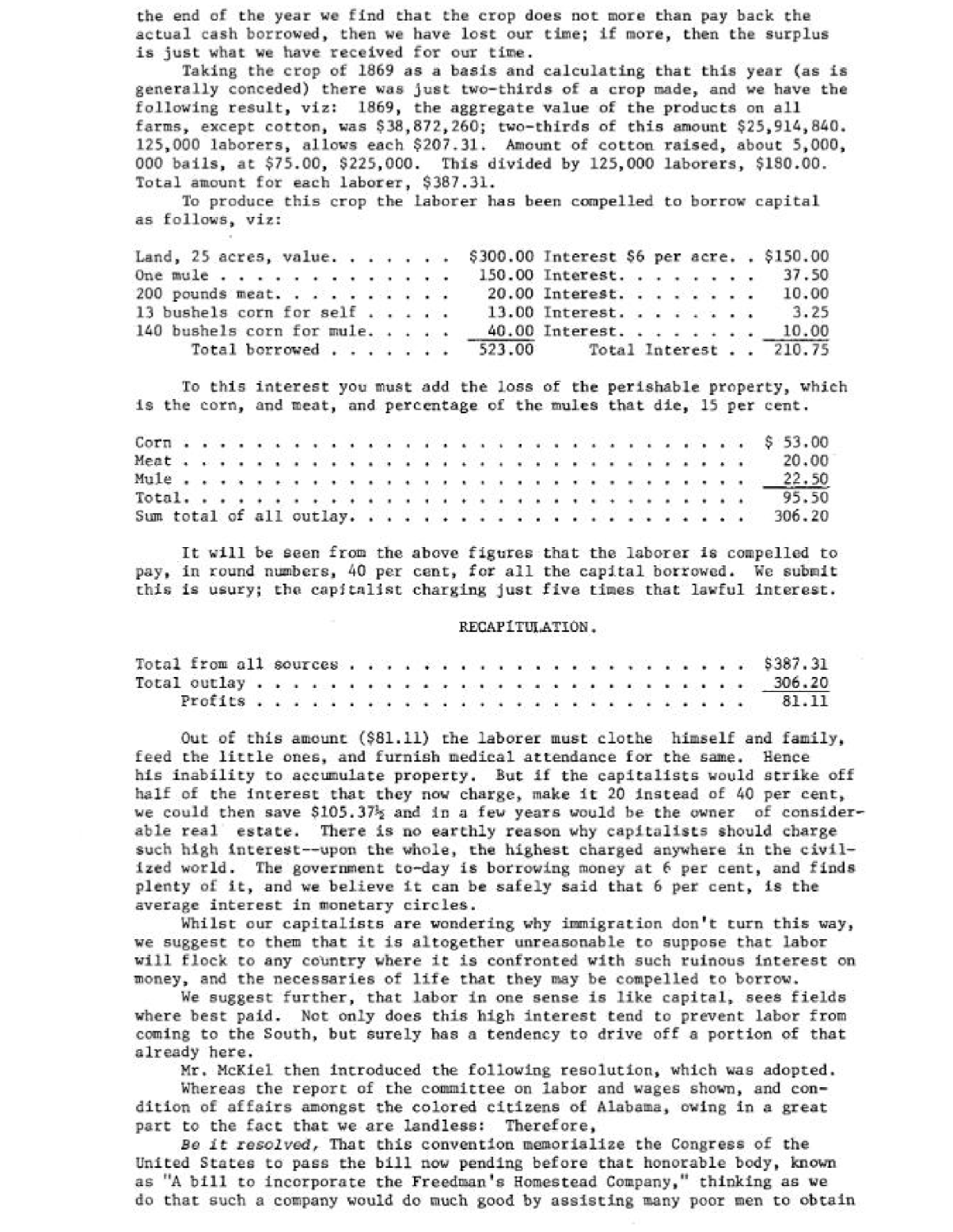
The most interesting document I transcribed from the Colored Conventions Project was a document establishing the Alabama Freedmans Homestead Committee.

An image from the Colored Conventions Project

In the document, the author breaks down the cost of living for the average “laborer” on a farm, and how much of his income gets taken from him due to high interest rates on materials he borrows in order to work the land. These include the land itself, food for the laborer and his mules, and in addition he gets charged 15% more if anything he uses is perishable. In total, there is a 40% loss of income. The author points out that this is not enough money to feed, clothe, and take care of a family’s medical needs. Therefore, this type of salary prevents any generational wealth from accumulating within black sharecropper families.

What I learned from transcribing and working with documents

From going through the line by line process of transcribing the document, I spent a lot of time with it. Especially the dollar amounts took up a lot of my attention because there were so many numbers and periods. This time spent with the document was very valuable because it enhanced my understanding of just how unequal the sharecropping profession was due to the painstaking process of transcribing and proofreading to make sure everything was recorded correctly. Rather than a quick readthrough, physically typing out the amount of money that was taken from these hardworking people made it all the more impactful. I also learned about an effort to help black Alabama families become homeowners that I wasn’t aware existed before the transcribe-a-thon. Unfortunately, the document cut off before I could learn what specifically the organization did to help this problem, but I was able to find out that the motion passed successfully and the Freedman’s Homestead Company was established with the help of congress. I feel so much more personally connected to this piece of history now that I helped to record it, and more invested overall in the history of sharecropping in Alabama. After typing out all those numbers they became much more real to me, and made me angry that the plantation owners were practically robbing them and sending them into debt because they were stealing 40% of the profits.

Although a silly observation, I have no experience transcribing, so the entire experience was new to me. I also learned that there are lots of different ways that information can be recorded both digitally and on paper. It took extra effort to record a list, for example, as opposed to a regular sentence, due to the formatting on the list.

What I learned about the history these documents embody

I learned more about the historical relationship between slavery and capitalism as a result of transcribing these documents. Over time, as I was transcribing documents I saw the development over time from slavery into ‘sharecropping’ after slavery was abolished because of the Civil War. With sharecropping slavery was essentially allowed to continue as normal, except actually making the slaves’ debts worse because now they owed money for using supplies. The people were still enslaved and exploited just in a different form that was technically legal. In this new system the familes working on the plantations were free on paper but really still owned by the plantation owners because this needless debt was held over their heads. The document about the Freedman’s Homestead Company highlights how this system maintained the type of second-class citizenship from traditional slavery because it prevented families from accumulating wealth, the key to social mobility.

How I see things now

I am frustrated that sharecropping was so deeply normalized because looking back at these documents now shows how insane the system was. Taking 40% of someone’s hard earned money feels deeply unfair to me, especially when considering the reperations that black people were intitially supposed to recieve. Forcing them to pay for the land, the animals, and the tools needed is a crazy concept when they were supposed to recieve 40 acres and mule as reperations specifically to assist in helping regain social mobility and economic power. I have a better understanding of the ways that capitalism uses marginalized groups to keep the machine going, and the ways that it reinvents itself to continue that goal, specifically in the United States.

Additionally, reading about the efforts of the Freedman’s Homestead Company combined with my already existing knowledge of different abolitionist groups gives me hope for progress. There were people who saw racism for what it was then, and there are now. Just because something is normalized for the time, doesn’t excuse the behavior, because especially marginalized groups deserve equitable treatment and an equal chance at success.

Douglass Day—An Effort of Many

My transcription work

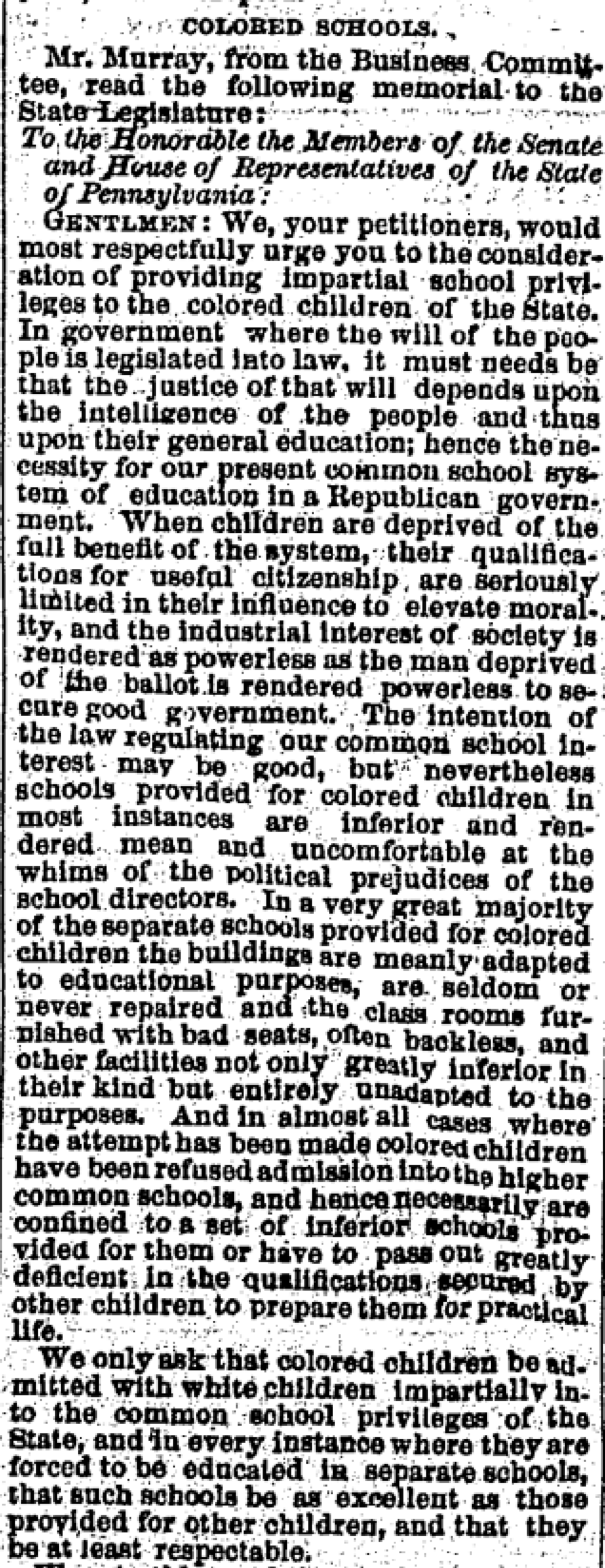
In this year’s Douglass Day transcription event, collections of documents were sorted into various regions. I ended up transcribing exclusively from the Pennsylvania region. Despite being only one state, there was a wealth of documents that needed transcribing. Many of the documents were simple record keeping. They followed a pattern of listing those in attendance, what was discussed, and any efforts resulting from the day’s discussion. Some documents were excerpts of speeches, where attendees spoke out against slavery and inequality, as well as urged their fellow people of color to join together in resistance. Most interestingly to me and my major were the two documents discussing education. One urged the government of Pennsylvania to provide the same level of schooling to children of color, whether alongside white peers or in separate schools held to the same standards. The other was discussed an unapproved project for establishing a Colored College. Frederick Douglass himself credited the project’s failure to “Garrisonian Abolitionists”, however the initial transcriber attributed this to Douglass’s own bias toward the Garrisonians.

What I learned from transcribing

Prior to participating in the Transcribe-a-thon, I had little appreciation for the labor of transcription. Growing up in a digital age, I am used to having a wealth of documents at my fingertips. I had previously worked under the assumption that these documents were always digital, or that they had been scanned in using some automated software. I now understand this is far from the truth. Resources like Project Gutenberg and the Colored Conventions Project rely on hand-typed transcriptions and the labor of many volunteers. Without them, there would be less access to key pieces of history and literature.

I also had little understanding or appreciation for the Colored Conventions themselves. History classes in school often skim over many critical details, especially since they need to fit the entire country’s history into one year of study. Of course, I could research in my own time, but I neglected to do so. Instead I worked off my own minimal understanding and assumptions. I knew that voices like Frederick Douglass and others were important in the ongoing quest for equality. However, I did not realize how involved and expansive the process was. I was only able to transcribe a few documents myself, but the amount of existant writings, as well as the number of Colored Conventions that were held nationwide, paint a clear picture of how much work was involved in reaching the relative equality we have today.

What I learned about working with documents

I consider myself lucky that I only had to be concerned with transcribing typed documents. Were they handwritten, I can imagine myself struggling immensely with the “spiderweb” handwriting that many texts consist of. Still, the typewritten work offered its own challenges. For one, some of the type was faded or produced only a half-character. In these instances I had to make an inference and tag for unclear text. Spelling across documents was also inconsistent (i.e. spelling as “color” and as “colour” across different texts). This was fine for familiar words, but led to more confusion with topics I did not know well. I also had to strike a balance between efficiency and attention to detail. I wanted to make good use of my time and complete many transcriptionss, but when typing too fast I fell into a pattern of guessing ahead and transcribing improperly. In the end I went back and worked with more care, sacrificing speed.

How I see things now

If anything, this project taught me to pay attention to the mountains of work that make my current life possible. On one side this means the numerous conferences, conventions, and appeals for equality that advocates like Douglass have made. Without them providing the foundation, much of what I consider normality would not be possible. On the other, this means the human labor behind the aspects of technology I once took for granted. Now I can realize that most of the text I read online was typed or transcribed by hand, all so people like myself can read it and better understand our world. Without the collaboration of so many people none of it would be possible.

Click here to see my transcription work!

A document scan from the 2026 Douglass Day transcription effort.