My attention span is quite short. Something is constantly changing the direction of my attention. Whether it’s a notification, background music, or just another random thought, most of the time it doesn’t last long. But, when I am paying attention for an extended period of time, I really examine every part of it.
With OCD, I find myself being forced to attend to more things than I agree to attend to. It pulls your attention in every direction. There is always a constant noise playing in the back of your head that demands immediate engagement. This makes it feel like I’m constantly focusing on at least two tasks at once. Most of the time the intrusive thoughts completely take over and strip my attention away from the current, important task. Digital media only enhances my short attention span as it is constantly leaving me with new thoughts to obsess over. I find myself either endlessly scrolling on social media or the exact opposite, only over analyzing one post or comment at a time.
On Monday, in my geography class, we watched a video about tsunamis, past tsunamis and potential future ones. There was a segment where the video explained the potential threat of a tsunami to the eastern U.S including New York, though it would be hundreds if not thousands of years before this natural disaster would occur. We were supposed to take notes and hand them in for an assignment but I was only able to write a few things down before my attention was completely turned to my safety from this potential tsunami.
Notifications are also a huge disruptor to my attention. While I never am on my phone during class to ensure I am paying attention to the lesson, I have my apple watch that still sends notifications. On Wednesday, I logged every time I stopped paying attention to whatever the current task was at hand to look at or respond to the notification sent. This happened 53 times throughout the day with the number one notification being from snapchat. This is one of the things that I agree to attend to. This has made me more aware of media attention disruptors and moving forward not allowing myself to become distracted from notifications.
Over the week I found many things that I both did agree to attend to as well as did not agree to attend to. The things that I did not agree to attend do have an impact on how I was able to “live my life” because of the pressures of the constant thoughts. But, the distractions that I do allow myself to attend have no hindrance on how I “live my life”. I feel as though distractions themselves are a part of life and how you choose to ignore or respond to them.
Introduction:
When paying attention to technology in an academic setting, it has become a much more prevalent tool in education. Although in secondary school, the use of technology for me was less of an active part in my everday life as a student, when I began my college career at Geneseo technology has not just become the norm but rather the agent in my everyday life. With using technology everyday, I have not only noticed the pros and cons of usig technology, but also the harsh reality that for me personally, technology is something that sets me back and takes my attention away from completing assignments and everyday tasks.
The Pros of Technology in Education:
Throughout my primary and secondary education, technology didn’t really play a big role in my everyday life as a student. Besides submitting essays or presentations, my educators chose to do paper handouts instead of making everything digital. However when I got to college, it became quite the shock to my system of learning when all of my professors utilized technology for readings, assigments, and other resources for their classes. Since being almost done with my second year of college, I have not only realized the importance of technology in education, but also its prevalence in today’s world as I prepare for my future career. One of the main pros that I have come to realize in college when using mainly technology to learn is the convienece of it all. Having assignments, readings, exams, and other things for courses all in one place makes it easier not only for the professor to grade, but also for the student to access what they need without having to keep track of multiple paper handouts. One thing that always annoyed me in high school was the fact that I had multiple papers that I needed to keep in specific folders for all of my classes which could be very hard at times when things are being moved around constantly. However, this semester when taking Literature in A Digital Age, I have learned how to take notes on Visual Studio Code which is way more convienet and keeps me more organized than having multiple notebooks for my courses. With that is also the fact that taking notes on a computer is way more efficient than handwriiting everything. Typing everything is way quicker than writing notes by hand which has been beneficial when taking notes on what the professors in my courses are saying. Lastly, the benefit that I think more people need to start paying attention to with the use of technology in education is the sustainability purposes Since everyhting is digital, this cuts down on the paper usage which is overall better for the environment. However despite these postive sides of technology in education, I have come to realize that there also negative sides when becoming dependent on technology in an academic setting.
The Cons of Technology in Education:
In my second year of college, I have not only seen and experienced the benefits of using technology in school, but also the cons. For me I have always loved writing everything down. This not only helps me to remember things better, but also is a keepsake for me to look back on when I am older, much like Thoreau’s manuscripts from Walden. The individuality and uniqueness of someone’s handwriting cannot be replicated by the use of typing on a keyboard. This is something I payed attention to and closely realized when transcribing documents from Thoreau’s writing, it felt almost fake when typing out someone’s handwriting from their diary entries. Although the information, thoughts, and ideas, are all beneficial and important for the world to see and learn from, it almost made me sad for Thoreau that his handwriting was being made into a more legible text. If it were me, I do not think I would be okay with someone transcribing my handwriting because it takes a way the uniqueness of my words. On a more surface level observation of the cons of technology in the education system, it is not alwayas reliable. Many system glitches or other software issues can arise that make it difficult to access webistes and or assignments on a computer. Then there is the newer issue of the use of artificial intelligence. I think students and even some have come so dependent on technology for completing assignments or creating lesson plans that it has back tracked peoples knowledge and critical thinking skills signfinantly. In addition to thee negative sides of the usage of technology in education, I have come to realize that technology has significantly impacted my attention span.
In Relation to Attention:
Over the years not only when using technology for school, but having access to it everyday with my personal phone I have closely payed attention to how much it deters me from completing everyday tasks, more recently than ever before. Something that in particualar catches my attention is the simple buzz of my phone alerting me I have a notification from soemthing on my phone, whether it is a text or social media update. This simple alert distracts me from whatever I may be doing whetehr that is homework, cleaning, or trying to just be offline for a once. I have also noticed for me personally that I end up checking my phone even where there isn’t a notification that something has changed or happened. This has gotten worse over the years with social media, I think people including myself has been living vicariously through social media and paying attention to what everyone else is doing that we forget to think about the fact that we should be paying attention to our own lives. When analyzing Walden all semester, Thoreau payed close attention to nature and the inhabitants of it, documenting and writing by hand all that he observed from the big details to the minute. In today’ world, i think we as a society do these same things, but rather in a more negative light that doesn’t contribute anything positivie in the ways Thoreau did. I think as a society we need to redirect our attention away from technology and focus on our surroundings in the same way Thoreau did all of his life.
For about a week, I paid attention to something I usually don’t think twice about, my attention itself. I learned a lot about Henry David Thoreau’s thoughts on how attention shapes our experience and Tim Wu’s argument that our attention is constantly being competed for in the digital age. I then began tracking what I focused on each day. I got to truly analyze what I choose to pay attention to and what pulls my attention away without my permission.
What I Chose to Pay Attention To:
Throughout the week, there were several areas where my attention felt intentional. These were the moments where I was actively deciding what mattered and putting effort into staying focused. Most of this attention was directed toward responsibilities and meaningful interactions.I chose to focus on studying, paying attention in class, completing homework, and having conversations with friends. It required me to plan and make myself focus in order to complete tasks. During these moments, I felt more present and in control of what I was doing. For example, while studying for an upcoming assignment, I booked a study room and put my phone on “do not disturb” in order to maintain focus. When it came to conversations with friends, my focus was less forced since I was interested in what was going on. I felt more engaged and connected during these activities. These moments reflect William James’s idea that “my experience is what I agree to attend to.” When I intentionally directed my attention, my experiences felt fuller and more meaningful.
What Took My Attention:
At the same time, there were constant interruptions, mostly from my phone, that redirected my attention without much thought. The biggest sources of distraction were notifications from tik tok or snapchat, which then lead to wasting time on other apps. Notifications were especially disruptive because they demanded immediate attention. Even if I was focused on homework or listening in class, a notification would appear and break my concentration. What started as a quick check often turned into several minutes of scrolling. TikTok was the biggest example of losing control over my attention. There were many times when I opened the app without really thinking about it, and before I realized it, I had spent 30 minutes to an hour scrolling. This wasn’t always a conscious choice—it often felt automatic, like a habit I didn’t fully control.
Chosen vs. Forced Attention:
One of the most important patterns I noticed was the difference between attention I chose and attention that felt forced. When I was studying or talking with friends, my attention was deliberate (although it was easier to focus on what I found more interesting). For example it was easier to focus on a conversation with friends compared to studying for a test. However when I stayed focused while studying I learned so much and felt very productive. Notifications and social media often forced themselves into my awareness.This connects to Tim Wu’s idea of the “attention merchants,” where companies design apps specifically to capture and keep our attention. Apps like TikTok and Snapchat are not neutral, they are built to keep users engaged for as long as possible. Because of this, my attention wasn’t just drifting randomly, but it was being actively pulled in different directions. Even when I wasn’t being interrupted, I sometimes gave up my attention too easily. Scrolling on TikTok often came from a lack of discipline, but the design of the app made it difficult to stop once I started.
How This Affected My Life & Moving Forward:
Tracking my attention made me realize how fragmented my daily experience can be. Even when I intended to focus, my attention was often divided between what I needed to do and digital distractions. If my life is shaped by what I pay attention to, as William James suggests, then these distractions are more important than they seem. They are not just small interruptions, but they shape how I spend my time and what I experience each day. There were moments where I felt fully in control, especially during focused study sessions or meaningful conversations. However, there were an equal amount of moments where my attention was pulled away without much resistance. Becoming aware of these patterns has made me more conscious of how easily my attention can be influenced. While I think I can improve my habits, like ignoring certain notifications or being more intentional about when I use social media, I also recognize that these platforms are designed to make that difficult. Even if I don’t completely change my behavior, this experience has made me more aware of the value of my attention. It is something that I often take for granted, but it plays a major role in shaping my daily life.
For this assignment, there is no use of generative AI
Introduction
To provide some context for my findings, it is generally difficult for me to sit and focus without routine. I am generally a pretty online person and often have the issue of going to do something on my phone, getting distracted, and forgetting why I even grabbed it in the first place. With that, there have been a number of events within the past month or so that I would say have definitely swayed a lot of my online activity. An example of this would be registration for fall classes. I noticed pretty early on how with registration around the corner, my attention during work time often flipped to courses for next semester, and I also found myself checking the registrar website multiple times to “double-triple check” my schedule was how I left it. This would lead to me also looking at degree works and seeing what attributes I needed for next semester (despite already having a schedule). All in all, I made a total of 4 different plans with multiple options to ensure that during registration I would have a backup. This is all to provide context for the rest of this post and also to provide some reasoning as to how and why I do certain things online.
Messaging
Aside from a few isolated incidents (i.e., events such as registration and day to-day-homework), I spend most of my time online on my phone. While I do use my computer from time to time, I feel it is much more effective to share how my attention has shifted online from my phone as opposed to my computer. I am a pretty big texter. Whenever I do homework, I feel like I need to check my phone about five times before I am actually able to focus. I also leave my phone on “do not disturb” (DND), so it makes me feel that I need to check it more often so that I don’t miss anything. When I inevitably do sit down to do work, I use a third-party timer app on my phone. Because of this, ads will run when I start and end the timer. I found that throughout my data, interacting with these ads (whether to close or silence them) became an easy gateway for me to check my messages and text people on my phone, ultimately distracting from the work I was trying to get done using the timer.
Many of these same ideas also go for my email on my computer. With the sheer amount of emails my school account gets daily, I feel that I need to constantly be on top of things to ensure I don’t get overwhelmed by a messy inbox. When I saw I had an email notification in another tab, it would distract me from potentially productive work, and I would start to peruse the messages sent that day. While I do think that email having a blinking notification at the top of tabs certainly allows for distraction, I also believe that there is something to say for me agreeing to attend to my messages, especially ones pertaining to clubs I am in, while finding myself forced to attend to certain aspects of my homework.
Social Media
I think especially when talking about attention in a contemporary context, the conversation seems to always come back to social media. I have within the past month cut scrolling social media (i.e., Tiktok and Instagram Reels) out of my routine. Though not entirely encompassing my digital attention, I think this change shifted my focus in a lot of ways, and I think that comparing where my attention was and how my attitude as a whole has changed towards it is interesting to look at.
What really scared me (and ultimately prompted me to act) was that scrolling almost became a habit. When I would go onto Instagram to talk to my friends or engage with their posts, I would just instinctively go to Reels and start scrolling. I realized that I almost had a dependancy on constant entertainment and needed to learn to be more okay with just being quiet and alone.
The screen usage, especially in the breakdown of what apps are being used the most, Instagram certainly fell off as one of my most-used applications. Right before I stopped, I averaged around 7 hours on Instagram a day. Shortly after I stopped using Reels, it makes a swift drop to not even being in my top 3 used applications.
I quickly replaced what would have been time to doom scroll with more productive means such as working, cleaning, hobbies, or even just lying down silently. I started this shift over my spring break so I was able to pick up many activities like painting or walks to fill time.
I really love nature, so (as I mentioned before), I became increasingly comfortable with quiet and silence. On my walks to class, I like to look at the ground in front of me and notice things such as the leaves, bugs, and flowers surrounding the path. I think this is fitting, especially in our conversations on Thoreau, as he mentions all throughout Walden the importance of nature and being deliberate in our way of life.
Conclusion
This blog post is not to demonize social media, nor is it meant to “prove” anything wrong with digital spaces like Instagram. I am rather, using this blog post as a personal account of why I stopped using scrolling social media, and my own perception of the changes around me. Though I choose not to go on Instagram Reels, I still have a private account where I look at and engage with my friends’ posts. I have definitely found that by cutting out certain aspects of Instagram (i.e., Reels), I find myself going on it less, and I am able to shift my attention to more tangible and productive tasks with ease. With this, it is ultimately my goal that I can shift my focus to being more productive and stop engaging with the things that distract me from living a full and content life. Whether it be senseless advertisements or worrying about unimportant dates and deadlines, a lot of my online attention can still be summed up as unmotivated. And with that, I don’t necessarily believe mindlessness online is an inherently bad thing either. We gravitate towards certain parts of the internet for a reason; however, it is important to pay attention to why those things catch our interest and assess how it may impact other aspects of our lives.
What did I know about the Colored Conventions movement before I participated in the transcribe-a-thon? What’s the most important take-away for me about the movement itself as a result of participating?
Previously to participating in the transcribe-a-thon, I knew limited information of the Colored Conventions movement. I knew some of the history of Frederick Douglass, the well-known local historical figure, as well as Frederick Douglass Day which we celebrate and remember him by at SUNY Geneseo. However, I had not known of the connection to this important day and the Colored Conventions project. In participating in the transcribe-a-thon, while also learning information about the convention in class, I learned that the projects name is based on the many political meetings held by African Americans after the Civil War, in which they campaigned and fought for basic civil and human rights. The name Colored Conventions comes from these meetings as a way to honor and remember that part of history. Over 600 Colored Conventions were held, and it is estimated that over 10,000 delegates attended. In holding the transcribe-a-thon and making it a yearly tradition for people all over the world, the memory and history is being kept alive through the eyes and personal accounts of the people involved. Documents being transcribed come from firsthand accounts of historical figures such as Frances E. W. Harper or Frederick Douglass, and many other influential people of the past. The digital world we live in today helps make it possible for anyone to access these documents and learn more about history and participate in a tradition that helps to keep history alive.
What did I know about working with digitized archival documents before I participated in the transcribe-a-thon? What are some key take-aways for me about digital archives as a result of participating?
Previously to participating in the transcribe-a-thon, I had limited exposure to digitized archival documents. Occasionally for a class in high school or throughout college I would read an assigned historical diary or record. Through participating in the transcribe-a-thon I was able to see the large number of archival documents that exist, even just pertaining to specific historical figures or time periods. The amount of information and historical accounts often overlooked in classrooms can be seen as so many documents exist throughout history, on a level that it would be impossible to cover them all. This is the benefit of the digital world and having these archived documents digitized, though. People can search for specific historical figures they have an interest in, or just scan through a variety of digitized documents from different time periods and people as done in the transcribe-a-thon. Having the ability to do this at home from your computer makes it easier and more accessible for most, especially students and those interested in such digitized archival documents, as those with a computer and internet now can learn as much as they choose and easily narrow in on specific topics.
What did I know about transcribing archival documents before I participated in the transcribe-a-thon? What do I now know about document transcription that I didn’t know before?
Previously to the transcribe-a-thon, I knew nothing of transcribing archived documents myself, and wasn’t aware that this was an event others participated in as well. I have learned that a vast amount of people help in transcribing historical documents, as done during the Colored Conventions Project. By transcribing these documents, people are given the chance to use computers and “…digital tools to bring the buries history of the nineteenth century Black organizing to life” (“Douglass Day at Suny Geneseo – How Do I Transcribe”). While learning about the documents and historical perspectives while transcribing, you are also helping to create a record and keep these parts of history alive.
What specific challenges did I face in doing the transcription? How did I overcome these challenges (if indeed I did)?
Any challenges I faced doing the transcriptions were minor, such as losing my place in longer documents on where I was in the transcription process, which can easily be fixed by rereading what you have written alongside the document. Alongside this I found the website itself to be difficult to work with at times, as it automatically scrolls the document down as you transcribe, which caused me to lose my place on occasion. Finally, I found depending on the document, especially those written in cursive without clear distinctions between letters, to be difficult to read and transcribe. I found it to be much easier to transcribe poems and letters that were already typed, with clear letters and writing.
Overall, how did the experience of engaging with archival documents change my sense of relationship to, or understanding of, the history to which these documents belong?
Engaging with these documents firsthand and reading them through while making the transcriptions gave me a firsthand view into their historical relevance. A lot of the valuable information we know about historical figures such as Frederick Douglass or Frances E. W. Harper, comes from documents they wrote at one point, or documents recounting their speeches/work. While transcribing, you can see glimpses into different historical figures lives and accomplishments. Pieces from documents I would have probably never seen otherwise that I have now learned about, even if just in reading it over once as I transcribed.
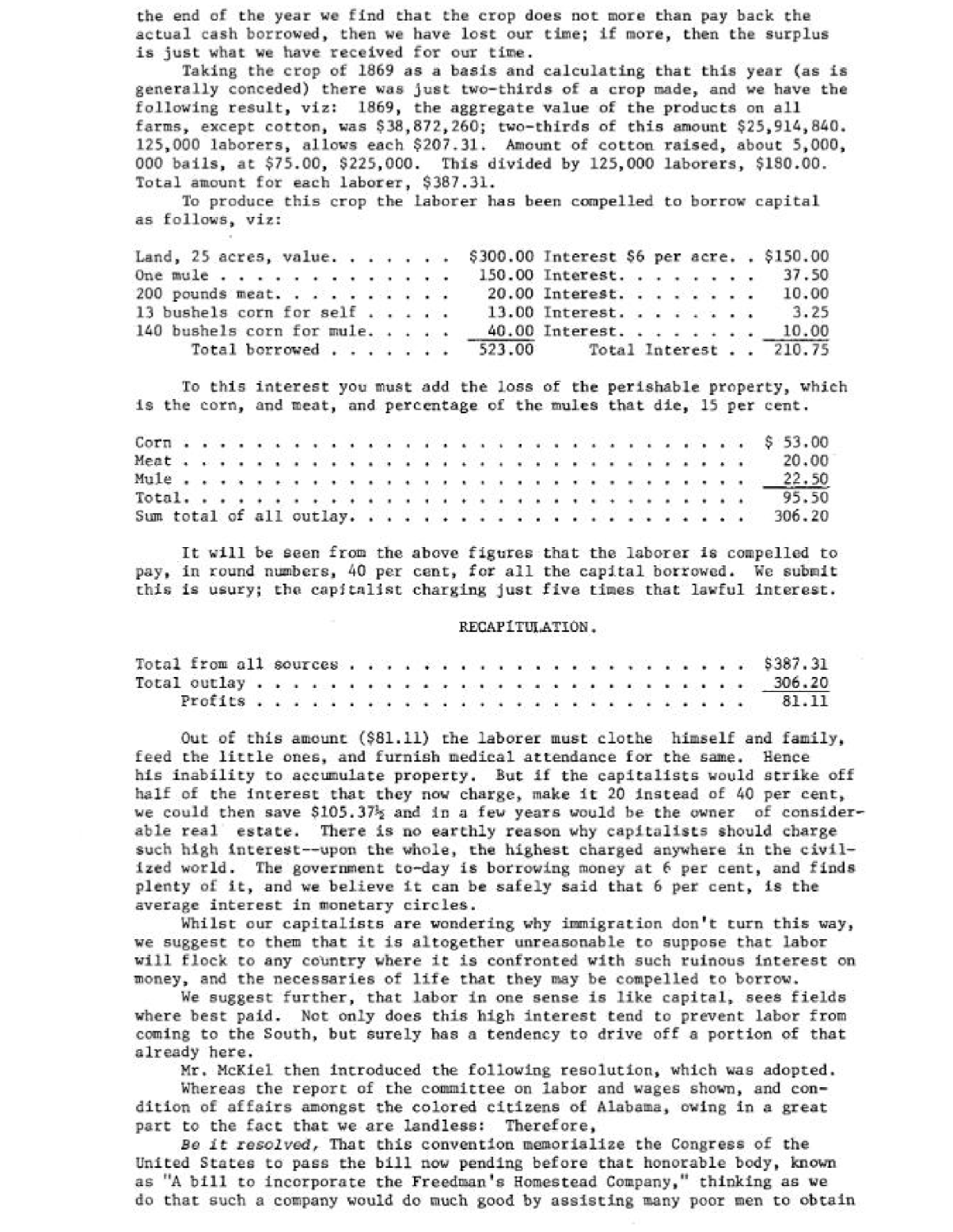
The most interesting document I transcribed from the Colored Conventions Project was a document establishing the Alabama Freedmans Homestead Committee.
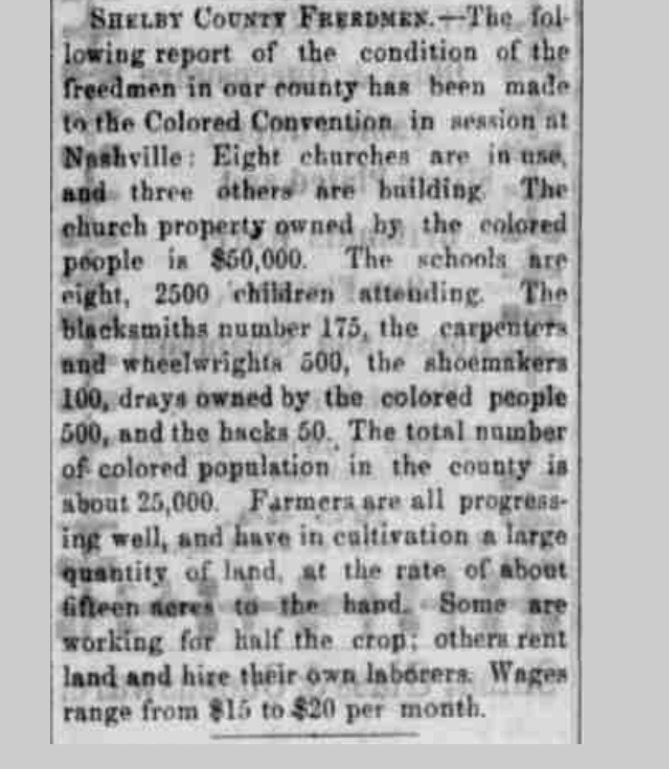
An image from the Colored Conventions Project
In the document, the author breaks down the cost of living for the average “laborer” on a farm, and how much of his income gets taken from him due to high interest rates on materials he borrows in order to work the land. These include the land itself, food for the laborer and his mules, and in addition he gets charged 15% more if anything he uses is perishable. In total, there is a 40% loss of income. The author points out that this is not enough money to feed, clothe, and take care of a family’s medical needs. Therefore, this type of salary prevents any generational wealth from accumulating within black sharecropper families.
What I learned from transcribing and working with documents
From going through the line by line process of transcribing the document, I spent a lot of time with it. Especially the dollar amounts took up a lot of my attention because there were so many numbers and periods. This time spent with the document was very valuable because it enhanced my understanding of just how unequal the sharecropping profession was due to the painstaking process of transcribing and proofreading to make sure everything was recorded correctly. Rather than a quick readthrough, physically typing out the amount of money that was taken from these hardworking people made it all the more impactful. I also learned about an effort to help black Alabama families become homeowners that I wasn’t aware existed before the transcribe-a-thon. Unfortunately, the document cut off before I could learn what specifically the organization did to help this problem, but I was able to find out that the motion passed successfully and the Freedman’s Homestead Company was established with the help of congress. I feel so much more personally connected to this piece of history now that I helped to record it, and more invested overall in the history of sharecropping in Alabama. After typing out all those numbers they became much more real to me, and made me angry that the plantation owners were practically robbing them and sending them into debt because they were stealing 40% of the profits.
Although a silly observation, I have no experience transcribing, so the entire experience was new to me. I also learned that there are lots of different ways that information can be recorded both digitally and on paper. It took extra effort to record a list, for example, as opposed to a regular sentence, due to the formatting on the list.
What I learned about the history these documents embody
I learned more about the historical relationship between slavery and capitalism as a result of transcribing these documents. Over time, as I was transcribing documents I saw the development over time from slavery into ‘sharecropping’ after slavery was abolished because of the Civil War. With sharecropping slavery was essentially allowed to continue as normal, except actually making the slaves’ debts worse because now they owed money for using supplies. The people were still enslaved and exploited just in a different form that was technically legal. In this new system the familes working on the plantations were free on paper but really still owned by the plantation owners because this needless debt was held over their heads. The document about the Freedman’s Homestead Company highlights how this system maintained the type of second-class citizenship from traditional slavery because it prevented families from accumulating wealth, the key to social mobility.
How I see things now
I am frustrated that sharecropping was so deeply normalized because looking back at these documents now shows how insane the system was. Taking 40% of someone’s hard earned money feels deeply unfair to me, especially when considering the reperations that black people were intitially supposed to recieve. Forcing them to pay for the land, the animals, and the tools needed is a crazy concept when they were supposed to recieve 40 acres and mule as reperations specifically to assist in helping regain social mobility and economic power. I have a better understanding of the ways that capitalism uses marginalized groups to keep the machine going, and the ways that it reinvents itself to continue that goal, specifically in the United States.
Additionally, reading about the efforts of the Freedman’s Homestead Company combined with my already existing knowledge of different abolitionist groups gives me hope for progress. There were people who saw racism for what it was then, and there are now. Just because something is normalized for the time, doesn’t excuse the behavior, because especially marginalized groups deserve equitable treatment and an equal chance at success.
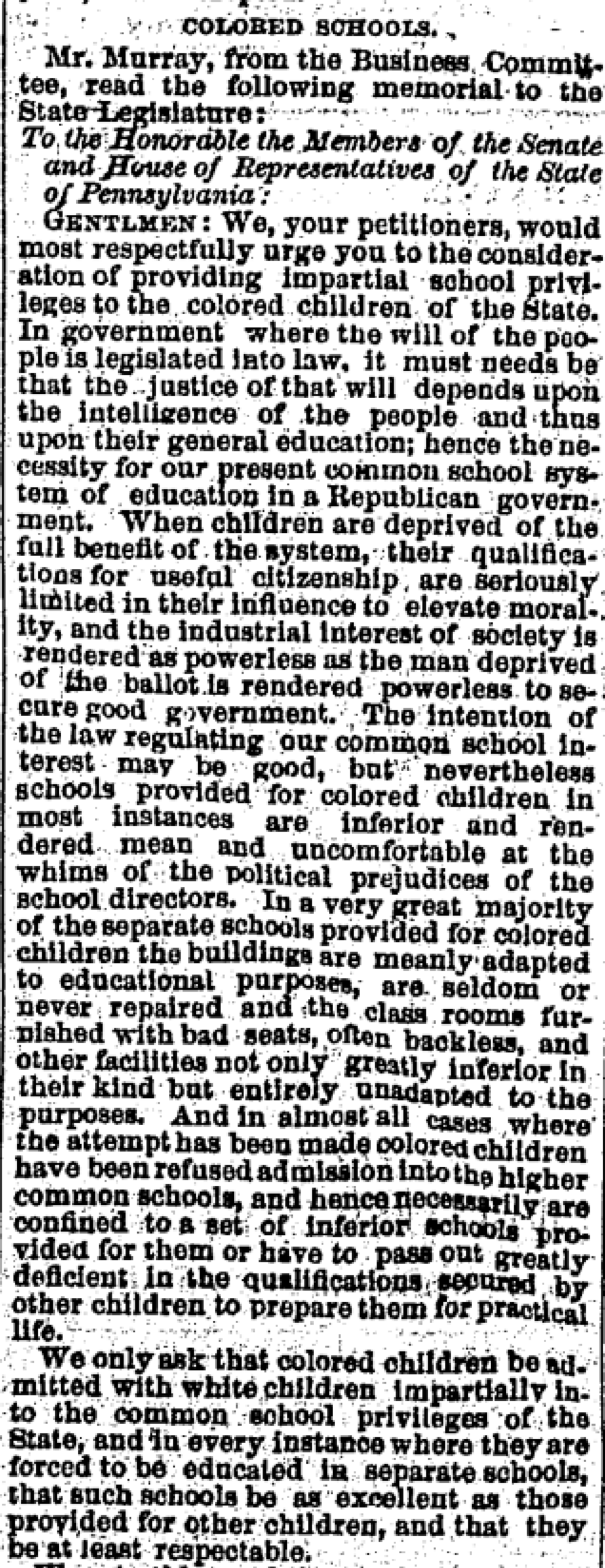
In this year’s Douglass Day transcription event, collections of documents were sorted into various regions. I ended up transcribing exclusively from the Pennsylvania region. Despite being only one state, there was a wealth of documents that needed transcribing. Many of the documents were simple record keeping. They followed a pattern of
listing those in attendance, what was discussed, and any efforts resulting from the day’s discussion. Some documents were excerpts of speeches, where attendees spoke out against slavery and inequality, as well as urged their fellow people of color to join together in resistance. Most interestingly to me and my major were the two documents discussing education. One urged the government of Pennsylvania to provide
the same level of schooling to children of color, whether alongside white peers or in separate schools held to the same standards. The other was discussed an unapproved project for establishing a Colored College. Frederick Douglass himself credited the project’s failure to “Garrisonian Abolitionists”, however the initial transcriber attributed this to Douglass’s own bias toward the Garrisonians.
What I learned from transcribing
Prior to participating in the Transcribe-a-thon, I had little appreciation for the labor of transcription. Growing up in a digital age, I am used to having a wealth of documents at my fingertips. I had previously worked under the assumption that these documents were always digital, or that they had been scanned in using some automated software. I now understand this is far from the truth. Resources like Project Gutenberg
and the Colored Conventions Project rely on hand-typed transcriptions and the labor of many volunteers. Without them, there would be less access to key pieces of history and literature.
I also had little understanding or appreciation for the Colored Conventions themselves. History classes in school often skim over many critical details, especially since they need to fit the entire country’s history into one year of study. Of course, I could research in my own time, but I neglected to do so. Instead I worked off my own minimal understanding and assumptions. I knew that voices like Frederick Douglass and others were important
in the ongoing quest for equality. However, I did not realize how involved and expansive the process was. I was only able to transcribe a few documents myself, but the amount of existant writings, as well as the number of Colored Conventions that were held nationwide, paint a clear picture of how much work was involved in reaching the relative equality we have today.
What I learned about working with documents
I consider myself lucky that I only had to be concerned with transcribing typed documents. Were they handwritten, I can imagine myself struggling immensely with the “spiderweb” handwriting that many texts consist of. Still, the typewritten work offered its own challenges. For one, some of the type was faded or produced only a half-character. In these instances I had to make an inference and tag for unclear text. Spelling across documents was
also inconsistent (i.e. spelling as “color” and as “colour” across different texts). This was fine for familiar words, but led to more confusion with topics I did not know well. I also had to strike a balance between efficiency and attention to detail. I wanted to make good use of my time and complete many transcriptionss, but when typing too fast I fell into a pattern of guessing ahead and transcribing improperly. In the end I went back and worked with
more care, sacrificing speed.
How I see things now
If anything, this project taught me to pay attention to the mountains of work that make my current life possible. On one side this means the numerous conferences, conventions, and appeals for equality that advocates like Douglass have made. Without them providing the foundation, much of what I consider normality would not be possible. On the other, this means the human labor behind the aspects of technology I once took for granted. Now I can realize that most of
the text I read online was typed or transcribed by hand, all so people like myself can read it and better understand our world. Without the collaboration of so many people none of it would be possible.
Just recently, I was called by duty of class credit to participate in the annual Douglass Day celebration! This turned out to be an excellent opportunity, as I knew precisely nothing about the event, nor about the Colored Conventions Project, or even transcribing documents in general. Luckily, I learned a lot!
What is Douglass Day?
This holiday is meant to commemorate the life of Frederick Douglass, a very famous leader of African-American Rights. Although he did not know his own birthday, he chose to celebrate it one Valentine’s Day, so the event takes place just the day before his decided birthday.
The event is hosted by the Colored Conventions Project. The organization is named after the real “colored conventions” made up of largely African American people. The conventions were political meetings that started with the hope of getting African Americans more rights in the United States, and in Canada. Frederick Douglass attended a few of these meetings himself.
An event is hosted by way of a livestream on Douglass Day, and includes speakers on the history of colored conventions and their meanings, a bake-off on who could make the best birthday cake for Frederick Douglass, and even singing happy birthday.
Of course, most of the stream is time dedicated to time spent transcribing documents on these Colored Conventions.
The Main Event- The Transcribe-A-Thon!
The vast majority of the event consists of the transcribe-a-thon. This is, well, it is exactly what it sounds like. From their organizations that are hosting the event, or possibly even people who are simply tuning in to the stream from home, people log into whatever site is being used this year for Douglas Day, and find a bunch of documents that seem to be a series of records from different Colored Conventions meetings. They use the time of Douglass Day to transcribe these documents, typing out word for word exactly what these documents said.
This was very different from what I thought transcribing was. To be clear, I did not even think that one needed to transcribe documents that were already digital before partaking in this event. It hadn’t even crossed my mind that one would be someone typing out what was already visible as a picture on the computer screen. Upon actually participating, I realized how silly of an assumption this was.
First of all, a lot of these documents were marked down in handwriting. While I was lucky enough to avoid coming across any documents like this, the rules listed on the official Douglass Day website imply that there are quite a few. This means a lot of people could find it tricky to read, especially if it happens to be cursive. I think that most people would agree that any good old serif font is much easier on the eyes than any handwriting, no matter how neat it may or may not be. On a similar vein, even if the majority of these documents were properly printed in something that resembled text, they were still pretty old. The ink might have run in a couple of these documents, which is another reason why they might be harder to read. These are just a couple reasons why it is good to have these documents typed out so that the wider public can access them without too much of a headache. Even better that enough people participate in Douglass Day that these documents can have multiple pairs of eyes looking at them, just to better the odds of getting the correct transcription written down.
Clearly, if I did not even realize this type of transcription was a thing, I certainly did not know how to do it. I honestly felt like I was thrown into the deep end when I first sat down, expected to type out these documents. Luckily, it was not too hard to pick up. Geneseo has its very own website to guide any students new to the event through what was expected of them, so all I really had to do was follow the steps. Unfortunately, that does not mean there were not a few hiccups on the road to discovery.
This year, the documents we were meant to be transcribing were found on a website known as Zooniverse. The trickiest thing I really had to face was remembering to mark down all the names I found, and remembering to do so in a certain order. Geneseo’s website recommended separating them by semicolons, and remembering to mark down any titles. It is not the hardest thing on paper, but there were times when I was in a flow and had completely forgotten to write down a name, or wrote down the same name twice and later had to fix that.
Overall, though, it was a pretty great experience. There is something exciting about having to figure it all out without being explicitly told. I learned a lot, and it was nice to be a part of something bigger than myself.
What did I learn about Colored Conventions
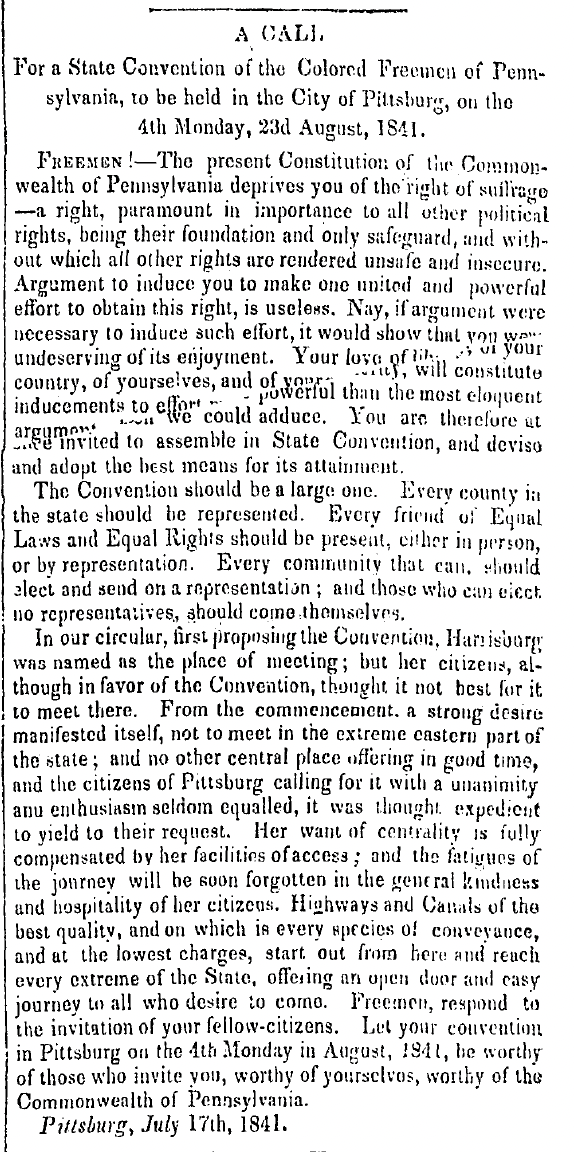
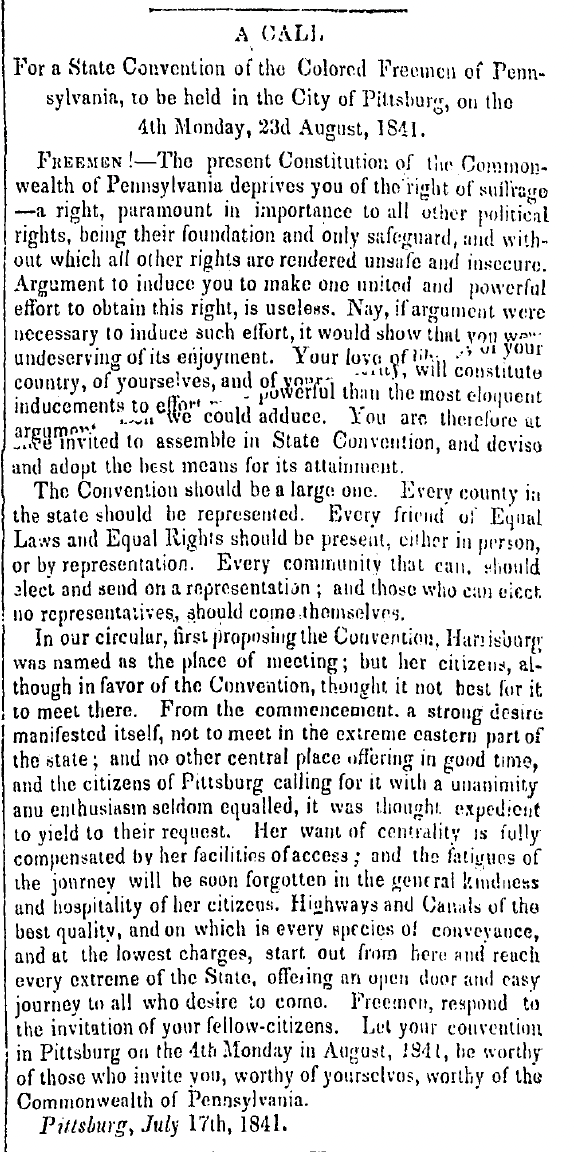
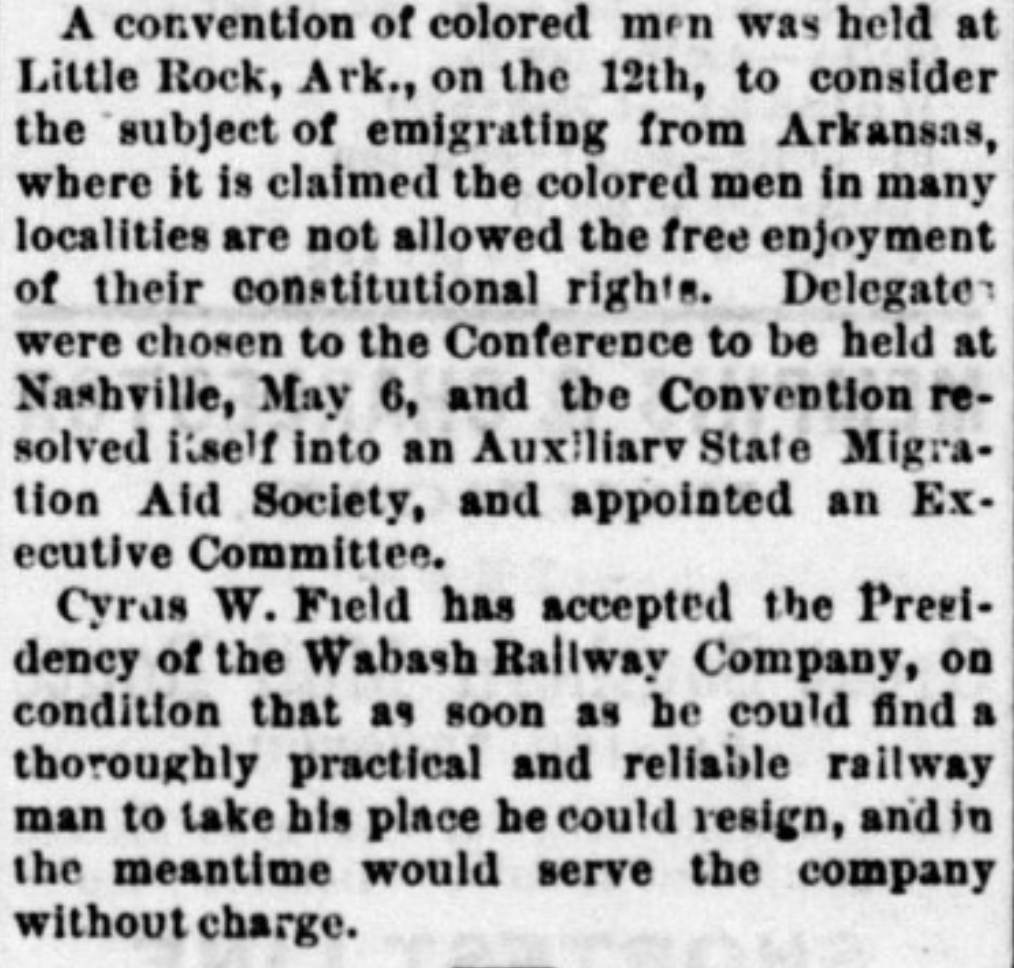
I transcribed a few document the Pennsylvania section. Non of them are the one pictured in this post, unfortunately. There were a few problems with the webstie to prevent me from getting that, but the picture is a good idea of the type of documents we were working with.
I learned an array of names, and vast amount of people who attended these colored conventions. I also learned of a precedent that many people about to enter a position of politcal power may have believed in equal rights in terms of voting, but kept quiet about it for a better chance of election. This led to a pledge in one of the Colored Conventions that the member would not support any candidate who was not sure to support equal voting rights.
Previously to the transcribe-a-thon, I had no idea what the colored convention movement was or what it had entailed. I also have never worked with any digitized archival documents let alone transcribe them. All of this was a brand-new experience for me as well as the information regarding the transcriptions. I think that the colored convention movement is incredible and what they are doing is very important. It felt rewarding to be a part of a movement like this and know that even just a small contribution can be extremely helpful. Transcribing documents is crucial to preserving the documents historical values and its impact on the development of African American political thought and organization. The transcription gives historical context for the movement’s issues it addresses like education, labor, and legal justice. It also fosters community engagement by allowing individuals to connect with the history and current civil rights struggles.
Some challenges that I faced during the transcription were initially navigating the website and trying to follow all of the instructions. I was quite confused about the process on how to find and report names in the documents. Some of the documents were also difficult to read and understand what was written. I was eventually able to find the correct way to identify names after playing around with the Zooniverse website. If there was a document that was illegible, I would just move onto a different one that I could read and transcribe that one.
One of the documents that I transcribed (not pictured) mentioned the city of Rochester NY which is quite close to Geneseo and where I grew up. It was interesting to see that the colored conventions movement operated so close to myself. I found the process to be slightly calming, copying words down exactly how they’re written and reading along without the stress of an assignment was oddly soothing.
When engaging with the archival documents I learned a lot about the colored conventions movement and the documents. It covers issues like labor rights, voting laws, education, health and many more. It laid the groundwork for later African American institutions. Reading the documents as I transcribed them made me become more interested in the issues that were addressed and the movement itself. I also never heard of Frederick Douglass day so I learned a lot about him and how he impacted the colored conventions movement.
In my opinion, the Douglas Day transcribe-a-thon where students were able to transcribe documents from the Colored Conventions Movement truly embodied the best of academia. This event gave college students the opportunity to play a direct role in engaging with documents from the past and contribute to their preservation which extends beyond the typical classroom activities. Participating in the transcribe-a-thon on Douglas Day gave me a strong sense of autonomy and transformed my understanding of history because for the first time I felt like I was immersed in this discipline. In high school I had always been fascinated by my AP European and United States history courses, and the study of history overall. I always recognized the importance of teaching and learning the true history of the country in which we live because honest education ensures that we don’t make the same mistakes. In all of my prior schooling about American history and the Civil Rights movement beginning in the 1950’s, I was never taught about the Colored Conventions Movement.
Since reading documents from the Colored Conventions Movement in the transcribe-a-thon, I have learned about a significant force of Black activists, leaders and civilians who fought for Civil rights, educational and labor equality and the abolition of slavery. It is essential that we know the name of the Colored Conventions Movement and the political advocacy and mobilization that they created in order to understand the reality of Black civil rights in America. Too often, White northern abolitionists get credit for fighting for the freedom and rights of Black civilians in America, when it was truly them who fought for their own liberation and progress. It is time that white saviorship is criticized and The Colored Convention and their strategized effort is recognized and taught.
My Experience
I am embarrassed to admit that prior to this experience I knew digital archival documents existed and were a valuable resource for academia and education, but I wasn’t sure who played a role in physically transcribing them. The act of transcribing allowed me to take ownership over my learning, as someone who finds interest in history and studying documents from the past. Transcribing made me feel as though I was contributing to something meaningful in society. Transcribing the document for Douglass Day was very easy, and took less than ten minutes which made me realize how easy it is to contribute to an important cause that is preserving historical documents. Our role in transcribing made documents more accessible through digital media, as well as identifying different people, specifically females and giving them credit for their impact in history. I felt as though transcribing the archival documents was slightly disheartening because it felt like I was ruining the authenticity of the document and that it was losing its character as it was typed. However, I understand that the digitized version can exist for functionality while the charm and originality of the document will not be lost in its original form.
Finally, I realized the importance of identity in these documents, as history tells a story that can strategically leave individuals out in order to teach a certain narrative. During the time period of the 1800s and 1900s women were commonly left out of fields of leadership, advocacy and political participation. Their role, even though essential, was under valued and not acknowledged in order to maintain females’ subordinate place in society. It is essential that we uncover the names of women who played a crucial role in the Colored Conventions Movement and the fight for civil rights. It is a privilege and an honor to be a female in today’s world, able to contribute to rewriting the narrative.
Challenges and Learning
The only challenge I experienced during the transcribe-a-thon was with internet service and connection due to the overpopulation of Zooniverse during Douglass Day. Ironically, this exposes a fundamental flaw of digital media compared to print which is a topic we are discussing in class. Digital media and transcription presents an issue of internet connection and service which undermines our goal to improve the accessibility of a document. After a short amount of time, the service issues were cleared up and I was able to transcribe documents as intended. In this process I learned that formatting is insignificant when it comes to document transcription and that what truly matters is the content and the story you are transcribing. The formatting of the archival document is special and unique to that of its original paper form and that doesn’t need to be replicated in the digital version because fortunately, the original edition can always exist.
Transcribing archival documents from the Colored Conventions Movement allowed me to be involved in recording history and take an active role in digitizing very important documents. Additionally, my experience with the specific documents gave me insight into the political and social climate of this time and the individuals as well as the efforts that they were fighting for in terms of civil rights, labor and social equality. I now know about the Colored Conventions Movement and the significant role they played in American history.