
Understanding text as “data” and accepting its fluidity

The survival of the humanities in the digital age relies upon the understanding that text is data: specific information that is carefully packaged for our analysis. In my experience as an English major, analysis is typically undertaken as a quest for interpretive meaning, bringing to the fore questions of symbolism and literary devices, like: “What does the green light symbolize in The Great Gatsby?” and “How does Fitzgerald’s diction convey this particular meaning, and not another?”

After focusing primarily on qualitative approaches to literary analysis, ENGL-340 introduced me to the quantitative analysis of text as data. With quantitative analysis, each bit of information is examined without projecting more meaning than what’s provided. An example of quantitative analysis applied to The Great Gatsby might be: “How many times are the eyes of T.J. Eckleberg mentioned? Where are they mentioned most often?”

ENGL-340 also introduced me to text as a corpus of data, or corpora if there’s more than one distinct corpus. We apply quantitative analysis to one body of text, or a collection of related texts, in search of patterns. Patterns are the keystone of meaning according to quantitative analysis, especially when examining a large corpora. For instance, you might wonder “What patterns can we discern across classic novels written by the modernist “Lost Generation”?” These “patterns” might materialize as the repeated use of a word, theme, or structural organization. From there, you might imagine why the great writers of the Lost Generation made similar, or different, stylistic choices.

Incorporating this mode of analysis into our literary approach is crucial because it bridges the perceived gap between the humanities and the sciences. Human thoughts crafted into words crafted into sentences crafted into coherent bodies of text are historical objects of information worthy of scientific analysis. They are markers of humanity’s achievements: some of the greatest, most timeless self-knowledge we’ve touched upon as a species is found in literature. Why not examine its concordance, then? Some tips for quantitative analysis that I picked up in ENGL-340, and which I hope to bring to future classes, are:

  • Searching a corpus for patterns at the command line: using a digital copy of the text you’re analyzing and the command line, you can search the text for the occurence rate of specific words, for a total word count, for the longest and shortest words in the text, for the word that occurs most often, and so on.
  • Generating graphs and other visuals for your data on Voyant: rather than using the command line, you can also view the quantitative analysis of textual data you upload on the website, VoyantTools.org. The cool thing about Voyant is that it generates different charts, graphs, and visuals of the data you’re focusing on.
  • Comparing data across versions using a Fluid Text Edition: here, we can analyze how data in a corpus has changed or stayed the same over time.

The second necessary development in my perception of literature as a result of ENGL-340 is tied to this final bullet point. First, there’s understanding text as data. Then, there’s understanding that text is fluid: not a fixed and stable object, but rather, an ongoing project.

Our favorite books, poems, and plays were formed gradually and with great care– not suddenly and miraculously crystallized. If we have access to earlier manuscripts/revised copies, we can compare versions of a text to better understand its development. Referring to a fluid text edition also brings awareness to the humanity of the author: reading Thoreau’s first draft of Walden, we are reminded of the flaws inherent in everyone’s first draft. It also serves to remind us, quite fittingly for Thoreau, that everything is done with some degree of deliberation in the literary world. Individual words are chosen with extreme care: Thoreau scratched out the words “book”, “work”, and “lecture” when describing Walden across various versions before finally settling on “book”. The attention put toward such minute matters reveals Thoreau’s dedication to “getting it right” as a writer– a quality not all writers, or authors, possess.

Thanks to ENGL-340, I am able to see the oft-overlooked juncture between qualitative and quantitative analysis in literary studies. With attention to the nature of text as “fluid data,” we can study the information before us both objectively and subjectively. Subjectivity particularly applies to imagining plausible revision narratives that explain changes made to a text. Of course, quantitative data is also fodder for further interpretation. Information, writing, art, life– I think James Gleick once called it a “moving target,” and I find that more than adequate. These things are constantly in flux as a result of being alive; final stability is like death, or whatever name you give to completion. Just like the way we learn from one another, we learn from art as we observe and analyze its change over time, its variations and constancies. In this way, ENGL-340 enhanced my understanding of literature and life.
Getting Lost Behind A Screen

The massive wave of technological advancement within the last two decades has spurred more than just shifts in culture and social dynamics. The entirety of the modern world (more specifically, America, but generally and first world country will do) has morphed into a society that’s nearly unrecognizable from that of the beginning of the previous century. In 1920, the radio had just been invented. Now, 100 years later, students are finding the connections between literature and technology, and how both have an immense impact on our culture, our future, and the way we think. 

If I’m being totally honest, the premise of this class confused me just a bit. In registration and the first couple of weeks of classes, I wondered what exactly was the purpose of this class. Ask me two months ago, and I would have said I’m in this class to learn about technology and literature, and how they’re related to the world we live in. While this isn’t incorrect, I realize now that there’s an ulterior motive – to change the way we, as students in this ever-changing society, think. Coming into this class as a second-semester freshman, I still hadn’t really learned just how different college English classes are from that of the ones I took in high school. In my secondary education years, English class went a little like this: read some state-mandated classic novel, analyze the dickens out of it for two and a half months, and then write an essay on it, usually some form of rhetoric analysis. Maybe there would be a multiple-choice unit, filled with generic strategies on how to pass the state testing like the Regents exam, or get a 5 on the AP. Not entirely sure why, but everything I knew led me to believe that college is just going to be a more advanced version of this – reading harder books, and more in-depth and complex essay prompts. Nothing and no one told me otherwise. 

Needless to say, this semester has been a whirlwind for me. While my view on English as a discipline changed drastically over the course of the part of the semester that we had on campus, I now feel that it’s almost entirely changed since being home. Having to switch to online learning forced me to read and think in ways I hadn’t before. All my life, I have been a hands-on learner. The kind of person that needs to have a physical copy of the text in order to fully process, read, and analyze it. I prefer in-class discussions because it allows us to talk about our ideas and converse with each other informally.  Reading and discussing on a screen just doesn’t do it for me, however, that only puts me at a disadvantage in the current situation. 

Over the past couple of days I’ve been rereading certain chapters of Walden, and I notice that he consistently forces the reader to be self-aware of their consciousness, and of their thoughts and body. He wants us, as the readers, to not lose ourselves in everyday life, but rather go through life conscious of our choices and ability to affect others. Since quarantine has started, I’ve begun locking myself in my bedroom, not coming out for hours on end because I’m studying or doing homework. I barely talk to my siblings and only really stop to eat or dawdle. But in reading Walden, I realized that it’s so easy to lose yourself in front of a computer screen, and come out dazed, forgetting who and where you are. 

Taking this English class has more than changed my view of English as a discipline, but it’s changed my view on everyday life. I now walk through my house aware of every step I am taking, and everything I say. I sat down to reread one of my favorite fantasy novels the other night, and I was constantly reminded of Walden and Thoreau’s plea to have us find meaning in everything. In rereading that novel, I came out with an entirely different point of view on the characters and their actions – they are just as unselfaware as I was. 

Before this class, I had an immature and primitive view of English. The object was to read books, analyze, and write essays. What I didn’t realize, however, is just how immensely English can change the way you think – you don’t need a philosophy class for that.

Studying Literature in Relation to our Course

When I first saw this question, I was having a bit of trouble understanding exactly what was being asked. After a long few minutes of really thinking to myself, I think in simpler terms, this question is asking me to think about whether or not the digital aspect of this class had an effect on the way that I read and understand literature. 

When I first decided to take on this class and saw that it was called “Literature in the Digital Age,” I thought we were just going to be discussing how literature has now changed in this time of advanced technology. Although this was partially correct for some of our assignments, I could not have been more wrong when we were studying Walden, the real heart of the class in my opinion. 

Throughout pretty much the entirety of the course, we were asked to read a select chapter or essays from Henry David Thoreau’s book Walden. He talks about living the simple life in the woods. How did this change my idea of studying literature? Well, the whole entire book was online, not in paper form. To add to this online experience, classmates comments could be seen throughout the “book” as you were reading the assigned section. 

Being a person who went to a high school where the curriculum was pretty much based around technology, this whole idea of doing stuff online was not a shock to me. However, we always read our books the traditional way. So reading Walden in a non tangible form was definitely an odd experience for me. The thing that really threw me off was the comments my classmates would make throughout the book. The way I usually read is that I do not like to get any outside ideas or opinions before forming my own. Reading other’s comments while I was reading the online text was distracting to me. I basically had to come up with a new way of reading, which for some might be cool but for me, I get the most out of reading when it is uninterrupted and while I value my classmate’s ideas, it would have been better for me if they were not there while I was reading. (Yes I know you can hide them while reading, but it still alerts you to their existence and I was tempted to look anyway). 

Also, although we had some discussion in class about the book, most of the conversations took place online prior to class. It made me realize something about myself. I enjoy in person discussion so much more than online discussion. To me, when a person speaks what they feel instead of writing it, it has more impact when engaging in a discussion or a debate. I really enjoy the natural flow of a conversation as opposed to the robotic way we all write. 

Let me make this very clear, I am not trashing the convenience and luxury of doing things online. Look at what’s happening in the world right now. The fact that we are able to finish the semester online is remarkable and I am grateful for having the ability to complete my studies and not fall behind. In my opinion though, some things should be left to be done in person. 

So, how has this class changed my view of studying literature? It made me realize how much I love the feel of turning the page of a book, and the voices of others around me.

The Merits of Applying Digital Analysis Tools to Literary Studies

As a graduating senior, I have often been asked a variation of the following question: “Why study English?” and my response has always been, and will probably remain: Well, why not study English? One of the most valuable lessons that my time within the English major at Geneseo has taught me is that when it comes to literary studies, the possibilities are boundless. That being said, I’ve also learned that when it comes the digital humanities, those possibilities become tangible. 

As I reflect on the various digital skills I’ve learned in our digital humanities class, Voyant Tools remains the most influential in my studies outside of class, particularly on my independent study on the influences of Lord Byron on the Brontë sisters. While I admit I was a bit wary of using this digital-analysis tool, most of my qualms were related to the unfamiliarity of it all. My experience with Voyant Tools was largely based on frustrating trials and errors. To be quite honest, trying to figure out Voyant felt like trying to decipher Middle English — it was tedious, time consuming, and required many workshops and tutorials. One of the hiccups that I encountered occurred when I tried to upload Jane Eyre in its entirety in addition to Lord Byron’s Corsair. I was considerably overwhelmed by the numbers, that is of course until I took a step back and tried to assess what specific aspects of the literature I really wanted to focus on. 

So, after learning how to split plain text files of Brontë’s works into separate chapters, I endeavoured to also split The Corsair into its three cantos. Finally, I returned to Voyant Tools and uploaded Cantos I in addition to chapters 11 through 27 of Jane Eyre because I wanted to decipher how Byron and Brontë were utilising language in the developments of their heroes. I chose Canto I because it is our first interaction with Conrad and the descriptive language is at its prime; the same can be said for Rochester in Chapters 11 through 27 of Jane Eyre. When I searched the syntax, I typed in the term “cordial” but as I typed the letters “cor,” Voyant suggested “corsair” and noted that it occurred in two instances throughout the texts. Normally, I would have assumed that it was simply reflecting Byron’s work, but I had just finished re-reading the first Cantos while I was stripping the text-file for all numbers, roman numerals, and unnecessary publication information and I did not recall seeing the word appear in the text. So, I searched “corsair” instead to see what the context of the word might be and I was surprised to find that it did not appear in the first Cantos at all, but rather in Chapter 17 of Jane Eyre. This tool launched the exact context of the term in the reader view and I was able to follow on as Miss Ingram argues that a man is “nothing without a spice of the devil in him… he was just the sort of wild, fierce, bandit hero whom I could have consented to gift with my hand” and Rochester sings a “Corsair-song” because Miss Ingram “doats on Corsairs”  (JE, XVII). In all of the scholarly articles that I referenced for connections between Byron and Brontë, most of the critics pointed out the various physical and emotional similarities between Rochester and Conrad, but in my reading of their work, it never caught my attention that Brontë alludes directly to Byron’s Corsair. While I am certain other critics took notice of this allusion before me, this particular moment in my research was eye-opening, it even felt like an epiphany, and my interpretations took a turn in a different direction. 

It is without a doubt that the connection I have to Jane Eyre is largely sentimental and as a result, I have read it every winter for the past eight years and eagerly took advantage of the opportunity to study the text twice the academic level in the Spring 2017 and Fall 2018 semester. Yet, in all those times I engaged with this novel, I never once noticed Brontë’s reference to Byron, but it took this digital analysis tool less than five seconds to uncover it! I was amazed, even as I write about it and reflect on it, I am still in awe about it. This particular instance taught me that when we, as students of English, leap out of our comfort zones and and utilise digital analysis tools; we are bound to find ourselves presented with unforeseen possibilities and challenges in our interactions with literature. Indeed this is what makes studying literature so extraordinarily rewarding and I am glad I recognised the merits of digital humanities before bidding farewell to my beloved discipline.  

New Views on “English”

The point of this blog post is to discuss how I view “English,” as a discipline, differently as a result of my work in this course. I can safely say that this class has definitely changed how I view aspects of this discipline. Yet I would be remiss if I didn’t state that some of these views changed after confronting the reality of our situation as a result of COVID-19. This class. To me, this class and this situation has allowed me to understand the importance of being able to adapt.

Early on in this class, adapting was very clearly important with the introduction of GitHub, Visual Studio Code, and the other tools we had to learn how to use. At first, I thought that these tools were just harder ways to do various tasks with the computer, as evidenced with opening my file explorer through the command line. But as time went on, I started realizing how these tools were enhancing the experience. Understanding my computer better has allowed me to review how I tackled aspects of this discipline. It has allowed me to open my eyes to how this discipline adapts. By looking at our laptops in a new way, it allowed me to see how the rest of the “English” discipline adapts in many new ways.

That changed, initially, when COVID-19 became a global pandemic and we were all sent home to wait it out. Because of this, I found myself looking at works like “Walden” deeper and really coming to understand how “English” as a discipline can adapt. I bring up “Walden” because it makes me reflect on my views of the English canon. I always used to think that the works in the canon were there because people forced them to change with the times. But looking at my situation, I found that “Walden” lends itself naturally to the changing times. Because of this new view on “Walden,” I find myself thinking this must be the case with most of the canon. But even with that, “Walden” wasn’t static, Henry David Thoreau revised and edited it several times, changing it over the course of a few years. This discipline is all about adaptation, just as we adapted to light levels of coding, authors and their works adapt to the times they are written in, as well as the changes of time. Even Gleick touched on adaptation as he went through the evolution of communication; from talking drums to the telegraph to the transistor. All around us is adaptation.

Because of our situation, adaptation is all that is on my mind. This view has allowed me to look back on what we have looked at in this class and has also allowed me to look at the discipline as a whole. All we can do is adapt, so it is always good to get the practice and come to the realization that we should. By having us look at our laptops in new ways, this class has allowed me to see how we adapt constantly to new situations. Through the command line, GitHub, Visual Studio Code, the English canon, communication, and more, we are surrounded by adaptation.

Literature and Technology: The Connection

Over the course of this semester in Literature and Literary Study in the Digital Age with Dr. Schacht, I feel as through I was given a unique opportunity to not only learn more about the things I can do on my computer, but also to think about literature, books, authors, and English as a discipline through a different lens.

For starters, as we near the end of the semester, I feel as through I have learned more about what my computer can do and have been given tools to help me manage my computer more effectively. With the use of github and the command-line, I not only have an online space to upload and store files that may be taking up valuable space on my computer, but I also have a collaborative workspace that may come in handy in the future. Additionally, I’ve learned valuable skills about the markdown coding language and how the python coding language works. These skills are obviously in high demand in many fields in todays society, so having this basic understanding will surely only help me post undergraduate education.

While learning all of the new things I can do on my computer were interesting, I think the most valuable lesson I learned this semester is in regard to how I view literature and what tools myself and other people can use to further understand it.

I don’t think I ever fully realized the amount of work that goes into creating a work of literature. Obviously, I knew that in order to get published, authors go through an intensive revision process that often times takes several different attempts to get it just right. I don’t think I understood that those revisions can be as intensive and tedious as simply changing one word to a different one until the author is satisfied. This idea has given me a greater appreciation for all the novels that sit on my bookshelf and around my room.

Going off of this idea, I also have found an appreciation for how easy it is to track these changes using technology. Using Voyant Tools and the Fluid Text reader, I feel like I have been able to connect more deeply with literature. Being able to find specifics about a text in Voyant Tools and then to be able to track those changes over a series of manuscripts has only deepened my understanding of the pieces of literature that we have worked with this semester. On top of that, its just pretty darn cool to see all the revisions to a text and how a manuscript may have started versus how it was published.

Overall, I think there is a huge connection between English as a discipline and technology. I think before I use to think of English more as just reading and writing – now I think of it more as a way of communication, a diffusion of ideas, and how we get from one point to another with the impact of technology. English is about how we communicate and how ideas are shared through reading and writing, rather than just reading and writing. Technology plays a very unique role in this, as the more advanced we become with our computers and our phones, the more we can do to communicate. From talking drums to the first telephone created by Alexander Graham Bell to the ability to group facetime, ideas are spread at a fast rate through talking. On top of that, the invention of the printing press has enabled us to share ideas through writings at a much faster rate than ever before, and it has just gotten faster as time has gone on – the use of a printing press is not even required any more, blogs, such as this one, and other online sources give you the same way to communicate through writing.

The connection between English and technology is a great one. The more you can do with technology, the more english enables you to do, share, write, read, and communicate. We have a web of information at our fingertips to learn and improve. Without the diffusion of information that english enables and the use of technology enabling more people to access it, the world would most likely be very different than it is today. This course, learning all these skills, and being able to have access to the tools that have been shown to us has ultimately changed my view on both English and technology; it has opened my eyes to how english, as well as other disciplines, and technology have a connection to one another that leads to improvements and advancements in all fields.

Learning From a New Perspective

To be honest, it has been difficult for me to connect the digital work we have been doing throughout this course to the concepts of literature and “English” as a whole. While I have learned something entirely different from what I was expecting to in an English course, I was unable to see where our work connected to the concepts of English. Since moving to online learning, this connection has been made easier for me to see as my reliance and relationship with technology has changed so dramatically in the span of a couple of weeks. 

Prior to distance learning, I couldn’t understand how the uses of Github, Voyant Tools, Visual Studio Code, and the other programs we have been using throughout the semester connected to my general concept of English and Literature. I was glad to be learning something I never imagined myself doing: coding (on a small level).  At the beginning of the course, I reorganized my documents folder to better fit this course, and this is something that has aided me in all other aspects of my life. Now, after learning online for about four weeks, my understanding of this course has changed dramatically and how I view work in my other courses has changed as a result of this. I find myself constantly thinking how any of this would be possible without “English,” reading, and literature. Knowledge and information, as cited in Gleick’s novel, has been passed down for centuries through literature and language itself. At some point in time, the idea for the internet must have been drawn out and described upon paper, into some form of literature. With every new technological advancement, for example any of Tesla’s recent releases, will be reported on and written about for the rest of the world to know. Many of Tesla’s innovations have changed how many people view electrical power and will surely be something people read about and reference in years to come. None of this would be possible without “English.” In my work for other classes, I am more aware of my word choices, specifically the repetition of words in my papers. I have caught myself thinking about imputing my essays into VoyantTools to track the frequency of certain words and phrases, to then go back and revise. When revising my work, I have begun to use Review/Tracking/Track Changes in Microsoft Word to analyze my revisions and watch how my own understanding of my work can change as I revise. Like Thoreau, I change words, phrases, and grammar in my writing which then go onto to change the overall meaning of that sentence and finally can change the overall meaning of that work. Our work in terminal and VSC, has led me to prefer typing in plain text (although, I wish there was a spell check feature!) and the simple format it provides. I find myself becoming frustrated with formatting issues in other classes and am better able to understand why author’s and online writers choose to prefer plain text, instead of another program. Being able to spend more time, and the majority of my day on my laptop has been able to see how the coursework throughout this semester has affected my daily life and my own meaning of “English” and literature. 

What I have realized is that this all relates back to communication as a whole. Literature was born from verbal communication, and communication has been strengthened by literature. Distanced based learning has taught me how vital communication is to learning, and how much I rely on in person communication to thrive. I have now adapted this need and have learned to work with my technology to best suit me, and I think that being in this course has better prepared me to do so. Ironically, I think that I took this course at the perfect moment and our current circumstances has taught me the real value in literature and “English.” Every day, we (the human race) use “English” to stay connected, and gain information about the state of the world. In doing this, we are a part of history, and this recording of history was made possible by the changed definition of communication and the innovations in “English.” 

Learning in a New Place

Until spring break, I never fully appreciated how communication links to learning. Living and learning on campus, everything is how it should be. I go to class and we all discuss what we’ve learned for homework and how to move forward. Now that there’s a pandemic and classes have shut down, it becomes a little bit more difficult to learn, for a reason I never saw coming; a lack of mass communication.

Now, of course there is still communication. The professors will always have time to meet with the students and discuss any issues. In fact, this class has a two hour period to chat with the professor during the scheduled class hours, a help page to write to the professor for help, a fill-out sheet to request a one on one video chat with the professor, and ti’s willing to help as well. However, there is still a missing out on general communication with everybody. Being on campus, you can talk with other students outside of class, study together, even just try to further understand what was discussed in class. If somebody missed a day, they can still get notes from a friend in the class. Now, you can’t really do that.

Communication is central to learning, but it is central to everything else too. James Gleick compares the telegraph to biological wiring. He says “…comparing cables to nerves; the nation, or the whole earth, to the human body”. Without communication, there wouldn’t be life as we know it. Communication expanded society at a much quicker rate. Instead of multiple nations trying to come up with something while having minimal communication, most of that being a messenger that can take weeks to months to arrive somewhere, communication began to be almost immediate. Telegraph stations were set up everywhere to quicken the time it takes for information to spread. Then the telephone got involved, having a voice transmitted across the world within a second like it’s nothing. Gleick describes this as ‘…begin to turn society, for the first time, into something like a coherent organism”. People can work together on the same projects around the world, at the same time, at a pace they’ve never been able to before.

Now that I am stuck with remote learning, it becomes difficult for me to learn, because i cannot communicate with everybody in a real time, class setting. I would love to join the scheduled class time video sessions, but unfortunately I have to work during the week now that I am home. It is not only this class that has gotten more difficult. Every class requires a scheduled class time because communication is a key to learning, so every class is becoming more challenging to learn in. However, every obstacle is something that can and should be overcome. We are still learning how to adapt to remote learning, but the more we do it, the more we find a way or a time to communicate with the right people, and still get the information that is needed to pass the class. After all, we have real time communication methods that are way more advanced than the telegraph.

Communication and the Coronavirus

James Gleick’s popular science book The Information also approaches the idea of communication as it was previously seen in 1948. Gleick writes that aside from cable and telephone sets, “The [Bureau of the Census] also counted several thousand broadcasting stations for radio and a few dozen for television, along with newspapers, books, pamphlets, and the mail… the dots and dashes representing letters of the alphabet; the letters representing sounds, and in combination forming words; the words representing some ultimate substrate of meaning…” (5).  

This concept itself is universal as it applies to pretty much every aspect of life today, too. I communicate with people every day, whether it be in person, on my phone, through my gestures/facial expressions, etc. Given how universal this concept is, communication, as shown by Gleick, can also take the form of media as well as the news; specifically, news outlets that are local, national, or international. For example, on any news outlet, information is constantly being delivered to me, as well as an even larger audience of people at once. In the current world we all live in, communication has been problematic during this coronavirus. 

Every day, I scroll through various social media platforms, such as Facebook, and I see what feels like thousands of posts about the virus. Some posts are promotionally used as they are trying to encourage me to buy a mask that is scented and the “best kind out there”; some posts are utterly useless as they repeat the same information found everywhere, telling people to wash their hands, as if people do not know; and some of the posts, on the other hand, are quite informative and educational as there are statistics provided of the areas that are most affected by the virus. 

While news outlets are also beneficial in learning about this virus and ways to prevent its spread, each of them has also been a bit useless. I watch the news pretty frequently with my family, especially since I have been home, and I feel like I just keep hearing the same thing over and over. I know, as I am sure everyone knows, that the unemployment rates are terribly high right now. I also know that different areas everywhere are constantly skyrocketing in the amount of COVID-19 cases. Of course each of these topics is extremely important, but it seems that there is less talk about the future too.

What I desperately wish I could see more of instead is interviews with health personnel who describe their experiences in the hospitals; the ones who are quite literally fighting for our lives as well as their own because of this pandemic. People who could more accurately provide more numbers about the amount of people checking into hospitals because of the virus. I also wish experts could communicate more frequently their projections for when they think life will return to normalcy. Or, if not that, pretty much any information they have that could give people hope about the future of employment, the estimated time of when the curve will start to flatten out, the recession, etc. Just something that gives people more hope. I do know that some of what I wish for is not necessarily possible to discuss right now. I also understand that some of the projections may not have been approximated yet. I do not mean to sound ignorant in expressing these thoughts, but it is just frustrating to feel like there is more about this pandemic that has not been said. 

While the communication of different outlets has not been the greatest thus far, I only hope for improvement so that people can stay informed, educated, and hopeful.

Meme-icry

When coming across the chapter in Gleick titled “Into the Meme Pool,” my mind immediately jumped to the captioned photos and videos blasted across the internet in succession, each changing slightly in form to the next. I did not expect the term “meme” that we commonly use now in pop culture to have first been coined by a biologist. According to Gleick, Richard Dawkins defined a meme as “‘a bodiless replicator'” (312). Dawkins considered memes to be catchphrases, tunes, ideas and images. The memes we see today fit well into this definition crafted in 1976, typically taking the form of a formatted image or video with captioning that is changed to the discretion of each repeater. According to an MIT Technology Review, the modern meme is “a variant of an image based on a common theme that has spread widely on the internet.”

Dawkins described the journey of memes as the replication of “themselves in the meme pool by leaping from brain to brain, via a process which, in the broad sense, is called imitation” (312). However, this form of imitation didn’t have the negative connotation of cheap copying — it is instead viewed as a collaboration. With each imitation, the meme evolves. As with the genes that form our lives, memes seek to repeat and evolve, stretching through the human story. The internet memes that have become so integrated into our culture (to the point where they reached the clutches of Facebook moms) are an example of how information and communication has evolved with technology.

Memes are comedic in nature, an inside joke for the internet. Some jokes are more exclusive than others. All memes are built upon a common understanding of the internet community. Memes are a testament to the strange culture and humor that has developed mainly with the younger generations that grew parallel to the internet itself.

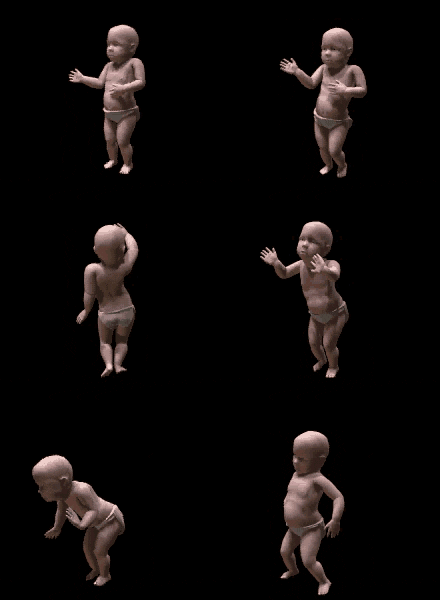
According to this article by Brady Gavin, the first meme was a dancing baby used to demonstrate the impressive movement of a new software.

The MIT Technology Review describes how Gianluca Stringhini and colleagues at the University College London developed an algorithm to track how memes go viral across the internet. Their algorithm used perceptual hashing or pHashing to identify similar images: memes. The group found that for a meme to be most successful, one must mass produce various forms of the meme — similar to how genes “evolve through mutation, reproduction, and selection.”

However, not all memes are innocent jokes. As the article discusses, some memes are used to perpetuate racism, and these memes can go horribly viral — as a virus does. These memes seem to act more like a vicious virus, seeking to harm for the sake of its continuity.

In retrospect, it is unsurprising that the pop culture concept of “meme” derived from the observation of a biologist. Internet memes seek to replicate and evolve as genes do. Memes thrive from their replication and evolution, and they have the best rate of survival when mass produced with a spectrum of competitive variants. Memes may be the expression of the internet’s genes, in a constant state of modification, adapting to the ever-changing terrain of the web.