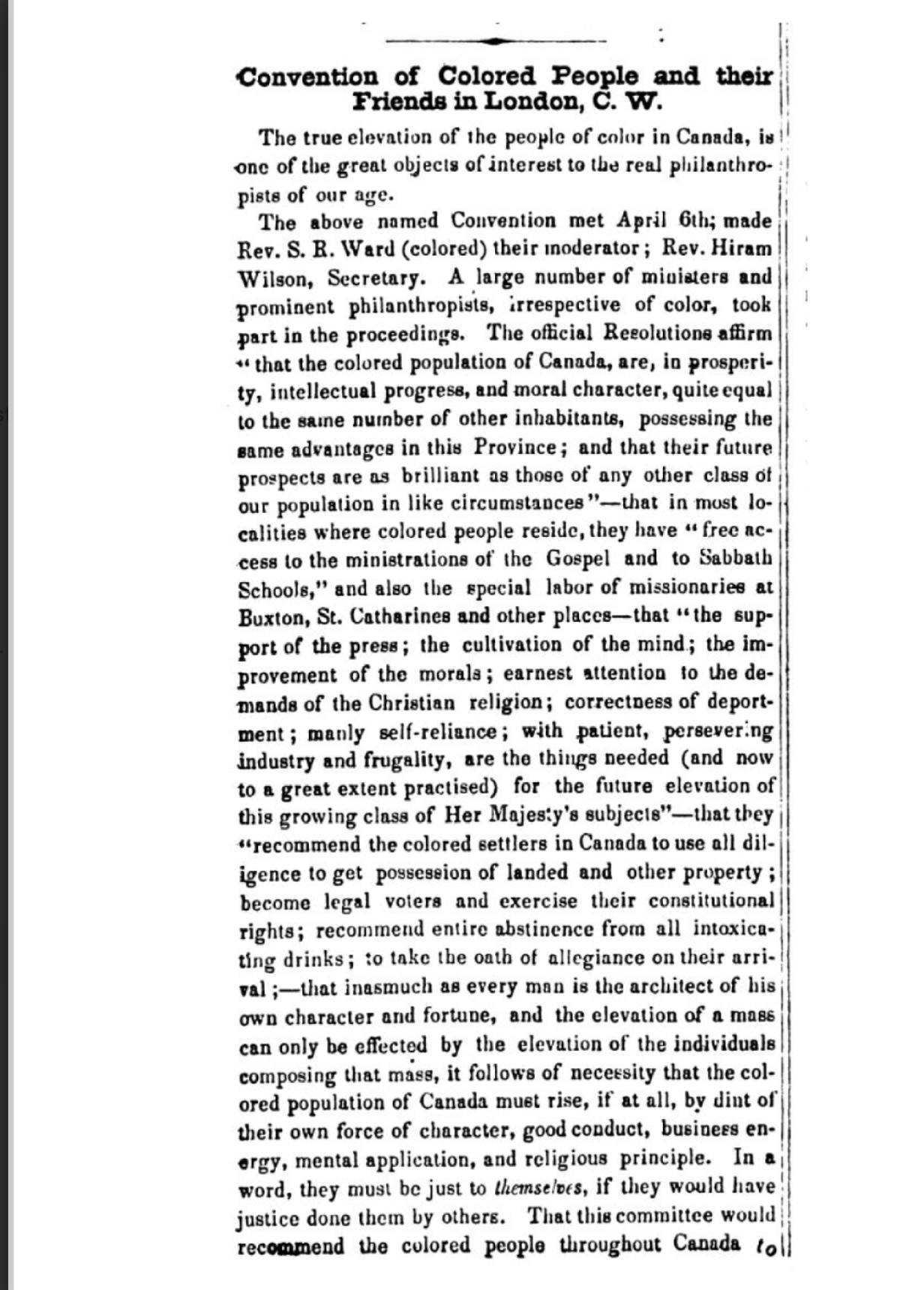
Before participating in the Douglass Day transcribe-a-thon for the Colored Conventions Project, I had very little knowledge on the subject. I had never transcribed before, and only a general understanding of nineteenth-century Black political organizing. I knew that Frederick Douglass and other abolitionists spoke publicly and wrote extensively. I also understood that there were gatherings and conventions that advocated for rights and freedom. I did not fully grasp the scope, organization, or intellectual seriousness of the Colored Conventions movement itself. Transcribing a document from the Convention of Colored People and their Friends in London, C.W. fundamentally deepened my understanding of how structured, deliberate, and forward-thinking these meetings were. The document I worked with reported on a convention held April 6th and described its resolutions concerning the “true elevation of the people of color in Canada.” Even in its old form, the language conveyed clarity of purpose. The convention appointed Rev. S. B. Ward as moderator and Rev. Hiram Wilson as secretary. It also noted the participation of ministers and philanthropists “irrespective of color.” The official resolutions stated that the “colored population of Canada” were equal in “prosperity, intellectual progress, and moral character” to others with similar advantages. Reading these words in their original form made their force feel immediate. This was not abstract history, it was a community publicly asserting dignity and capability in a world structured to deny it. One of my most important takeaways about the Colored Conventions movement is how deeply it emphasized self-determination and a collective uplift. The resolutions encouraged Black settlers to own land and property, become legal voters, exercise rights, avoid intoxicating drinks, increase their knowledge, and follow religious and moral discipline. The language stressed that “every man is the architect of his own character and fortune,” arguing that the transformation of the group depended upon the elevation of individuals. This rhetoric reveals both the immense pressure placed on Black communities to prove their worthiness and their strategic embrace of respectability, education, and civic participation as tools of survival and advancement. Transcribing these words made me more aware of the moral and political balancing act required in a society that judged them harshly. Before this experience, I also had a limited understanding of what it meant to work with digitized archival documents. I thought digital archives were just scanned images of old papers. Participating in the transcribe-a-thon changed that perception. I realized that digitization alone does not equal accessibility. The scanned page I worked with contained inconsistent spacing, unusual punctuation, broken words at line endings, and typographical irregularities that were likely due to the nineteenth-century printing practices. Without transcription, the document would be very difficult to search, quote, or analyze at scale. Transcription transforms an image into usable text and it bridges the gap between preservation and engagement. The act of transcription itself was far more demanding than I expected. I assumed it would involve straightforward typing, but it required a lot more concentration and attention to detail. Words were sometimes split across lines with hyphens, spelling was inconsistent, and certain letters were faint or smudged. For example, phrases like “manly self-reliance” or “business energy” were skewed by irregular spacing. I had to decide whether something was a printing mistake or a misreading on my part. There were moments when I had to zoom in repeatedly, compare letter shapes elsewhere on the page, and re-read sentences to determine whether a word made contextual sense. One specific challenge was resisting the impulse to “correct” the text. Modern readers are trained to fix spelling errors or smooth out grammar automatically. However, transcription requires fidelity to the original document. Preserving misspellings and outdated phrasing is part of respecting the historical artifact. I overcame this by reminding myself that I was not editing, I was witnessing. My role was to carry the document into the present as accurately as possible, not to modernize it. I also struggled getting on the website since it was very glitchy due to the fact that so many people were on it. Once I finally got onto the site and figured out how to transcribe it all clicked. Looking at the physical characteristics of the page such as the uneven ink, the cramped layout, the long blocks of text without the spacing we expect today, makes the labor of both the original printers and modern transcribers visible. The document’s physicality emphasizes that history is not just ideas but paper, ink, hands, and effort. Overall, engaging directly with this archival document changed my sense of relationship to the past. Reading a textbook summary of the Colored Conventions movement would have informed me, but transcribing a primary source made me feel connected to the individuals who organized, and passed these resolutions. I had to slow down and encounter their words at the level of individual letters. That slowness created a different kind of understanding, one that felt less distant and more participatory. The experience also highlighted the collaborative nature of historical recovery. The Colored Conventions Project relies on volunteers to help make these documents accessible. By transcribing, I contributed in a small way to preserving and amplifying voices that were historically marginalized. That realization reshaped my understanding of digital humanities work. It is not merely academic; it is an act of restoration. In the end, the transcribe-a-thon taught me that archives are not just fixed collections, but living spaces of engagement. The Colored Conventions movement emerged not only as a series of meetings in the nineteenth century, but as an ongoing conversation sustained by scholars, students, and volunteers today. Through transcription, I moved from being a passive consumer of history to a participant in its preservation.