
Thoreau’s Revision in “Economy” (Paragraph 19)

Introduction

In the “Economy” chapter of Walden, Henry David Thoreau argues that luxury and material comfort weaken humanity, while simplicity allows for wisdom, independence, and moral growth. By comparing Version A, Version B, and the published version of the passage, it becomes clear that Thoreau did not simply revise for grammar or style. Instead, he deliberately reshaped the passage to make his argument more universal, more philosophical, and more authoritative. Thoreau’s revisions to this passage reveal a deliberate effort to transform an emotionally charged personal critique of luxury into a polished philosophical argument that presents simplicity as a universal moral principle rather than an individual opinion.

Link to Full Page Manuscript:
Image number 23 of the manuscript of Walden showing a portion of paragraph 19a in economy

Link to Partial Page Manuscript:
Image number 23 of the manuscript of Walden showing a region of paragraph 19a in economy

From General Complaint to Focused Argument

The earliest draft begins with a broad and awkward construction. Paragraph 19 of version A says, “To the elevation and ennoblement of mankind what are called the luxuries & many of the comforts of life are not only not indispensable, but positive hindrances.” In the published version, Thoreau revises the sentence into, “Most of the luxuries, and many of the so-called comforts of life, are not only not indispensable, but positive hindrances to the elevation of mankind.” This revision changes the focus and rhythm of the sentence completely. Rather than beginning abstractly with “the elevation and ennoblement of mankind,” the published version immediately foregrounds “luxuries” and “comforts,” making the critique more direct and forceful. The phrase “so-called comforts” is especially important because it introduces irony and skepticism. Thoreau implies that society falsely labels unnecessary material possessions as necessities (Litcharts). This change supports the idea that his revisions were philosophical as well as stylistic. He wanted readers to question whether comfort itself might actually prevent spiritual and intellectual growth.

Universalizing the Philosophical Tradition

Another major revision occurs when Thoreau expands his discussion of ancient philosophers.Version A states, “The ancient philosophers, were a class of men than whom none were have been poorer in respect to outward riches, none so rich in inward.” In Version B and the published text, Thoreau revises the sentence to include, “Chinese, Hindoo, Persian, and Greek…” This addition broadens the argument significantly. Simplicity is no longer associated with only one philosophical tradition, instead, Thoreau presents it as a universal value shared across civilizations. This revision reflects Transcendentalist interests in Eastern philosophy and comparative religion (Walden Woods Project). One of the most revealing revisions appears in Version B, where Thoreau briefly writes, “and I may add Christ as a more popular example perhaps.” However, this reference disappears entirely from the published version. The deletion is important because it suggests that Thoreau intentionally moved away from relying on Christian authority (Walden Woods Project). By removing Christ as an explicit example, he makes the argument broader and more philosophical. The published text presents simplicity as a universal truth rather than a specifically Christian ideal.

Revising the Definition of a Philosopher

The most dramatic revisions occur in section 19b, where Thoreau defines what it means to be a philosopher. Version B contains emotionally charged criticism when it states, “We are pigmies and dwarfs,”and “Where are the progenitors of a nobler race of men?” These statements disappear entirely from the published version. /Their removal suggests that Thoreau recognized that excessive emotional rhetoric weakened the seriousness of his argument. Instead of attacking society with dramatic insults, the final version adopts a calmer and more authoritative tone. Thoreau also revises several awkward sentences into more balanced and polished prose. Version B states, “To be a philosopher is not even to have subtle thoughts, and found a school, merely…” The final version becomes, “To be a philosopher is not merely to have subtle thoughts, nor even to found a school…” This revision improves readability and rhythm while reinforcing the concise style that defines Walden. The final sentence feels more controlled and memorable, suggesting that Thoreau revised carefully for rhetorical impact.

Philosophy as a Practice Rather Than a Theory

One of the most revealing revisions concerns Thoreau’s belief that philosophy must be lived rather than merely discussed. Version B says, “With the actual life of man for the problem, to see how you can solve it!” In the published version, this changes to, “It is to solve some of the problems of life, not only theoretically, but practically.” The revision transforms a dramatic personal statement into a universal philosophical principle. Rather than sounding spontaneous or emotional, the final version reads like a carefully considered moral claim. This change strongly supports the hypothesis that Thoreau revised the passage in order to increase its philosophical authority. He consistently removes emotional excess and replaces it with clarity, balance, and universality.

Conclusion

The revisions across Version A, Version B, and the published version reveal a clear pattern in Henry David Thoreau’s compositional process. Throughout the drafts, he consistently clarifies awkward syntax, removes excessive emotional rhetoric, strengthens philosophical precision, broadens the universality of his ideas, and emphasizes lived experience over intellectual performance. These revisions support the hypothesis that Thoreau intentionally transformed the passage from a passionate personal critique into a polished philosophical argument about simplicity and moral independence. In the published version of Walden, philosophy becomes more than abstract thought; for Thoreau, true philosophy is a way of living grounded in simplicity, self-reliance, and deliberate action.

AI Use and Citations

We used AI, specifically Chat gpt, to help organize our thoughts and correct grammer throughout this blogpost. It was very helpful when we could not figure out the order to lay out the project. There were also alot of words we had AI define for us simply along with revising run on sentances. We used two websites to help us interpret the text when we were stuck. These two sites gave us alternative views and open the door for new ideas!

LitCharts. (n.d.). Walden: Economy summary & analysis. https://www.litcharts.com/lit/walden/economy/

Walden Woods Project. (n.d.). Philosophy. https://www.walden.org/what-we-do/library/thoreau/philosophy/

By Alexandra Campitiello, Brianna Tooke, Courtney Goodwin, Marlea Petroziello
Who’s Really in Control? A Week of Tracking My Attention

For about a week, I paid attention to something I usually don’t think twice about, my attention itself. I learned a lot about Henry David Thoreau’s thoughts on how attention shapes our experience and Tim Wu’s argument that our attention is constantly being competed for in the digital age. I then began tracking what I focused on each day. I got to truly analyze what I choose to pay attention to and what pulls my attention away without my permission.

What I Chose to Pay Attention To: Throughout the week, there were several areas where my attention felt intentional. These were the moments where I was actively deciding what mattered and putting effort into staying focused. Most of this attention was directed toward responsibilities and meaningful interactions.I chose to focus on studying, paying attention in class, completing homework, and having conversations with friends. It required me to plan and make myself focus in order to complete tasks. During these moments, I felt more present and in control of what I was doing. For example, while studying for an upcoming assignment, I booked a study room and put my phone on “do not disturb” in order to maintain focus. When it came to conversations with friends, my focus was less forced since I was interested in what was going on. I felt more engaged and connected during these activities. These moments reflect William James’s idea that “my experience is what I agree to attend to.” When I intentionally directed my attention, my experiences felt fuller and more meaningful.

What Took My Attention: At the same time, there were constant interruptions, mostly from my phone, that redirected my attention without much thought. The biggest sources of distraction were notifications from tik tok or snapchat, which then lead to wasting time on other apps. Notifications were especially disruptive because they demanded immediate attention. Even if I was focused on homework or listening in class, a notification would appear and break my concentration. What started as a quick check often turned into several minutes of scrolling. TikTok was the biggest example of losing control over my attention. There were many times when I opened the app without really thinking about it, and before I realized it, I had spent 30 minutes to an hour scrolling. This wasn’t always a conscious choice—it often felt automatic, like a habit I didn’t fully control.

Chosen vs. Forced Attention: One of the most important patterns I noticed was the difference between attention I chose and attention that felt forced. When I was studying or talking with friends, my attention was deliberate (although it was easier to focus on what I found more interesting). For example it was easier to focus on a conversation with friends compared to studying for a test. However when I stayed focused while studying I learned so much and felt very productive. Notifications and social media often forced themselves into my awareness.This connects to Tim Wu’s idea of the “attention merchants,” where companies design apps specifically to capture and keep our attention. Apps like TikTok and Snapchat are not neutral, they are built to keep users engaged for as long as possible. Because of this, my attention wasn’t just drifting randomly, but it was being actively pulled in different directions. Even when I wasn’t being interrupted, I sometimes gave up my attention too easily. Scrolling on TikTok often came from a lack of discipline, but the design of the app made it difficult to stop once I started.

How This Affected My Life & Moving Forward: Tracking my attention made me realize how fragmented my daily experience can be. Even when I intended to focus, my attention was often divided between what I needed to do and digital distractions. If my life is shaped by what I pay attention to, as William James suggests, then these distractions are more important than they seem. They are not just small interruptions, but they shape how I spend my time and what I experience each day. There were moments where I felt fully in control, especially during focused study sessions or meaningful conversations. However, there were an equal amount of moments where my attention was pulled away without much resistance. Becoming aware of these patterns has made me more conscious of how easily my attention can be influenced. While I think I can improve my habits, like ignoring certain notifications or being more intentional about when I use social media, I also recognize that these platforms are designed to make that difficult. Even if I don’t completely change my behavior, this experience has made me more aware of the value of my attention. It is something that I often take for granted, but it plays a major role in shaping my daily life.

The Encountering of the Colored Conventions Through Transcriptions

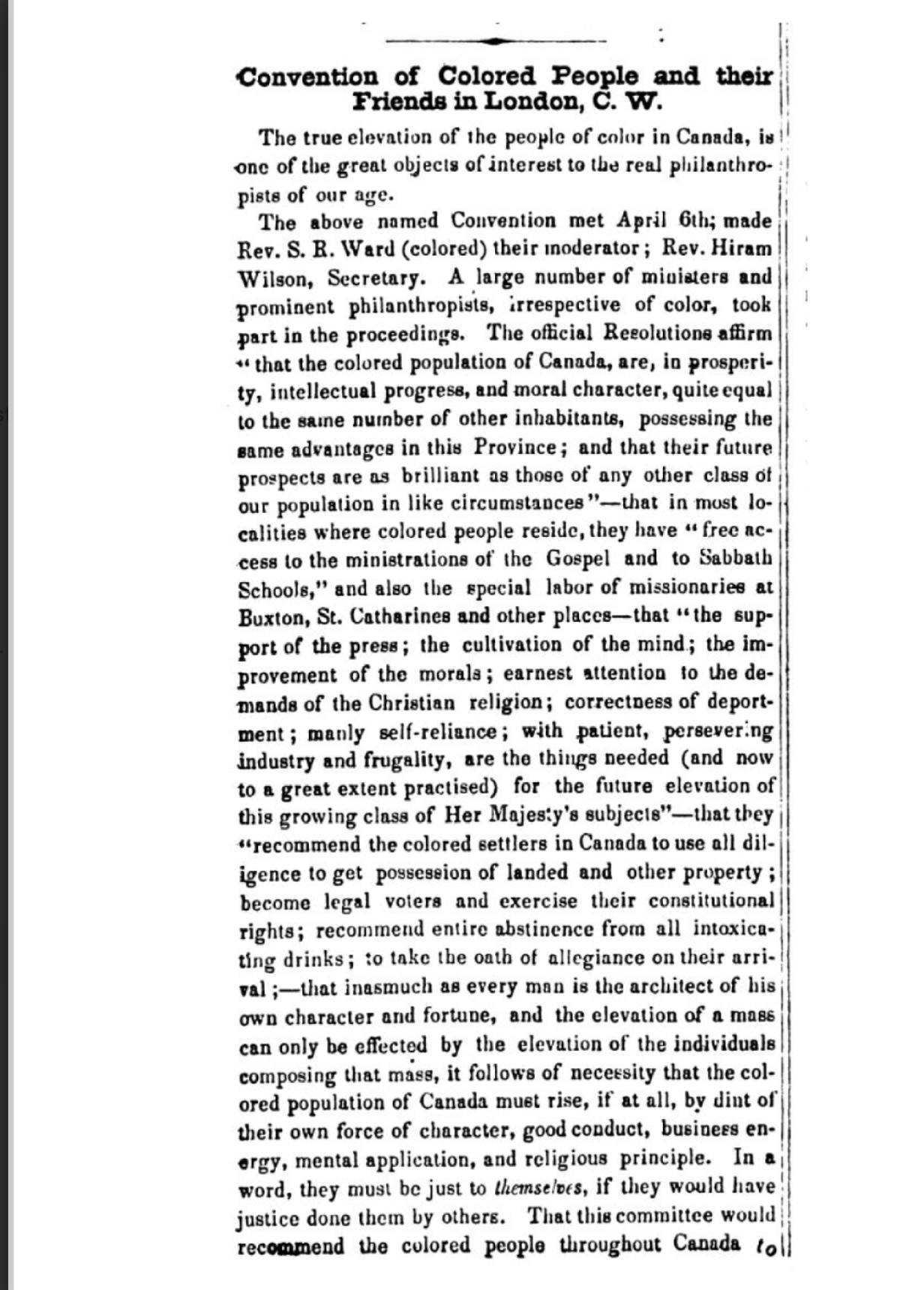
Before participating in the Douglass Day transcribe-a-thon for the Colored Conventions Project, I had very little knowledge on the subject. I had never transcribed before, and only a general understanding of nineteenth-century Black political organizing. I knew that Frederick Douglass and other abolitionists spoke publicly and wrote extensively. I also understood that there were gatherings and conventions that advocated for rights and freedom. I did not fully grasp the scope, organization, or intellectual seriousness of the Colored Conventions movement itself. Transcribing a document from the Convention of Colored People and their Friends in London, C.W. fundamentally deepened my understanding of how structured, deliberate, and forward-thinking these meetings were. The document I worked with reported on a convention held April 6th and described its resolutions concerning the “true elevation of the people of color in Canada.” Even in its old form, the language conveyed clarity of purpose. The convention appointed Rev. S. B. Ward as moderator and Rev. Hiram Wilson as secretary. It also noted the participation of ministers and philanthropists “irrespective of color.” The official resolutions stated that the “colored population of Canada” were equal in “prosperity, intellectual progress, and moral character” to others with similar advantages. Reading these words in their original form made their force feel immediate. This was not abstract history, it was a community publicly asserting dignity and capability in a world structured to deny it. One of my most important takeaways about the Colored Conventions movement is how deeply it emphasized self-determination and a collective uplift. The resolutions encouraged Black settlers to own land and property, become legal voters, exercise rights, avoid intoxicating drinks, increase their knowledge, and follow religious and moral discipline. The language stressed that “every man is the architect of his own character and fortune,” arguing that the transformation of the group depended upon the elevation of individuals. This rhetoric reveals both the immense pressure placed on Black communities to prove their worthiness and their strategic embrace of respectability, education, and civic participation as tools of survival and advancement. Transcribing these words made me more aware of the moral and political balancing act required in a society that judged them harshly. Before this experience, I also had a limited understanding of what it meant to work with digitized archival documents. I thought digital archives were just scanned images of old papers. Participating in the transcribe-a-thon changed that perception. I realized that digitization alone does not equal accessibility. The scanned page I worked with contained inconsistent spacing, unusual punctuation, broken words at line endings, and typographical irregularities that were likely due to the nineteenth-century printing practices. Without transcription, the document would be very difficult to search, quote, or analyze at scale. Transcription transforms an image into usable text and it bridges the gap between preservation and engagement. The act of transcription itself was far more demanding than I expected. I assumed it would involve straightforward typing, but it required a lot more concentration and attention to detail. Words were sometimes split across lines with hyphens, spelling was inconsistent, and certain letters were faint or smudged. For example, phrases like “manly self-reliance” or “business energy” were skewed by irregular spacing. I had to decide whether something was a printing mistake or a misreading on my part. There were moments when I had to zoom in repeatedly, compare letter shapes elsewhere on the page, and re-read sentences to determine whether a word made contextual sense. One specific challenge was resisting the impulse to “correct” the text. Modern readers are trained to fix spelling errors or smooth out grammar automatically. However, transcription requires fidelity to the original document. Preserving misspellings and outdated phrasing is part of respecting the historical artifact. I overcame this by reminding myself that I was not editing, I was witnessing. My role was to carry the document into the present as accurately as possible, not to modernize it. I also struggled getting on the website since it was very glitchy due to the fact that so many people were on it. Once I finally got onto the site and figured out how to transcribe it all clicked. Looking at the physical characteristics of the page such as the uneven ink, the cramped layout, the long blocks of text without the spacing we expect today, makes the labor of both the original printers and modern transcribers visible. The document’s physicality emphasizes that history is not just ideas but paper, ink, hands, and effort. Overall, engaging directly with this archival document changed my sense of relationship to the past. Reading a textbook summary of the Colored Conventions movement would have informed me, but transcribing a primary source made me feel connected to the individuals who organized, and passed these resolutions. I had to slow down and encounter their words at the level of individual letters. That slowness created a different kind of understanding, one that felt less distant and more participatory. The experience also highlighted the collaborative nature of historical recovery. The Colored Conventions Project relies on volunteers to help make these documents accessible. By transcribing, I contributed in a small way to preserving and amplifying voices that were historically marginalized. That realization reshaped my understanding of digital humanities work. It is not merely academic; it is an act of restoration. In the end, the transcribe-a-thon taught me that archives are not just fixed collections, but living spaces of engagement. The Colored Conventions movement emerged not only as a series of meetings in the nineteenth century, but as an ongoing conversation sustained by scholars, students, and volunteers today. Through transcription, I moved from being a passive consumer of history to a participant in its preservation.

Screenshot 2026-02-26 at 4.49.19 PM