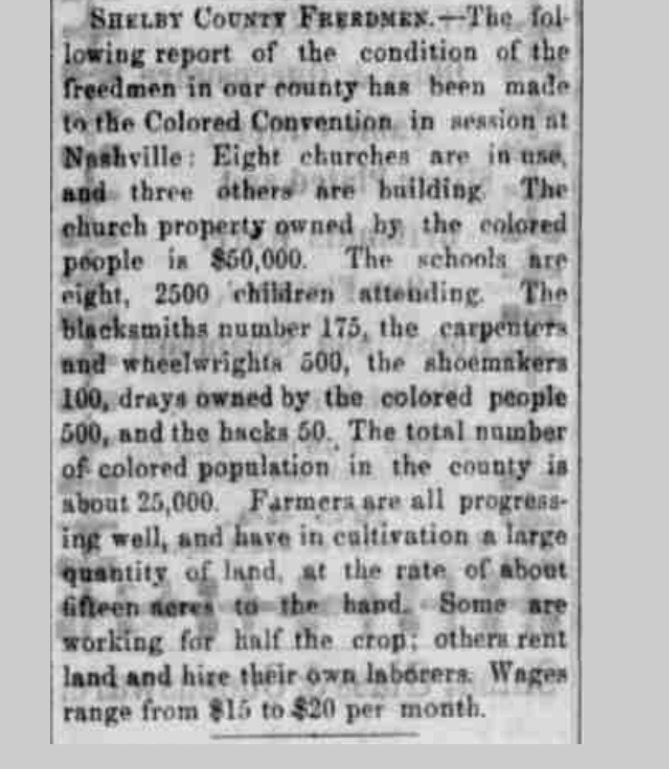
Before this, my understanding of the Colored Conventions movement was pretty surface-level. I knew it involved Black leaders organizing in the nineteenth century to fight for civil rights and equality, and I associated it with names like Frederick Douglass. But I had not really thought about how extensive or coordinated the movement was. Transcribing the convention proceedings changed that. For example, during the transcribe-a-thon I looked at a document that was a report of the freedmen in Shelby County.  These meetings were not informal or symbolic, they were serious and strategic gatherings. Delegates debated issues like education, voting rights, and economic opportunity with intention and urgency. Reading their words made it clear that they were not simply reacting to oppression, they were actively planning for the future. What stood out to me while transcribing these documents was how organized everything was. Motions were proposed, amended, and voted on. Committees were formed, language was chosen carefully, and seeing this unfold line by line made the movement feel very real. It was not just an idea discussed in class or summarized by a textbook, it was a living process, carried out by people who understood the stakes of what they were doing.
The experience also changed how I think about digital archives. I have used online databases plenty of times, but I have always taken their readability for granted. Working with scanned documents show me how much effort goes into making historical materials accesible. Some pages were faded or slightly damaged, the spelling and punctuation did not always match modern conventions, and certain words took a couple of tries to decipher. It made me realize that digital archives are not effortless or automatic, they are build through careful, and often invisible labor. Now when I use online databases with digital archives, I will remember just how much work and dedication goes into making something accessible for all.
Transcribing the documents was harder than I expected. I assumed it would be mostly a matter of copying text, but it required real focus. I had to slow down and look closely at every word, even when I thought I already knew what it said. There were moments where a single unclear word stopped me in my tracks. In those moments, context became extremely important. Reading surrounding lines, double-checking spellings, and sometimes just taking a breath and coming back to it helped me move forward. At times I would type quickly because I was able to read the document quickly, then when I went back to check my typing there were many errors. As a result of that, I had to go back, reread, and retype, so it took even more time. One thing I learned quickly was how tempting it is to “fix” the text (to modernize spelling or smooth out some of the awkward phrasing). But I learned that transcription is not about making the document easier to read, it is about preserving it as accurately as possible. Letting the document speak in its original voice felt important. Those small quirks in language are part of the history, which makes it easier to appreciate the document as a whole.
What surprised me the most was how connected I felt to the people behind the documents. Typing their words created a strange sense of closeness, almost like if I were listening in on their conversations from nearly two centuries ago. Their concerns did not feel distant. Issues like access to education, political representation, and economic fairness still resonate today. That realization made the past feel less like something finished and more like something ongoing. In this day and age, I think that is important for everyone to transcribe documents like these at least once. The hardships and issues that they experienced are being experienced today, but in a slightly different font.
By the end of the transcribe-a-thon, I did not feel like I just had completed an assignment. I felt like I had contributed to something meaningful. Helping turn fragile historical documents into accessible digital text made me feel connected to both the past and the present. It reminded me that history is not only preserved by famous figures or major institutions, it is also preserved by students, volunteers, and everyday people willing to spend time engaging with it.