Introduction
Our group picked the Ponds because he focused on the ever changing meaning of the water and nature around him which intrigued us and made us want to take a deeper look into that chapter. We chose to focus on paragraph 5 because it immediately stood out to us as it contained the most edits, it also started out as one or two sentences and then became one large paragraph. It ended up becoming one of the largest paragraph within The Ponds by the end of his last version.
Hypothesis
Our hypothesis is that Henry David Thoreau’s hard work that he puts into the water reflects the appreciation that he wants to pass onto other people to value nature. Thoreau’s continued edits of his own descriptions reflect an attempt to properly appreciate the purity of water and reach the same purity in his words.
Challenges
One of the challenges we faced when we first took a look at the different versions for The Ponds, was that versions A-C included no changes for paragraph 5. It only included section 5B in those versions which consisted of no changes, except for being retained. For us, we then decided to just take a look at versions D-G because these versions included the more crucial changes and additions that Thoreau made. Another challenge we faced was how version G had minimal to no change with the Princeton edition.
Comparing Versions
Version D to E
Between versions D and E of “The Ponds”, we see a good number of differences in section 5a-c. Thoreau made quite a few changes in each part of section 5, whether it was adding/taking away sentences or changing wordings and descriptions. While examining this section and its revisions, we are able to see the configuration of Thoreau’s piece, and make guesses as to why some text did or did not make it to the final copy. I focus on both the differences between versions D-E, and version D to the Princeton edition, both concentrating on section 5a-c. In version D, there is a section titled “5b”, almost as if 5a almost made the cut, but then last minute didn’t make it for this version, in which Thoreau decided to not change the name of the section. While in version E, there is a section with quite a bit of text labeled “5a”. Thoreau states in version D, “are generally from 50 to 75 feet high though in one place they rise to the height of about 150 feet”, when discussing the hills surrounding the woods. However, he decides to change up that wording in version E as he states, “The hills rise abruptly from the water & are from 40 to 8- feet high, though on the southeast & east they attain the height of about one hundred & fifty feet respectively within a quarter & ⅓ of a mile.”. This abrupt change makes the audience and myself wonder why Thoreau changed up this wording? Why did he change the measurements from 50-75 feet, to 40-8 feet? Why did he write the number out numerically in version D, but wrote it out as words in version E?
Version D to Princeton Edition
One thing that the Princeton edition has that version D of “The Ponds” does not include is a section of paragraph 5, titled “5a”. This was something that I first noticed when comparing the versions D and E together, and during the comparison of versions D to Princeton. While examining this section, and the revisions that made it into the Princeton edition, one finding was in section 5b. Version D states “in the midst of pine woods”. However, Thoreau changes it in the Princeton to, “in the midst of pine and oak woods”. Although this is not a dramatic change, it was still something that made us wonder why the few words and descriptions needed to be changed. Additionally, 5c also shows some changes, after analyzing some of the descriptions and formattings that were noticed when comparing versions D and E together. One of the major differences in D to E was the wording about the height of the hills, how the numbers changed and how Thoreau originally wrote the measurements numerically, but then wrote the number as words. In the Princeton edition, there is no description of the height of the hills, how far away they are from said location, and there are not as any descriptions of the surrounding environment as there is in version D. “in fair clear weathers” is what Thoreau describes the climate to be in version D in 5c, but the princeton states “in stormy weather”. As we analyze this we may wonder, what made Thoreau change the climate? Does he not remember and is just using made up information? However, the Princeton edition does describe water in more creative detail “vitreous greenish blue” and “crystalline purity” is what he uses to describe the water.

Version E to F
When looking at versions E and F, the most immediate feeling one may gather from looking over Thoreau’s edits, is one of uncertainty. In paragraph 5 Thoreau puts as much effort as he is capable of into attempting to describe Walden, a task that we see is no easy achievement. He goes from simple descriptions of colors, to these almost grand depictions of this body of water. An early example of this can be seen in an edit made while describing the Concord waters, in version E he presents them and states “All our Concord waters have one color viewed at a distance…” Yet, when we look over to Version F he now says “All our Concord waters have two colors at least…” This isn’t Thoreau correcting himself on a slight error, or misplacement of a word, it is him playing up the beauty of the bodies of water he’s attempting to properly appreciate. He further goes on to say that a bather jumping into the body of water would look “monstrous” and actively tarnish the beauty of the water. It is fair to say that this isn’t merely a compliment towards the inanimate blue liquid, this is a much deeper appreciation which we can see going forward in other versions. Each individual edit specifically from E to F speaks of frustration, and even moving forward into the Princeton edition, it is difficult to tell if he truly reached a point of satisfaction regarding the description of Walden.
Version E to Princeton Edition
It’s difficult to tell if the changes from version E to Princeton mean Thoreau found a final answer to the question of how to describe this area. One large issue though is that it is incredibly difficult to mark this end of journey moment as satisfactory. As provided to us by Professor Schacht, there are other pieces of writing by Thoreau which further add on to this same paragraph and only add on more descriptions! The leaves which we can’t find in the fluid text version mark other steps of the journey, and perhaps serve to show us that this journey isn’t one with a clear end. Thoreau is a writer that puts an incredible amount of thought into each description and values his clarity above all else. “Like the rest of our waters, when much agitated, in clear weather, so that the surface of the waves may reflect the sky at the right angle, or because there is more light mixed with it, it appears at a little distance of a darker blue than the sky itself…” This type of description and the love involved is part of why we find ourselves discussing Thoreau, it is a unique form of appreciation that we sometimes struggle to find. Regardless of if Thoreau’s attempt at describing Walden was truly successful, the effort put into reaching a satisfactory level of clarity is vastly important to appreciate. Walden, no matter if green or blue, or how it is affected by the weather, is to thank for some of the most direct and focused effort in describing nature.
Version F to Princeton Edition
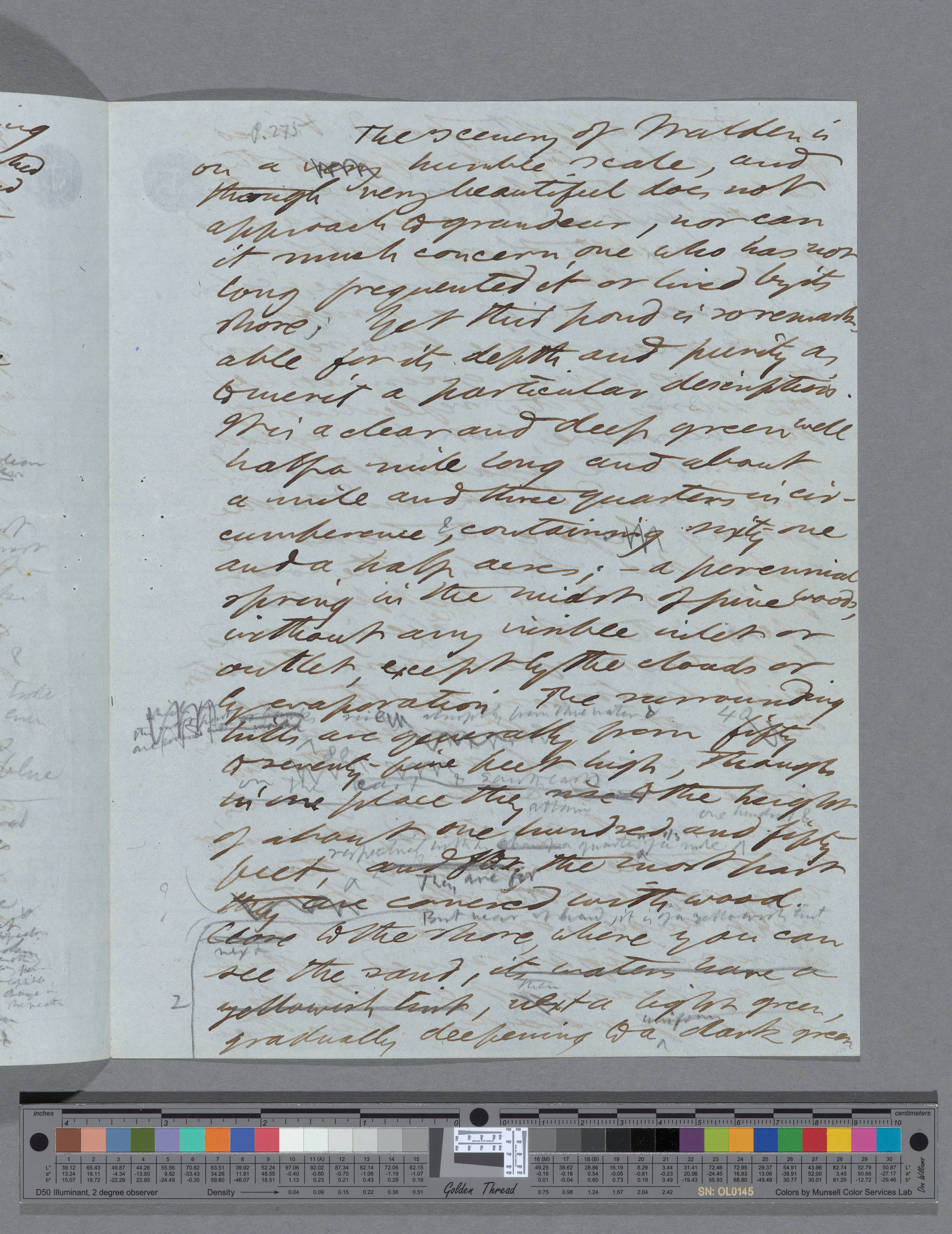
Many of Thoreau’s changes he makes tend to be for clarity and organization, which I noticed quite a lot in version F of paragraph 5. He is always adding and changing words out throughout this version, but in section A it was written in E but rewritten in F for that sense of clarity. For example in section A it only included one sentence that was a minor critique. I think the small critiques he made were to create that clarity. The change that was made was, “The scenery of Walden is on a very humble scale, and, though very beautiful, does not approach to grandeur….”. The word highlighted in red was a cancelled text in this section. I believe the word “very” being taken out made the sentence run more smoothly, as the emphasis it added before was unnecessary. Next thing I noticed was splitting a sentence in section “a” that became the entirety of section B . I wonder why the sentence was broken up to create another section because This section consisted of 1-2 lines that were describing the view he saw of nature during spring. It also consisted of minor changes like “or by”, that was cancelled out and changed with “and”. The “And” was interlinked with ink, so I think this change is where he went back to a word he wrote because it flowed much better than the “or by”. In this section that inlerinked word, along with the “and oak” are part of a missing leaf. Section C was a very long section that contained lots of edits and words that were interlinked with either ink or pen. This section was written in Version D and rewritten in both E and F. A major change I saw was a large paragraph being taken out, it contained descriptions of water, earth, and nature. Part of me was confused why he would do that at first because throughout Walden he always uses a descriptive choice of words which this section contained. This change was made in version D but it is said to be retained in version F. This cancellation could be for clarity as the sentences were very long and potentially it could have made it feel unnecessary because he continues to discuss the water right after, including the weather. I wonder if he felt as though he was repeating himself or even the way he wrote involved too many words and symbolic ideas that lost the true focus he was getting at. Even in the rest of section C, he took out many small parts of sentences which I want to believe is for clarity and descriptiveness of his writing because he did always take such care in that part of his writing. As well as parts being considered as interlinked with ink or pen but other than that no major things being changed except those smaller words being changed for clarity. He takes care and pride in his choice of words which is why in this version he continues to edit words to make sure it has 100% clarity and the focus is maintained.
Version G to D
Between versions D and G, several notable revisions reflect both stylistic refinement and deeper thematic development. Version D is missing the entirety of section 5a, a significant omission that is fully present in Version G. One major change is the more elaborate and nuanced description of the pond’s water in Version G, which emphasizes the gradation of color from the yellowish tint at the shore to a dark green in the deeper areas, with additional attention to how lighting alters its appearance. In contrast, Version D provides a simpler color contrast “blue in the depths and green near the shore” without the same depth of visual detail. G also deletes part of a sentence found in D, removing the phrase “Some have referred the more obvious greenness next the shores,” perhaps to streamline or reframe the observation. A new addition in G offers a speculative explanation for the green tint, suggesting it may result from the interplay of the prevailing blue water and yellow sand. Subtle changes in phrasing also emerge: “Like any water” in D becomes “like the rest of our waters” in G, and “The water of the river” becomes “The water of our river,” indicating a shift toward a more personal or communal relationship with the landscape. Version G further formalizes the text by spelling out ampersands (e.g., “and at such a time…”), though retains one instance (“being on its surface, &”) in ink as part of the drafting process. Interestingly, G later reverts to D’s original phrasing in the description beginning “It is well known likewise that,” suggesting a selective process of revision aimed at balancing new elaboration with the clarity of earlier expressions.
Version F to G
In this comparison of F and G, I noticed that section A and B were the same changes but there were lots of parts in G of those sections that had more of the words being highlighted as assumed to be retained. I wonder if because this was his last version he wrote, he just was writing minor changes for clarity or focus would mean he would not include every little detail of the last version. As all of the changes he made or words that are considered interlinked were the same in version G so maybe because this was his last version he had less changes to make from version F. With that it makes sense why more of verison G had retained because he didn’t need to make any more changes. With that being said G looked very much like the princeton version which makes sense why I couldn’t see much difference from F and G. I wonder why he would write another version if there were no major differences because he finished F in 1954 and also finished G in 1954. I wonder if he felt the need to do version G to make sure he had that clarity and focus for it to become the full version.
Version G to Princeton
There appeared to be no significant revisions between Version G and the Princeton edition. Most edits were minor punctuational revisions. Overall, the changes between these versions seemed to be motivated simply by the movement towards formal and finalized punctuation and structure.
Conclusion
What we can gather from our interpretation of the edits Thoreau made in this paragraph is a point we find somewhat commonly when regarding the majority of his writing. He values clarity, and when dealing with the beauty of the nature surrounding him, strives to describe it in a way which preserves that beauty. In this case specifically, we can see just how much he values Walden and how important a proper description of it is to him. Walden, in its beauty and purity, becomes such a strong focus for Thoreau, and as we’ve attempted to show–is something of an end-goal for him.