Walden: In practice…

I want to start this by saying I have never been more aware of my goldfish-level attention span than during the process of collecting data for this assignment. I also learned a lot about where my train of thought goes and why it goes the way it does. I think due to my psychology classes I’ve taken, I should’ve been way more aware of my brain activity in general, but nonetheless I will discuss my findings.

Parallel Distributive Processing

From what I can remember from class, Parallel Distributive Processing is the mental map your memory uses to determine the meaning of different stimuli that your senses are intaking. This means when you see, for example, Snoopy in a Charlie Brown cartoon, your brain is sorting through everything it already knows to figure out what you’re looking at. The ‘parallel’ part means its making these connections all at the same time until it finds what it’s looking for. The train of thought might be dog -> beagle -> cartoon -> peanuts art style -> snoopy. Or, some people might notice that it’s a Peanuts art style first, and then identify Snoopy based on that starting point. Most people make a web of all their prior knowledge thats relevant to the stimuli almost immediately and all at the same time. This makes it very hard to track a single flow of attention, but I have tried my best.

To What Extent Was I Able to Live Comfortably?

My personal approach to collecting data was to set aside the hour of 8pm-9pm everyday for a week to record my attention that way it was more consistent and I wasn’t torturing myself being 100% mindful of distractions all week, although I can say that it did make me crazy even not during that hour of the day because I did end up being CONSTANTLY aware of it. So that was a fail. Honestly it made that hour of the day really unproductive because I kept either stopping what I was doing to record something in my journal or I was following a rabbit hole on purpose because something interesting had caught my attention that I normally wouldn’t have pursued. For example, I spent ~15 minutes googling the effects of plants on productivity because I had noticed I was zoning out a lot looking at the plants around me in Bailey. From my journal:

"zoned out lookign at the fake plants in bailey a lot. why are they even here if theyre fake?? would just get back to work but i might as well look it up. ok looked it up- apparently plants increase workplace productivity by 15%, but thats coming from a website that specializes in designing plants for workspaces soooo reliable prob not but maybe. did not doubl check. went back to my work."

I honestly don’t think distractions like these took away from my autonomy or comfortability at all because if anything I was engaging with my train of thought instead of shutting it down for the sake of mindfullness.

Navigating Digital Enviornments Going Forward

This assignment has made an immediate and lasting impact on how I navigate both real life and digital spaces, as you’ve already read. I walk through life with a much more mindful approach now, I even set a time limit for my social media apps because that kept coming up in my data as a distraction. Specifically, Instagram was mentioned the most times, with Pinterest as a close second, and Tiktok as the third. I am very grateful for this opportunity and this class as a whole.
Douglass Day Thoughts

What I transcribed

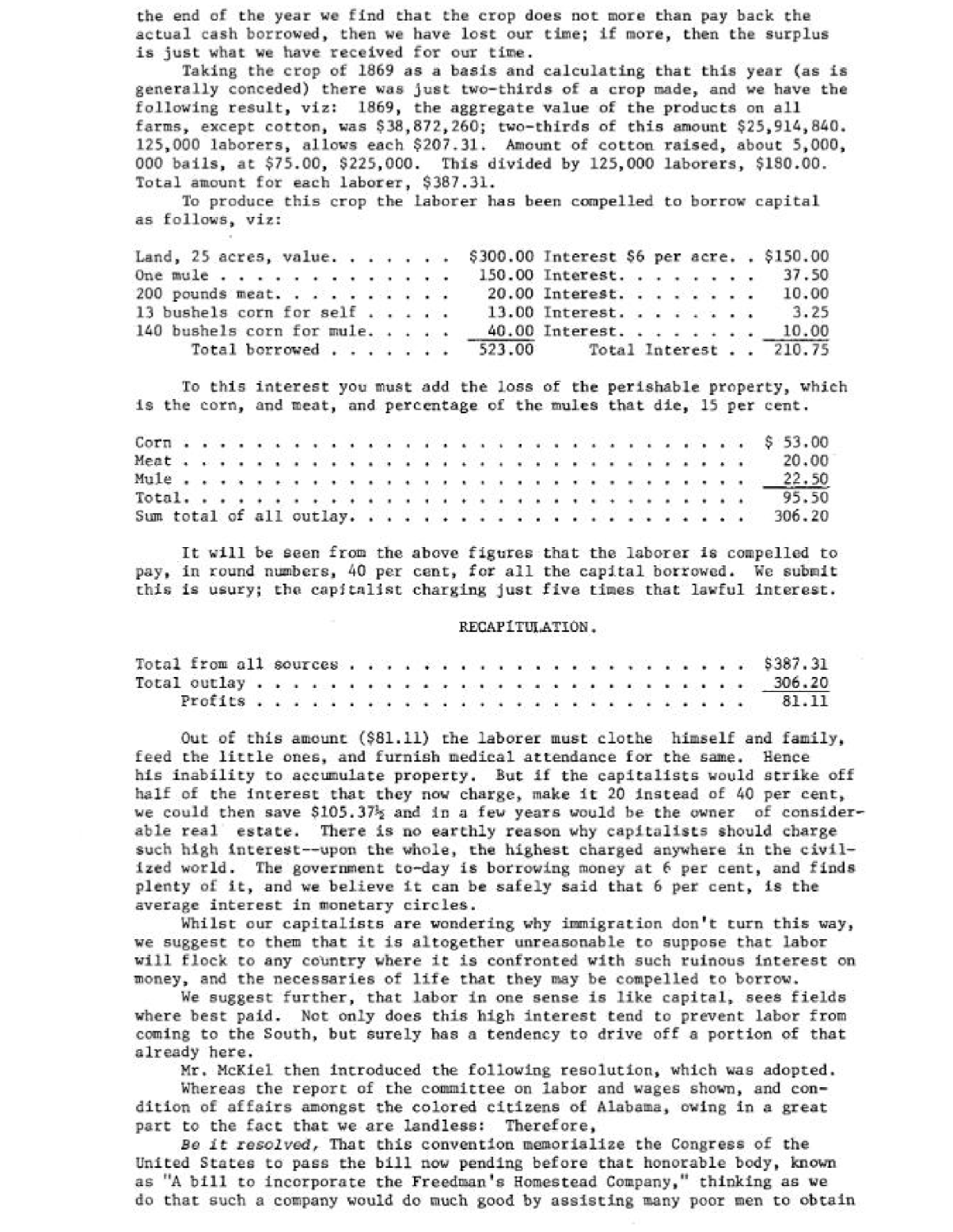
The most interesting document I transcribed from the Colored Conventions Project was a document establishing the Alabama Freedmans Homestead Committee.

An image from the Colored Conventions Project

In the document, the author breaks down the cost of living for the average “laborer” on a farm, and how much of his income gets taken from him due to high interest rates on materials he borrows in order to work the land. These include the land itself, food for the laborer and his mules, and in addition he gets charged 15% more if anything he uses is perishable. In total, there is a 40% loss of income. The author points out that this is not enough money to feed, clothe, and take care of a family’s medical needs. Therefore, this type of salary prevents any generational wealth from accumulating within black sharecropper families.

What I learned from transcribing and working with documents

From going through the line by line process of transcribing the document, I spent a lot of time with it. Especially the dollar amounts took up a lot of my attention because there were so many numbers and periods. This time spent with the document was very valuable because it enhanced my understanding of just how unequal the sharecropping profession was due to the painstaking process of transcribing and proofreading to make sure everything was recorded correctly. Rather than a quick readthrough, physically typing out the amount of money that was taken from these hardworking people made it all the more impactful. I also learned about an effort to help black Alabama families become homeowners that I wasn’t aware existed before the transcribe-a-thon. Unfortunately, the document cut off before I could learn what specifically the organization did to help this problem, but I was able to find out that the motion passed successfully and the Freedman’s Homestead Company was established with the help of congress. I feel so much more personally connected to this piece of history now that I helped to record it, and more invested overall in the history of sharecropping in Alabama. After typing out all those numbers they became much more real to me, and made me angry that the plantation owners were practically robbing them and sending them into debt because they were stealing 40% of the profits.

Although a silly observation, I have no experience transcribing, so the entire experience was new to me. I also learned that there are lots of different ways that information can be recorded both digitally and on paper. It took extra effort to record a list, for example, as opposed to a regular sentence, due to the formatting on the list.

What I learned about the history these documents embody

I learned more about the historical relationship between slavery and capitalism as a result of transcribing these documents. Over time, as I was transcribing documents I saw the development over time from slavery into ‘sharecropping’ after slavery was abolished because of the Civil War. With sharecropping slavery was essentially allowed to continue as normal, except actually making the slaves’ debts worse because now they owed money for using supplies. The people were still enslaved and exploited just in a different form that was technically legal. In this new system the familes working on the plantations were free on paper but really still owned by the plantation owners because this needless debt was held over their heads. The document about the Freedman’s Homestead Company highlights how this system maintained the type of second-class citizenship from traditional slavery because it prevented families from accumulating wealth, the key to social mobility.

How I see things now

I am frustrated that sharecropping was so deeply normalized because looking back at these documents now shows how insane the system was. Taking 40% of someone’s hard earned money feels deeply unfair to me, especially when considering the reperations that black people were intitially supposed to recieve. Forcing them to pay for the land, the animals, and the tools needed is a crazy concept when they were supposed to recieve 40 acres and mule as reperations specifically to assist in helping regain social mobility and economic power. I have a better understanding of the ways that capitalism uses marginalized groups to keep the machine going, and the ways that it reinvents itself to continue that goal, specifically in the United States.

Additionally, reading about the efforts of the Freedman’s Homestead Company combined with my already existing knowledge of different abolitionist groups gives me hope for progress. There were people who saw racism for what it was then, and there are now. Just because something is normalized for the time, doesn’t excuse the behavior, because especially marginalized groups deserve equitable treatment and an equal chance at success.