Walden-Between the Lines

Beck Fox, Skylar Riedell, Jaidyn Vorpahl

Introduction

“Brute Neighbors,” as its name would suggest, centers around the “neighbors” Thoreau had in his cabin property. It is no secret that Henry Thoreau had a deep respect for the natural world and the wildlife around him. The cabin gave him, so far from the hustle and bustle of a town that moved too fast for creatures of such a natural world to want anything to do with, a chance to become particularly in tune with the animals and the wildlife that he came across, particularly the wilder kind that have not been integrated into civilization. This could range from interactions with these creatures as they occasionally made their way into his house to appreciative and thoughtful observations on how their different minds could work. There are mice that occasionally sneak into his cabin or birds that make their nests near his wild living space. Thoreau considers himself lucky to be so close to creatures that may otherwise go their entire lives without ever being seen by mankind. For our purposes, it is a recount of coming upon a mouse and a mother bird that we take the most interest in.

Version A

Ground Bird Story

In Version A, paragraph 9, Thoreau describes two experiences that reveal different aspects of nature and his relationship with it. First, he tells the story of finding a bird’s nest in the path of his plow, which he moved in an effort to save the birds and their nest. However, after the nest was moved, the parent birds abandoned the babies, leaving them to die. Through this story, Thoreau seems to suggest that although humans try to help nature, we don’t always fully understand it or know what is best for it. After telling the story of the birds, Thoreau shifts to an experience with a mouse. At first, the mouse is fearful of him, but the mouse eventually gains enough comfort to eat cheese out of Thoreau’s hand. This interaction displays a more intimate and trusting side of nature by showing the connection that humans can have with animals. While describing the mouse, Thoreau compares it to other creatures, like squirrels or flies. These comparisons suggest that he sees commonalities among different living things and recognizes the ways that animals and humans interact with the world around them.

Mouse Story

Version A does not ascribe to the later manuscript editions’ chapter organization. In this manner, what became “Brute Neighbors” paragraph 9 initially followed “Spring” 25b. After writing his recollections of the field mouse, Thoreau returned to this leaf to pencil in the story about the downed nest. This may have been done to ease the transition between “Spring” 25b, which discusses the birds of Walden pond, and the closer nature encounter with the field mouse.

Version E

Paragraph 8

In Version E, paragraph 8 is seen for the first time, where Thoreau questions animals’ existence and purpose. He seems to be thinking about animals’ place and responsibility in the world and their role with one another and with nature itself. This leads him into paragraph 9, which introduces his experience with the mice. In earlier versions, paragraph 9 included both the mouse and bird stories. In Version E, however, Thoreau removes the bird story and focuses solely on the mouse. In the manuscript, the bird story is written in ink, while paragraph 8 is written in pencil between those lines. Because of this, it is unclear which section was written first, and both possibilities can be argued. The reasons to believe the ink came first are that the rest of the page was written in pen, so he probably wrote the whole page in pen first and added the pencil later; the pencil is also written pretty precisely between the lines of the font, which makes it seem like it was added with the knowledge of how the pen was formatted; the font size throughout the page is the same in the pen, and the pencil-written font size is much smaller; and the transition from Thoreau’s musing about the society he left in paragraph 8 to his firsthand experience with animals is much smoother. Paragraph 8 was likely included as a direct replacement for the original transition phrase, which dealt with Thoreau’s appreciation for nature despite being a hunter. This is clear because this phrase is actually separated from the rest of paragraph 9’s text that got deleted, which was about Thoreau attempting to save the nest of a ground bird. While dissecting Walden, we went back and forth on which possibility seemed more likely, but we ultimately decided that we believe the ink came first and then the pencil.

Bird story

Meanwhile, the ground bird story as a whole was probably deleted because the story with the mouse simply got the point of Thoreau’s compassion across more. The story of the mouse simply details Thoreau feeding a mouse that happened upon his cabin. The ground bird story mentions Thoreau moving a ground bird’s nest out of the way so he wouldn’t plow it, only to find the birds were still doomed as their parents had abandoned the nest. Not only is this a useless story to add within a paragraph revolving around compassion, but it is also possible that Thoreau accidentally doomed these birds by misplacing the nest, and didn’t want to put his mistake in the paragraph about compassion.

Mouse Story

Experience and Challenges

One of the biggest challenges while working on this project was the manuscript itself. Thoreau would frequently move sections of his writing around, interline them with pencil text, or cross them out entirely. Page 784, from Version E of the manuscript, contains an entire section of ink that Thoreau brought over from “Brute Neighbors” paragraph 9 in Version A. This section was then interlined with the pencil text that became paragraph 8 and eventually crossed out entirely as Thoreau grew tired of it. Although a great window into his creative process, it also left the manuscript page chaotic and hard to understand. In places, the text overlapped with itself, and words—written in Thoreau’s spiderweb-esque handwriting—often became illegible.

Another challenge we had was interpreting why Thoreau made certain revisions. It was hard to keep track of what he changed throughout different versions, but it was a whole different challenge to interpret why he made those changes. Thoreau’s writing tends to be pretty abstract, and sometimes even identifying the point he is trying to make in one version is hard in and of itself. But when it came to not only interpreting what was being said but also interpreting his revisions and why he made them, it was very challenging. It’s also hard to narrow down our best theories as to why Thoreau made the revisions he did, because sometimes there are so many possibilities.

One small blessing was the presence of the Walden fluid text. Referencing the existing transcriptions was the difference between total confusion and understanding. Words in Thoreau’s script often resembled others (“and” and “sod” being a common issue for me), and the fluid text offered needed clarity. However, the fluid text itself is not without flaws. Consistency in transcription style was at times lacking, and some minor edits were missing completely. In these cases, someone more familiar with the manuscript was consulted to decipher the text.

That being said, sometimes referencing between the fluid text and the manuscript proved to be a nightmare. The fluid text tended to lump things together based on where they ended up in the final version of Walden. However, they would actually be in an entirely different order in the manuscript, so actually finding the manuscripts would always be a struggle. One example was struggling to find where the opening sentence to paragraph nine was, only to find it smack in the middle of the paragraph within the script, in incredibly small and hard-to-read pencil.

example

How does our attention get pulled away?

It is no secret that we live in an age of distractions and short attention spans. “Doomscrolling,” the word for finding yourself sucked into social media for much longer than you ever intended to be, is a household word at this point that just about every single person has experienced. In all fairness, most of these distractions, social media or otherwise, are literally designed to keep your attention. You are motivated to keep going through those little dopamine rushes that most of us are also becoming aware about. However, we certainly have motivations to not get distracted, especially since most of us are in a college environment. We have grades to think about, and a limited amount of time in our days most of us would rather spend with friends. How often do distractions actually win out, and how much are we enabling these distractions?

Procrastination

In my personal experience, I find myself most vulnerable to digital distractions as a form of procrastination. If there is something I do not want to do, then I am more likely to spend more time on my phone or more likely to pull up a sudoku puzzle on my computer instead of reading the Walden text that was on my screen before. This only gets worse if it is an assignment that I feel like I am going to have a particularly hard time on. I am going to dread the extra amount of work, but I do know that I still have to start it at some point. This is where I give myself the digital distractions that I do agree to attend to. They are the limited distractions that have a time limit. I will only do the amount of sudoku puzzles that are available in the New York Times. I will only scroll on Social Media until my screentime count kicks in. Are these time consuming and distracting? Absolutely! But they are distractions that I am actively allowing myself, as I do enjoy them and because I have the belief that they will end. I am living my life under the dictates of the distractions I allow myself. Unfortunately, the one that gets out of hand is the screentime one. It is where I fall victim to a trap that a phone has set for me. See, when you set an app to only give you an allotted amount of screen time every day, and that time runs out, the phone does not immediately kick you out of the app. Instead, it gives you four options. Only one of the options will shut the app. The other three options allow you to extend your screentime, as well as to shut off the screen time limit for the app for the rest of your. All it takes is a simple thoughtless tap. Now, yes, when I am making the choice to extend these times when I tap “fifteen more minutes,” which I especially do when dealing with a particularly threatening assignment on the horizon and want to reset that timer. However, this choice is made under deliberate pressure of someone who designed this option, who most likely did so with the intention of making it easier to override. People who have screentime limit most likely due so because they have trouble self-regulating, so making the option to override is able to be done so thoughtlessly makes it feel like an intentional trap. A more concerned part would have made override more difficult, like having to go directly to “Settings” to override it, so a user would be forced to give themselves a moment to think about what they are doing and possibly change their mind. The current design is deliberate pressure intended to keep me distracted.

What makes an assignment seem intimidating or easy to get distracted on?

Now, I tend to allow myself distractions on certain assignments more than others, which is interesting. I had a heap of assignments, both intimidating and not, last week, so it was pretty easy to analyze why that is. The assignments that are always the least intimidating are usually the reading directly from the modules in this very class, English 340, such as the IIIF Images module from last week. These are the assignments that I never had trouble starting or finishing. I think this is because they were usually pretty short, so it was easy to hype myself up and get them done. More than that, they usually came along with instructions to follow on VHS Code as you read, so they kept one engaged Another assignment that I do not get distracted during is reading out of a physical book, particularly a novel. I am attempting to read the novel Muck for my Bible as Literature class without getting much of a schedule, but I am reading two chapters a day without any distractions. This is because I enjoy reading, and because it actively takes me away from any screens that may want to take my attention away. The assignments that are intimidating and that I find myself getting distracted by are two particularly difficult reads that happened to be on my schedule last week, and pretty regularly. This is Walden and the Bible. They are intimidating because they do not keep my attention. They are rambling and repetitive, and though I can see the beauty of their ideas, I know it is going to take more focus and effort to read them than I am occasionally willing to give. It is being bored in an assignment that makes me open to distraction in this case, but I would say that getting distracted during these texts is certainly more something I agree to do than hesitating to start them, even though both are common. The absolute worst offender of intimidating assignments are newspaper articles. I am member of the Lamron, which usually means I am writing at least an article weekly. Last week, I took two articles, one of which was in the News. You need a lot of sources to write for News, and rightfully so, but that means these articles come with a lot of research. That makes it daunting to start, and when you actually start writing, it is so easy to get distracted by the random questions that pop into your head when your cursor is already at the search bar.

Distracted from Distractions

Here is a fun little corner I ended up backing myself into last weekend. Feeling burnt out from both social media and my workload, I made myself a little deal. I would start my homework after I finished a drawing I had been wanting to make (“It is not procrastination if it is productive!” What a beautiful lie we love to tell ourselves as we clean our dorms to avoid that essay). Now, that is not a “digital distraction,” but it was certainly one that I agreed to attend to. At least, for the most part I agreed. In an ideal world, I would have sat down, finished my drawing in a timely manner, and moved right along to my homework feeling refreshed and rejuvenated. Unfortunately, I encountered a problem because of the fact that I usually use reference photos while I draw, so my phone was right next to me and I was glancing at it quite a lot. This made it easy to distract myself in the same way I could while researching for an article. I am already on Google, so what’s the harm in typing in that one random question that popped into your head, and accidentally falling down that rabbithole of link after link that has nothing to do with the task at hand.

In conclusion, it seems like knowing these distractions are available makes it harder to ignore them. If your screentime reminder is giving you the option to ignore it with just a tap, of course it is easy to say “fifteen more minutes”. If you are already doing something on your computer, and your not having a great time, you start to notice it would be so easy to switch tabs to a little mindless game online, and voila, you are stuck. A lot of it comes down to self-discipline, but we are also living in a world where phones and computers want you to waste time. It gives them money, so of course they are going to make it easy. We are living our lives under the pressure of these distractions, and we have to make an effort to be conscious of where we are putting our attention.

Jumping into History on Douglass Day

Just recently, I was called by duty of class credit to participate in the annual Douglass Day celebration! This turned out to be an excellent opportunity, as I knew precisely nothing about the event, nor about the Colored Conventions Project, or even transcribing documents in general. Luckily, I learned a lot!

What is Douglass Day?

This holiday is meant to commemorate the life of Frederick Douglass, a very famous leader of African-American Rights. Although he did not know his own birthday, he chose to celebrate it one Valentine’s Day, so the event takes place just the day before his decided birthday. The event is hosted by the Colored Conventions Project. The organization is named after the real “colored conventions” made up of largely African American people. The conventions were political meetings that started with the hope of getting African Americans more rights in the United States, and in Canada. Frederick Douglass attended a few of these meetings himself. An event is hosted by way of a livestream on Douglass Day, and includes speakers on the history of colored conventions and their meanings, a bake-off on who could make the best birthday cake for Frederick Douglass, and even singing happy birthday. Of course, most of the stream is time dedicated to time spent transcribing documents on these Colored Conventions.

The Main Event- The Transcribe-A-Thon!

The vast majority of the event consists of the transcribe-a-thon. This is, well, it is exactly what it sounds like. From their organizations that are hosting the event, or possibly even people who are simply tuning in to the stream from home, people log into whatever site is being used this year for Douglas Day, and find a bunch of documents that seem to be a series of records from different Colored Conventions meetings. They use the time of Douglass Day to transcribe these documents, typing out word for word exactly what these documents said. This was very different from what I thought transcribing was. To be clear, I did not even think that one needed to transcribe documents that were already digital before partaking in this event. It hadn’t even crossed my mind that one would be someone typing out what was already visible as a picture on the computer screen. Upon actually participating, I realized how silly of an assumption this was. First of all, a lot of these documents were marked down in handwriting. While I was lucky enough to avoid coming across any documents like this, the rules listed on the official Douglass Day website imply that there are quite a few. This means a lot of people could find it tricky to read, especially if it happens to be cursive. I think that most people would agree that any good old serif font is much easier on the eyes than any handwriting, no matter how neat it may or may not be. On a similar vein, even if the majority of these documents were properly printed in something that resembled text, they were still pretty old. The ink might have run in a couple of these documents, which is another reason why they might be harder to read. These are just a couple reasons why it is good to have these documents typed out so that the wider public can access them without too much of a headache. Even better that enough people participate in Douglass Day that these documents can have multiple pairs of eyes looking at them, just to better the odds of getting the correct transcription written down. Clearly, if I did not even realize this type of transcription was a thing, I certainly did not know how to do it. I honestly felt like I was thrown into the deep end when I first sat down, expected to type out these documents. Luckily, it was not too hard to pick up. Geneseo has its very own website to guide any students new to the event through what was expected of them, so all I really had to do was follow the steps. Unfortunately, that does not mean there were not a few hiccups on the road to discovery.
This year, the documents we were meant to be transcribing were found on a website known as Zooniverse. The trickiest thing I really had to face was remembering to mark down all the names I found, and remembering to do so in a certain order. Geneseo’s website recommended separating them by semicolons, and remembering to mark down any titles. It is not the hardest thing on paper, but there were times when I was in a flow and had completely forgotten to write down a name, or wrote down the same name twice and later had to fix that. Overall, though, it was a pretty great experience. There is something exciting about having to figure it all out without being explicitly told. I learned a lot, and it was nice to be a part of something bigger than myself.

What did I learn about Colored Conventions

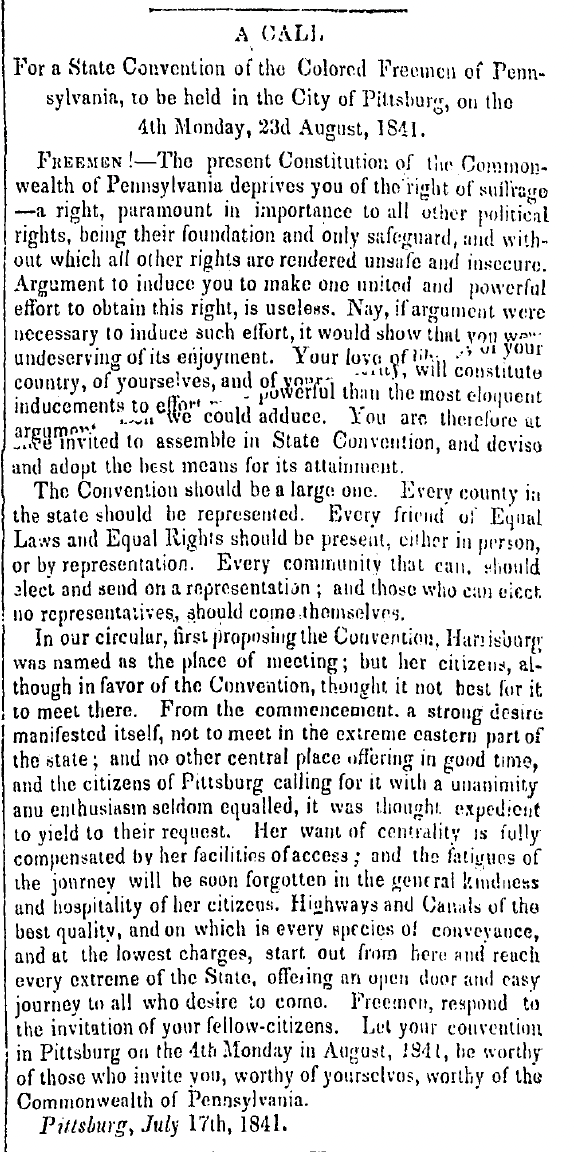
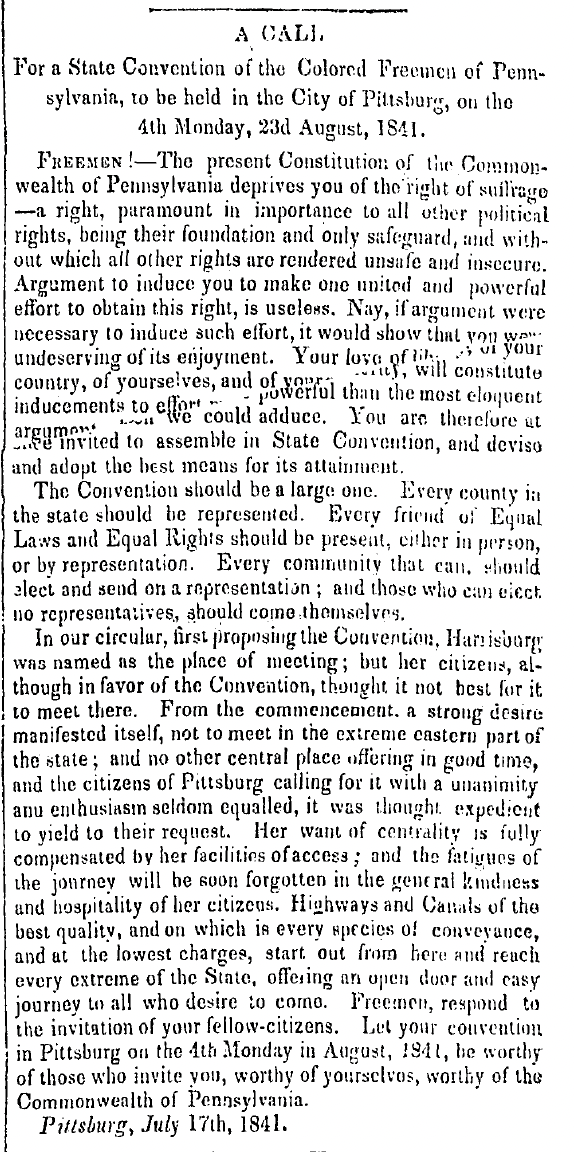
I transcribed a few document the Pennsylvania section. Non of them are the one pictured in this post, unfortunately. There were a few problems with the webstie to prevent me from getting that, but the picture is a good idea of the type of documents we were working with. I learned an array of names, and vast amount of people who attended these colored conventions. I also learned of a precedent that many people about to enter a position of politcal power may have believed in equal rights in terms of voting, but kept quiet about it for a better chance of election. This led to a pledge in one of the Colored Conventions that the member would not support any candidate who was not sure to support equal voting rights.

For The Blog Post!!