Animals in Geneseo’s Arboretum

Mother Nature is always around us even if we are blind to it, and she can take on multiple forms. These include, but are not limited to, trees scattered randomly around a city block, birds singing songs in someone’s backyard, a local park with bike trails, or an entire national park that fills tourists in awe with each visit. In our seemingly rapid-paced and money-chasing society, it can be easy to forget to slow down and appreciate her beauty. Spending time in nature allows us to relax and process the world around them, both externally and internally, as well as learn new things about ourselves and the natural world.

The Arboretum

I made my own nature-based observations while traipsing through Geneseo’s Arboretum, which was located just beyond the residence halls on the south side of campus. Upon entry the trails were all hidden from view, but next to a wooden bench, I found the entrance to a trail marked by yellow arrows. I attempted to follow the trail completely, but about a quarter of the way down, the path was covered in mud. My shoes, lacking the proper traction, made it hard to continue, until I found a drier trail at an intersection. Despite this, it was a very quiet and peaceful escape from college.

The majority of my observations were of animals, especially birds. I found it surprising that, although the nature trail itself was not too far away from civilization, there was quite an abundance of wildlife. Watching them required me to focus inward on my immediate surroundings and ignore the road just beyond the trails. Every time a truck drove by, producing a cacophony of sound, or I took out my phone to take a picture, the animals would disappear entirely and I would lose track of them. These animals were: three turkey vultures circling above the tree canopy, a goldfinch, with winter plumage, flying from one tree to another, two crows ducking in an out of the trees following each other, a rather adorable and small garter snake from underneath a wooden bridge, and two 2 robins hopping in the shrubbery with near perfect camouflage.

Specific (and fascinating) animal obervations

The two crows were probably the most fascinating to watch. They were following each other through the treetops silently, twisting and turning through the branches. If I was really quiet, I could hear the flapping of their obsidian wings, which only added to the wonderful display. It was truly mesmerizing to watch these black birds carry out their airborne ritual, though I was unable to record it. Unfortunately, the experience was cut short by a truck thundering along on the road behind me, which distracted me completely from the birds. When I looked back at the trees, I could not find them at all. However, I heard the calls of crows throughout my hour-long nature-walk, and I wouldn’t be surprised if they were hiding somewhere in the trees, talking to each other.
Entrance to Arboretum
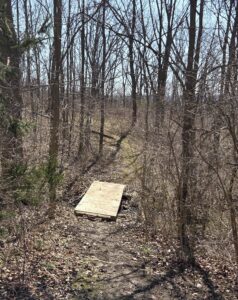
Entrance to Arboretum located near Suffolk Hall

While wandering around, and seeing where the path led, I found another entrance to the Arboretum down the road near Suffolk Hall. It was located on a downhill path that curved towards the bottom, before leading to a small bridge made of wooden planks flowing over a small stream, as shown above. When I re-entered, after seeing what lay beyond the exit, I crossed the same bridge to return to the trails. When I was halfway across, I heard a strange rustling sound from beneath me. What greeted me, or crept away from me, was a little garter snake fleeing from the noise my feet made. I’ll admit that I found it adorable to watch the tiny snake, who was probably afraid of the two-legged giant, slither towards the jungle of dead leaves and tree-roots that surrounded the stream. However, after looking away to open the camera app on my cell phone to snap a picture of the small creature, I completely lost sight of it, unsurprisingly.

In conclusion

If there is one thing I’ve learned from this hour-and-fifteen minute excursion, it is to live in the moment. It is so easy to be distracted by loud noises, or do actions that unintentionally pull one away from their surroundings. That said, it is nearly impossible to be in complete control of one’s surroundings and any given moment; I had no control over the loud truck driving behind me and producing a loud noise that disrupted my observance of the two crows. However, the memory of that experience and the serenity I felt while taking time to relax and watch the natural world go by is one I will not soon forget.

My Life: A Series of Unlocked and Re-Opened Doors

Unlocked Doors

Everyone’s life goes through changes via opening, closing, or sometimes re-opening imaginary doors. These could be events such as high school graduation, to reminiscing about a time gone by. Throughout this semester, I have done the same, by learning things that otherwise I never would have known, and applying what I’ve learned and read in high school to my new college life. For instance, snce the start of the semester, I have learned how to code, and have been reminded of a book I read during senior year through our in-class discussions.

Reading textbooks

One of the many things that I’ve realized while taking this class is that it is easier for me to concentrate on what I’m reading if I can visualize the words in my head. Most of the books I read, or write, outside of class are fantasy novels with pages of description, like Lord of the Rings for instance. The author wants to immerse their reader in their made-up world through descriptions, so while reading, one can visualize the palace walls and the tapestries hanging from them. However, nonfiction books, while some do have descriptions and/or footnotes explaining what they’re talking about, don’t need to rely as heavily on them as fictional books. This is because they are talking about real events, objects, people, and/or animals that have illustrations and/or photographs of them.

In one of my other classes, we are reading a book that is focused more on facts and the author’s opinions with a few detailed descriptions to go along with them. This is a completely different reality from Walden. In the section titled “The Village,” Thoreau spends the entire first paragraph describing his daily routine, the shops and buildings within it. He also explained the shops’ signs beckoning one to enter the store to buy their products were like the sirens in Greek Mythology; leading sailors astray with their hauntingly beautiful voices, and so on. These enthralling descriptions really helped me focus on what I’m reading.

Working with computers

I started this class very nervous about messing with my computer, especially since the syllabus stated that “we will write code!” The last time that I did something remotely close to that was during fifth grade when I took a typing class. We would sit in a giant computer lab to learn how to type properly. I had no idea what “VS Code,” “Git Bash,” or “a Graphic User Interface (GUI)” was. The differences between terms “xml”, “html”, and “tei” files were also completely foreign subjects to me. However, every time that I’ve been asked to mess around with the GUI, download something, or create something in Git Bash, I’ve been able to do it almost instantly provided I was given step-by-step directions. It felt as if a part of me that was previously locked is now accessible. I would like to learn more about what my computer can do and get skilled enough so I no longer need to rely as heavily on my professor’s step-by-step instructions.

Fahrenheit-451 Allusions

Fahrenheit-451 by Ray Bradbury is a dystopian novel describing a world in which books are completely banned from society, and if anyone is caught with them, their entire house would be burned with the owners inside it. The protagonist, Guy Montag, is a fireman with this harrowing job and at first, he is completely on-board with society’s view on these collections of paper. However, it isn’t until he meets a book-reader that he starts to see the world for what it really is, and how valuable books are. Instead of reading books, people consumed advertisements, podcasts, screens, and even have their own versions of ear-buds called “seashells.” Additionally, the city in which they resided in believed that it was the best in the world. No one, aside from a small band of outcasts, Montag, and Clarisse MaClennan, thinks differently about their world. Nor do they see the flaws in trying to consume pleasure by being the biggest, best, and shallowest city in the land.

When I first read this book, I was in my senior year of High School and it was one of the most striking readings from my college-level English class. A lot of what we have discussed in class has reminded me of this thought-provoking book; especially our in-class discussions about how fast-paced our lives are now with AI, the internet, and screens being almost everywhere.

This issue, while relevant, is not new. In his manuscript, written at least 100 years prior to Bradbury’s novel, Thoreau explained that “Our inventions are wont to be pretty toys, which distract our attention from serious things. They are but improved means to an unimproved end, an end which it was already too easy to arrive at; as railroads lead to Boston or New York. We are in great haste to construct a magnetic telegraph from Maine to Texas; but Maine and Texas, it may be, have nothing important to communicate.” (Thoreau; Economy, paragraph 73) Even though these two works were written ninety-nine years apart, they both have a fear of, and warn against, a world where people act without thinking, seek pleasure, and want to make the biggest possible mark on the world without really comprehending the motives and thoughts behind their actions.

AI is one example of this. Yes, it does have its uses, such as being able to create outlines, come up with prompts for essays, as well as creating beautiful pieces of art with ease. However, their problem lies in their inability to create anything from their own “minds.” Everything that AI comes up with heavily relies on information that gets feeded into its programming. It also takes away from the process of creating things that could take weeks at a time. As great as it is to have things fed to us, it is crucial that we retain the ability to think critically.

As this semester has passed, I have had classes that have taught me things about myself that I otherwise never would have never would have known, such as how to code properly. I have also made the discovery that reading descriptions and imagining scenes in my head as I read is a crucial part of how I understand what I’m reading. Doors have also been re-opened, as I have begun to apply what I’ve learned in high school to the new information being provided to me.