
Observing Thoreaus changes to The Ponds passage 5 between version D and E: By Grace Delisanti, Amaya Martin, Michael Crowley, Evan Shuryn, and Oliver Perkins

But How Many Inches is Walden Pond?: The Dueling Desires for Concision and Comprehensiveness in Thoreau’s Walden

Let us not presume to understand the mechanisms of a long-dead man’s mind — Henry David Thoreau passed beyond the vale over a century and a half ago; it would be folly to say we know what passed through his mind as he wrote his seminal novel. However, we are unusually gifted in this case — while with most authors we can only speculate based upon the final product, we can witness Walden’s revisions firsthand. Through this privilege, we can begin to speculate on some of the motivating drives behind Thoreau’s process. This blog post will focus on two equal opposites: comprehension and precision, and will do so by examining paragraph 5 of “The Ponds”, where the tension between them is quite clearly evident.

An Additional Introduction

Shows 5a-5c

Version E adds an introduction that describes Walden to the reader. The introduction contextualizes the pond before Thoreau begins to describe its measurements and surroundings. This addition shows the tension between concision and comprehensiveness in Thoreau.

Concision Versus Description

“The Ponds” paragraph 5 contains many examples of edits made in favor of descriptive imagery and precise detail. Version E of Thoreau’s Walden includes additions such as sections 5a, 5c, 5e, and 5g. These sections do not appear in Version D. Section 5a acts as an introduction, as aforementioned, the rest of the added sections are descriptions of Walden Pond’s differing colors and imagery relating to the beauty of the pond. Paragraph 5 also includes examples of intended concision, where Thoreau chooses succinctness over long-windedness. 5d is a good example of this as he removes and rewords certain phrases to shorten the overall description. Thoreau continues his battle between focused and precise writing with vivid imagery and layered description. He aims to provide in-depth imagery of the beauty of the pond and its connection to its viewers and its environment while also keeping the reader focused and interested throughout the chapter. The manuscript image from version E shows an entire passage originally written in pencil describing the color of water, which is deleted from paragraph 5 with a vertical line through it.

shows vertical deletion strike

Measurements

The sudden changes in measurements is a prime example of Thoreau attempting to be precise. Thoreau, in both versions D and E, either adds or refines measurements to make sure that readers can picture the ponds that Thoreau is describing. This precision with the measurements is possibly done to make sure that readers do not waste time trying to imagine what the pond might be, rather than trying to imagine what it could be like. In version D, it added more concise measurements by adding an accurate range and adding a more specific height when talking about the measurement of a hill. Then in version E, he edited version D by adding a different range with cardinal directions and adding miles for a distance. This is all at the beginning at 5c in the chapter “The Ponds”. On top of this, version 5a, as mentioned before, was added to version E out of the blue. Thoreau decides to add miles and acres measurements again to make sure that readers are able to envision the distance of the land. As a reader, looking at the difference in measurements and adding measurements seems like a slight detail, but the significance of these small changes shows Thoreau’s obsession with being precise, but this detail is not wasting readers’ time, as he wants to make sure they can witness the beauty of it. One difficulty we had with noticing the measurements was trying to figure out how it was important. This was one of the first changes that was noticed, and sparked the hypothesis that was created. It is still subjective on what it could mean, but it was one of the sparks that helped build up this project.

Transcribing with TEI

The biggest difficulty in transcribing the manuscripts in the XML file was marking the deletions in the correct order as they appear on the manuscript. Other than that, learning basic HTML was easy, and I was able to look up different tags if I didn’t understand them.

Color

Throughout section 5 between versions D and E, there are edits made having to do with color that are both added to the text, deleted from the text, and interlined in pencil. For example, in 5C version E, “But near at hand, it is of a yellowish tint next to the shore, where you can see the sand, then a light green gradually deepening to a uniform dark green in the bosy of the pond”. This section is added to enhance detail within the color of the pond and add more detail to emphasize the natural beauty and complexity of Walden Pond. This edition takes the reader on a journey of color throughout the physical pond. He starts with the shore, describing it as yellowish, then to light green, then to dark green seen in the deeper water, and finally describing the color reflecting from the sky. The word yellowish is used rather than simply yellow because it conveys subtlety and precision in observation. It humanizes the description rather than making it a scientific one.
Rotted Mattresses and Wild Garlic

Greeklife’s Ill Effects

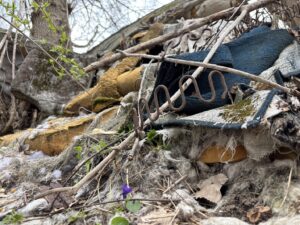
On my quest into the woods to observe deliberately, I decided to go with my friend and groupmate, Evan Shuryn. We thought about going to the Arbortetum on south campus but figured it would be easier to walk behind Evan’s house on our beloved ‘frat row’. Behind his house is a small grove of trees and bushes before a slight cliff that gives way to more student housing below. The weather was pleasant when we first stepped past the collapsed fence on the edge of his property, there was a pleasantly warm breeze blowing east from the genesee valley and it was overcast. Although, I quickly realized this was the wrong place to observe nature, we followed a small path through dead undergrowth and an accumulation of rotted mattresses from years of college students assaulted my vision. Their rusted springs rose out of the growth mother nature had been using to digest them. I noticed a defiant, purple flower protesting the mattressess’ occupation. The ground was littered with broken glass and rusting beer cans, which might have been less offensive during summer, winter’s affect laying bare their ugliness. Despite this offensive scene, saplings, flowers, and honeysuckle were sprinkled all over and were beginning to bloom; giving me some hope that maybe nature would prevail.

Mattress-Flower
Flower protests against mattress

Southside’s Arboretum

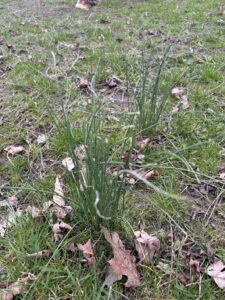
Fleeing from ‘frat row’, Evan and I parked on Southside and walked over to the Arboretum. As we walked towards the arboretum I noticed strangely tall grass clusters with small white tips, I took out my phone and used a plant-identifier to found out it was wild garlic. I dug my hand into the soft soil to dig out a root out of child-like curiosity and behold! It smelled like garlic! It was exciting to find an edible herb, and I began to notice it everywhere. As we walked along the paths I noticed small clusters of wild garlic everywhere. Even though most plants have yet to bloom this spring, honeysuckle’s bright green leaves stood out among the brown and gray background. The trails are also home to some of the oldest trees I have seen with my own eyes, the width of the trunk of one of the trees indicated it was at least 200 years old. It felt like an honor to see such an old, wise creature in an age where most old-growths have been destroyed. As we began to circle back I noticed a bright cluster of yellow tulips among last fall’s rotting leaves and winter-dulled moss. Excited by my discoveries and observations, I only noticed the mud all over my hands and new sneakers as we got into Evan’s car.

Wild-Garlic
Smells like garlic!

Broadened horizions

Women’s role in the development of Computer Science as a discipline

After reading most of “Broad Band” by Claire. L. Evans, I learned about women’s large role in the history of computers and the internet. First, I learned how women were accidentally placed at the forefront of computer science because computing and programming were originally viewed as secretarial, feminine jobs. Additionally, women were put in these roles because they could be paid less than men for the same work. However, as the importance of computation and then programming were realized, women were pushed out of the field; their accomplishments were largely unmentioned. Learning about the all-women teams of programmers that greatly advanced computer science who were then ignored bothered me. I imagined my mother or sisters going unappreciated in their careers and made me think everyone who uses a computer should have to read Broad Band. Currently, the computer science discpline is male-dominated and most people assume it has always been male-dominated. The role that women like Grace Hopper played in creating computers and the internet, as we know it, is unreplacable. Much of what I knew about the development of Computer Science as a discipline came from a intro to philosophy class I took over intercession; specifically the AI unit our professor taught. In that class we read the Turing Paper and Searle’s response, the Chinese Box Arguement, and these two papers made me think that men had always been at the forefront of computer science. I will say though that Ada Lovelace: collaborater of Charles Babbage, is mentioned with an admonishing tone in the Turing Paper, but only so Turing can refute her. Otherwise, I was left completely ignorant of women’s role in Computer Science.

The development of the internet

The general history of computer science and the internet was also a mystery to me before taking Lit and Lit Study in the Digital Age. I did not realize the affect the countercultural movement had on the development of the internet.Although it makes sense that a cultural movement emphasizing a collectivist lifestyle would create networks of communication to help others in their community. It was interesting to learn about the tech-commune in San Fransisco that created their own network of communication, using computers, between social service groups in the area. While the internet is largely commercialized now, in the beginning it was supported by the government and academia, e.g, “.net”, “.edu”, “.gov”. I was very surprised to learn that the internet as we know it, was first viewed as a flawed, antequated approach to networking. The internet we rely on today uses one way links, that if changed at all become unusable.

Computer Software and how to navigate my computer

I have also learned how computers are organzied and how they store information. I grew up familiar with computer hardware, e.g, cpu, gpu, ram, ssd, etc, but knew nothing about software or coding. This course has taught me how to navigate my computer through the terminal line. I know how to create files manually and edit them using Visual Studio Code. The way that computers store information also was beyond my understanding before taking this course. Computers store information hierarchically, “users/michaelcrowley/journal/my-blog-post”. The name of the file is also its location, which reminds me of how libraries are organized by number: each respective genre to its own number. As someone who grew up enjoying video games: the product of massive coding projects, it is really interesting to advance my own understanding of computers.