My transcription work
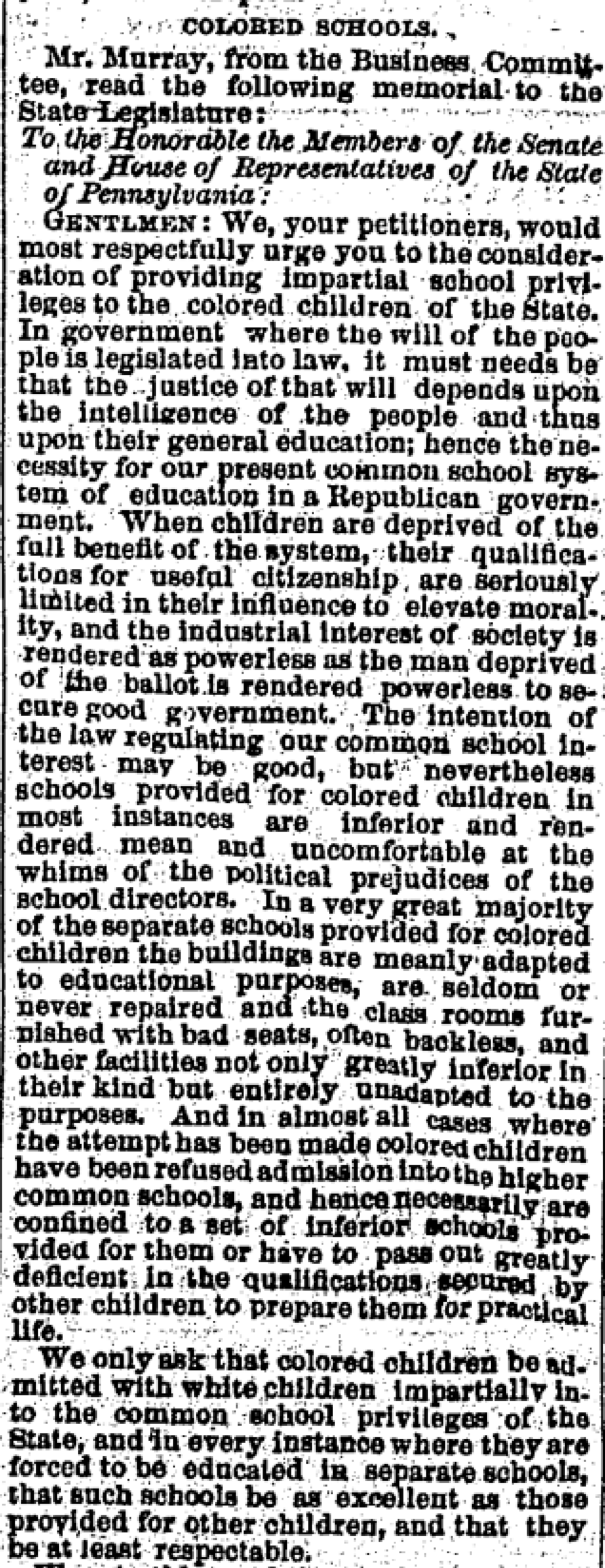
In this year’s Douglass Day transcription event, collections of documents were sorted into various regions. I ended up transcribing exclusively from the Pennsylvania region. Despite being only one state, there was a wealth of documents that needed transcribing. Many of the documents were simple record keeping. They followed a pattern of listing those in attendance, what was discussed, and any efforts resulting from the day’s discussion. Some documents were excerpts of speeches, where attendees spoke out against slavery and inequality, as well as urged their fellow people of color to join together in resistance. Most interestingly to me and my major were the two documents discussing education. One urged the government of Pennsylvania to provide the same level of schooling to children of color, whether alongside white peers or in separate schools held to the same standards. The other was discussed an unapproved project for establishing a Colored College. Frederick Douglass himself credited the project’s failure to “Garrisonian Abolitionists”, however the initial transcriber attributed this to Douglass’s own bias toward the Garrisonians.
What I learned from transcribing
Prior to participating in the Transcribe-a-thon, I had little appreciation for the labor of transcription. Growing up in a digital age, I am used to having a wealth of documents at my fingertips. I had previously worked under the assumption that these documents were always digital, or that they had been scanned in using some automated software. I now understand this is far from the truth. Resources like Project Gutenberg and the Colored Conventions Project rely on hand-typed transcriptions and the labor of many volunteers. Without them, there would be less access to key pieces of history and literature.
I also had little understanding or appreciation for the Colored Conventions themselves. History classes in school often skim over many critical details, especially since they need to fit the entire country’s history into one year of study. Of course, I could research in my own time, but I neglected to do so. Instead I worked off my own minimal understanding and assumptions. I knew that voices like Frederick Douglass and others were important in the ongoing quest for equality. However, I did not realize how involved and expansive the process was. I was only able to transcribe a few documents myself, but the amount of existant writings, as well as the number of Colored Conventions that were held nationwide, paint a clear picture of how much work was involved in reaching the relative equality we have today.
What I learned about working with documents
I consider myself lucky that I only had to be concerned with transcribing typed documents. Were they handwritten, I can imagine myself struggling immensely with the “spiderweb” handwriting that many texts consist of. Still, the typewritten work offered its own challenges. For one, some of the type was faded or produced only a half-character. In these instances I had to make an inference and tag for unclear text. Spelling across documents was also inconsistent (i.e. spelling as “color” and as “colour” across different texts). This was fine for familiar words, but led to more confusion with topics I did not know well. I also had to strike a balance between efficiency and attention to detail. I wanted to make good use of my time and complete many transcriptionss, but when typing too fast I fell into a pattern of guessing ahead and transcribing improperly. In the end I went back and worked with more care, sacrificing speed.
How I see things now
If anything, this project taught me to pay attention to the mountains of work that make my current life possible. On one side this means the numerous conferences, conventions, and appeals for equality that advocates like Douglass have made. Without them providing the foundation, much of what I consider normality would not be possible. On the other, this means the human labor behind the aspects of technology I once took for granted. Now I can realize that most of the text I read online was typed or transcribed by hand, all so people like myself can read it and better understand our world. Without the collaboration of so many people none of it would be possible.
Click here to see my transcription work!