What I transcribed
The most interesting document I transcribed from the Colored Conventions Project was a document establishing the Alabama Freedmans Homestead Committee.
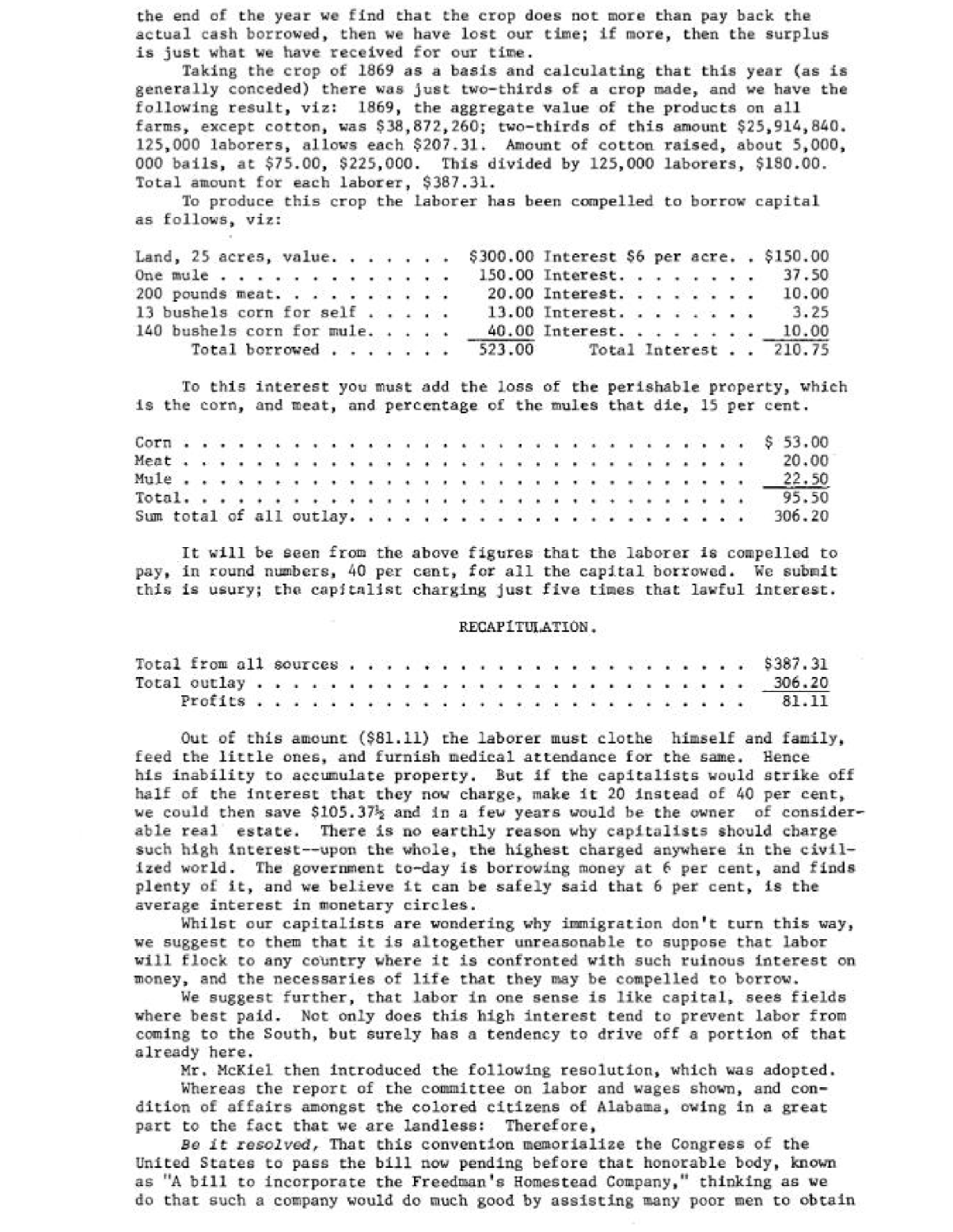
In the document, the author breaks down the cost of living for the average “laborer” on a farm, and how much of his income gets taken from him due to high interest rates on materials he borrows in order to work the land. These include the land itself, food for the laborer and his mules, and in addition he gets charged 15% more if anything he uses is perishable. In total, there is a 40% loss of income. The author points out that this is not enough money to feed, clothe, and take care of a family’s medical needs. Therefore, this type of salary prevents any generational wealth from accumulating within black sharecropper families.
What I learned from transcribing and working with documents
From going through the line by line process of transcribing the document, I spent a lot of time with it. Especially the dollar amounts took up a lot of my attention because there were so many numbers and periods. This time spent with the document was very valuable because it enhanced my understanding of just how unequal the sharecropping profession was due to the painstaking process of transcribing and proofreading to make sure everything was recorded correctly. Rather than a quick readthrough, physically typing out the amount of money that was taken from these hardworking people made it all the more impactful. I also learned about an effort to help black Alabama families become homeowners that I wasn’t aware existed before the transcribe-a-thon. Unfortunately, the document cut off before I could learn what specifically the organization did to help this problem, but I was able to find out that the motion passed successfully and the Freedman’s Homestead Company was established with the help of congress. I feel so much more personally connected to this piece of history now that I helped to record it, and more invested overall in the history of sharecropping in Alabama. After typing out all those numbers they became much more real to me, and made me angry that the plantation owners were practically robbing them and sending them into debt because they were stealing 40% of the profits.
Although a silly observation, I have no experience transcribing, so the entire experience was new to me. I also learned that there are lots of different ways that information can be recorded both digitally and on paper. It took extra effort to record a list, for example, as opposed to a regular sentence, due to the formatting on the list.
What I learned about the history these documents embody
I learned more about the historical relationship between slavery and capitalism as a result of transcribing these documents. Over time, as I was transcribing documents I saw the development over time from slavery into ‘sharecropping’ after slavery was abolished because of the Civil War. With sharecropping slavery was essentially allowed to continue as normal, except actually making the slaves’ debts worse because now they owed money for using supplies. The people were still enslaved and exploited just in a different form that was technically legal. In this new system the familes working on the plantations were free on paper but really still owned by the plantation owners because this needless debt was held over their heads. The document about the Freedman’s Homestead Company highlights how this system maintained the type of second-class citizenship from traditional slavery because it prevented families from accumulating wealth, the key to social mobility.
How I see things now
I am frustrated that sharecropping was so deeply normalized because looking back at these documents now shows how insane the system was. Taking 40% of someone’s hard earned money feels deeply unfair to me, especially when considering the reperations that black people were intitially supposed to recieve. Forcing them to pay for the land, the animals, and the tools needed is a crazy concept when they were supposed to recieve 40 acres and mule as reperations specifically to assist in helping regain social mobility and economic power. I have a better understanding of the ways that capitalism uses marginalized groups to keep the machine going, and the ways that it reinvents itself to continue that goal, specifically in the United States.
Additionally, reading about the efforts of the Freedman’s Homestead Company combined with my already existing knowledge of different abolitionist groups gives me hope for progress. There were people who saw racism for what it was then, and there are now. Just because something is normalized for the time, doesn’t excuse the behavior, because especially marginalized groups deserve equitable treatment and an equal chance at success.