
DEMK Revision Narrative

By Daphne Paul-LaRonca, Ellie Clodfelter, Makenzie Gardiner, Kendra Brace

Walden by Henry David Thoreau is a work that attempts to bring the reader closer in their relationship to nature and living deliberately. When looking through the different versions of the manuscript, we found the choice of tense in his writing to often be intentional to make particular points about nature and the self. When analyzing paragraph 15 of “Spring,” Thoreau demonstrates an impressive manipulation and understanding of the four different types of past tenses, particularly past perfect tense and continuous past tense. By using the past perfect tense, he creates a sense of distance between him and the nature he is observing by completing his action. This approach invites the reader to consider the deeper meaning of the natural phenomena he describes, rather than focusing on Thoreau as a character and what he is doing. The addition of a new concluding sentence then turns the paragraph into a reflective meditation on the cyclical nature of spring, ending that day and starting a new one in the next paragraph.

Additionally, Thoreau’s choice of tense lends the observations a quality of truth. Spring, as a season, recurs, and Thoreau’s reflections on it are meant to resonate beyond a single, fleeting moment as he records several days within the season. By using the past tense, he suggests that these experiences are not unique to a particular year but are part of a larger, ongoing cycle. This aligns with Thoreau’s broader goals in Walden to rediscover and articulate truths about nature and human existence that transcend the limitations of time and place to a wide audience and encourage them to also take the time to slow down in their daily lives.

The actual changes Thoreau makes are precise in diction and description that make the scene more lively and vivid. For example in version A Thoreau concludes paragraph 15 with “As I stood at the door, I could hear the rush of their wings”. He changes this in version E to “Standing at my door, I could hear the rush of their wings”. The very subtle change from “As I stood at the door” to “standing at my door” creates a more exciting and lively feeling for the readers as it is easier to envision oneself as Thoreau. Another example can be found when Thoreau is describing the geese he encountered. He changes “clanking” from version A to “honking” in version E to find the richest sensory details to describe the sound of the geese. https://cdm16003.contentdm.oclc.org/digital/iiif/p16003coll16/887/268,245,2554,1476/full/0/default.jpg

By adding the concluding sentence in “Spring” paragraph 15, Thoreau created closure. Shutting the door literally and metaphorically creates closure for the readers as they finish paragraph 15 and begin the next paragraph which begins with “In the morning…” Spring is the season of rebirth, change and transition, which is for Thoreau’s experience as he is learning new lessons at Walden Pond for the meaning of life. Thoreau tirelessly grapples with the correct verb tense to use, which can be seen directly on the manuscript. In paragraph 15 version A, Thoreau crosses out words to change the narrative from past to present, showing he was actively in a state of revision. For someone who was trying to live simplistically, Thoreau truly could not decide the perfect verb tense to make his story as meaningful as he could. In version E he finally decides to keep the paragraph 15 in the past tense because his descriptions and verbs create enough liveliness for the reader. Even just the phrase “suddenly driving toward my house” absolutely creates a sense of anticipation and action for readers, that is not always achievable in the past tense. https://cdm16003.contentdm.oclc.org/digital/iiif/p16003coll16/238/1747,3104,6291,710/full/0/default.jpg

When doing this project, we faced many challenges including finding the correct manuscript pages as well as coming up with a hypothesis. When using the manuscript search tool on the digital Thoreau website, we found that we were not able to find the section we needed in version E. In order to insert the paragraph into our tei file we had to manually search all of the pages for the paragraph. We also struggled with finding a strong hypothesis that we enjoyed. This stemmed from changing the paragraphs that we wanted to use multiple times. It became difficult as the changes we found were very small but also extremely meaningful.

To overcome the challenge of identifying a strong hypothesis, we looked to explain the impact of details that to some, could be described as insignificant. In Walden Thoreau’s precise writing style conveys meaning even apart from what he is actually saying, so we were fascinated by his journey of meticulously crafting sentences. In the end we found that the effect of Thoreau’s use of vivid descriptions and verbs even while using the past tense, is what makes Walden so special. After all, a philosophical memoir about the meaning of life should immerse readers and allow them to feel the impact of his observations, so they can look to apply it to their own experience.
Who’s Really In Control? Attention and Autonomy

The themes in Henry David Thoreau’s Walden truly resonate with me because I too have been trying to live a more present and intentional life over the past year. In my second semester of college I experienced intense anxiety and I was looking for ways to enjoy life again. I deleted social media and found myself trying to take control over my “life experience” in a new way than I had before. I returned to activities that I once loved as a little girl like coloring, sitting outside and watching movies. However, despite my lifestyle change of deleting major social media platforms like Tik Tok and Instagram, this past week I have realized that distraction still finds a way to sneak into my daily activities. In documenting my attention over the past week I discovered two themes. First, as described by Tim Wu, advertisements and “data collection” are so meticulously catered to preferences and past searches, and my logical thinking completely shuts down when I view one of them. I found myself clicking on an ad or a notification, and browsing on a page I had no intention of being on as if it was my idea. Secondly and arguably more concerning, the capitalistic, uber productive society we live in causes a feeling of urgency when performing tasks or making decisions. I realized, when I saw the notification of an advertisement come across my computer screen, it was as if there was a magnetic force pulling me to check what it was. When clicking on an advertisement feels like life or death, we know we have a problem.

It’s funny how even when I was deliberately paying attention to my attention, my mind was influenced by forces of our impossible digital environment. Multiple times this week, I fell victim to algorithms that cater your online feed, your taste and what you desire. While researching supplies I needed for my lesson plan on Amazon, I suddenly found myself shopping for headbands. Amazon has features like “you might also need” and “bundle these items” that distract you from the thing you intended on buying. Even the feature that shows what you searched prior when you go to look for something new is a reminder of whatever materialistic thought you had yesterday. At this moment I paused, because while I was trying to research something for an important school project, I found myself online shopping for a headband that I had decided previously I wasn’t going to get. The distraction of seeing the headband I was looking at earlier threw me off so much that I forgot I made the logical decision not to get a headband because of trying to save money. These uninvited advertisements interrupted the thinking of my logical brain, making me forget that previously I decided I did not need one.

This past week, every time I sat down to do work, the ding of a notification or the icon on my computer interrupted my focus. On Tuesday this happened four times while I was completing an assignment. Almost every time I received a notification from pinterest, sephora or an email from a store I immediately clicked on it as if I was desperate to get away from my assignment. Sprinting as far away from my boring homework as I could, my mind was stimulated by the sight of brightly colored, aesthetic products and clothes. Of course all of the emails I receive are products I have looked at or absolutely love, keeping me hooked as if I have to keep looking. My algorithm knows me so well, sometimes I think better than I know myself, and that catches me even when I don’t intend on shopping. Algorithms trick your brain into believing that this is the route it wants to take as if it was you who had the thought to search for a random product. Through this study, I realized that most of the time when I think I am choosing to take a brain break from my work and maybe look at a shopping site online, it is my phone that encourages this. It truly made me analyze what decisions I make for myself based on my own free will or which ones I make because I am influenced by my digital environment.

The results of this project were concerning, as I truly realized that my digital environment, the constant advertisements, and data collection have more control over my life than I thought. I’ve never really worried about AI taking over the world, but if the digital world around me is shaping my behavior and autonomy that starts to feel uncomfortably close. I realized that while I thought I was able to “live my life” based on my decisions, of shopping for my school project and taking a break from studying, these choices were all suggested to me by digital pressures.

Unfortunately, I think the pervasive distractions that come with living in such an advanced technological age are inevitable. However, this project has opened my eyes to how oblivious I was to them influencing me on a day to day basis. I intend to be more mindful when I feel myself influenced to click away from whatever I intended to do. I think as a society we need to continue to have these discussions of the extent to which platforms can track our data and use advertisements and that we have structured legislation as suggested by Tim Wu. Going forward I strive to be mentally tougher and resist the urge to experience something if I didn’t intend to in the first place, because we have one life and I want to be the one deciding how to live it.

Rewriting History

Previous Knowledge

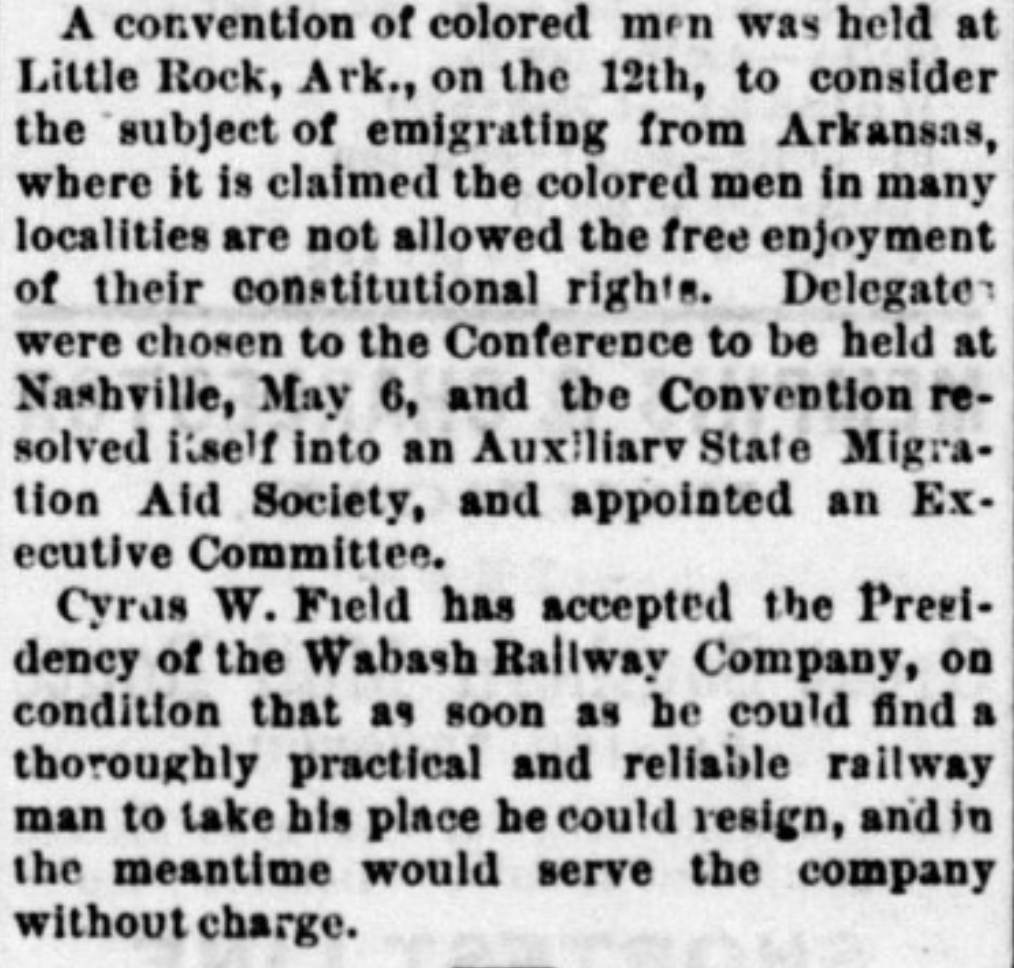
In my opinion, the Douglas Day transcribe-a-thon where students were able to transcribe documents from the Colored Conventions Movement truly embodied the best of academia. This event gave college students the opportunity to play a direct role in engaging with documents from the past and contribute to their preservation which extends beyond the typical classroom activities. Participating in the transcribe-a-thon on Douglas Day gave me a strong sense of autonomy and transformed my understanding of history because for the first time I felt like I was immersed in this discipline. In high school I had always been fascinated by my AP European and United States history courses, and the study of history overall. I always recognized the importance of teaching and learning the true history of the country in which we live because honest education ensures that we don’t make the same mistakes. In all of my prior schooling about American history and the Civil Rights movement beginning in the 1950’s, I was never taught about the Colored Conventions Movement.

Since reading documents from the Colored Conventions Movement in the transcribe-a-thon, I have learned about a significant force of Black activists, leaders and civilians who fought for Civil rights, educational and labor equality and the abolition of slavery. It is essential that we know the name of the Colored Conventions Movement and the political advocacy and mobilization that they created in order to understand the reality of Black civil rights in America. Too often, White northern abolitionists get credit for fighting for the freedom and rights of Black civilians in America, when it was truly them who fought for their own liberation and progress. It is time that white saviorship is criticized and The Colored Convention and their strategized effort is recognized and taught.

My Experience

Screenshot 2026-02-26 at 12.54.06 PM
I am embarrassed to admit that prior to this experience I knew digital archival documents existed and were a valuable resource for academia and education, but I wasn’t sure who played a role in physically transcribing them. The act of transcribing allowed me to take ownership over my learning, as someone who finds interest in history and studying documents from the past. Transcribing made me feel as though I was contributing to something meaningful in society. Transcribing the document for Douglass Day was very easy, and took less than ten minutes which made me realize how easy it is to contribute to an important cause that is preserving historical documents. Our role in transcribing made documents more accessible through digital media, as well as identifying different people, specifically females and giving them credit for their impact in history. I felt as though transcribing the archival documents was slightly disheartening because it felt like I was ruining the authenticity of the document and that it was losing its character as it was typed. However, I understand that the digitized version can exist for functionality while the charm and originality of the document will not be lost in its original form.

Finally, I realized the importance of identity in these documents, as history tells a story that can strategically leave individuals out in order to teach a certain narrative. During the time period of the 1800s and 1900s women were commonly left out of fields of leadership, advocacy and political participation. Their role, even though essential, was under valued and not acknowledged in order to maintain females’ subordinate place in society. It is essential that we uncover the names of women who played a crucial role in the Colored Conventions Movement and the fight for civil rights. It is a privilege and an honor to be a female in today’s world, able to contribute to rewriting the narrative.

Challenges and Learning

The only challenge I experienced during the transcribe-a-thon was with internet service and connection due to the overpopulation of Zooniverse during Douglass Day. Ironically, this exposes a fundamental flaw of digital media compared to print which is a topic we are discussing in class. Digital media and transcription presents an issue of internet connection and service which undermines our goal to improve the accessibility of a document. After a short amount of time, the service issues were cleared up and I was able to transcribe documents as intended. In this process I learned that formatting is insignificant when it comes to document transcription and that what truly matters is the content and the story you are transcribing. The formatting of the archival document is special and unique to that of its original paper form and that doesn’t need to be replicated in the digital version because fortunately, the original edition can always exist.

Transcribing archival documents from the Colored Conventions Movement allowed me to be involved in recording history and take an active role in digitizing very important documents. Additionally, my experience with the specific documents gave me insight into the political and social climate of this time and the individuals as well as the efforts that they were fighting for in terms of civil rights, labor and social equality. I now know about the Colored Conventions Movement and the significant role they played in American history.