Harriet Hollister

Harriet Hollister

In the frigid I sat in one of my favorite spots in which I had forgotten about. In my youth I spent hours here. It was never empty, even in the winter you could find teens walking the car path, even though it was closed, in search of the bench that overlooked Honeoye Lake, watching the sunset and doing whatever teenagers did.

I now sit in this spot, watching the sunset, in the quiet, as all the teenagers who once grew up in this place, are now grown and have forgotten about the bench and the sunset in which they spent most of their time.

Without getting to the spot by car, it is a good walk through the wooded trees to get there. During the daylight hours the trees stand still, the bushes do not make any noise because you do not notice it. The slight movement of footsteps on the gravel and birds singing in secret spots in the trees are the only sounds that can be heard by the ears. Although walking to the exit at dark unleashes an entirely new set of noises, with which I was familiar. The trees tapped amongst one another in the wind that always seemed to be there in the dark, even on the calmest of nights; the bushes violently shook with whatever animal hid within its coverage, and your footsteps hitting the gravel always seemed to pick up its pace in fear of what is lurking.

The bench seemed older than I remembered. Its smooth wood finish was pealing, causing cracks, making the once comfortable and familiar, unpleasing to rest upon. There were the same old carvings amongst its posts, mostly initials surrounded by the heart of couples who are more than likely not together anymore and the same old cursing’s that were left by people who thought it would be cool. Although there were some fresh ones too drawn on in black sharpies, making the inactive park feel more lively.

I sat on the stiff bench for a while, watching the sun completely fall, and the moon slowly rise, which was as beautiful as I remembered. The sky painted its beautiful rainbow colors over its lake which was empty and quiet besides the few flocks of geese the obnoxiously flew over, disturbing the sky’s peace. The lake slightly reflecting the colors hues making its light blue appear more pink.

During the summer days, the lake will be filled with boats of people who are fishing, occasionally hearing cheers of the people down below who caught a big one. During its spring months the lake is forgotten and still, making its top layer of water appear to be glass, without any sudden movement. I had never actually felt the silence of the lake until now, usually the crowd of teenagers, that once was me, brought in their own noises. The typical teenage music filled the woods, along with the laughter of people who called themselves friends.

Although this place was a distant memory of mine, it is not entirely forgotten. The pieces of trash surrounding the lookout area and the benches deteriation shows that people still come to sit over the lake. Some hoping for the deep reconnection with the power of its beauty and others hanging out with their friends.

The Spring That Took Its Time

Every winter, I like to try and guess how early or late spring is going to begin. I take a wild guess, others I look more closely into. Such include rough/steady our winter was, if the temperature rapidly increases & decreases a ton, and more.

Springs false arrival surprised us in early March; it got our hopes up that spring finally has come, the birds got excited to explore, the trees couldn’t wait to restart their beautiful creations, the clouds allowed the sun to take over, until the second and third winter took over.

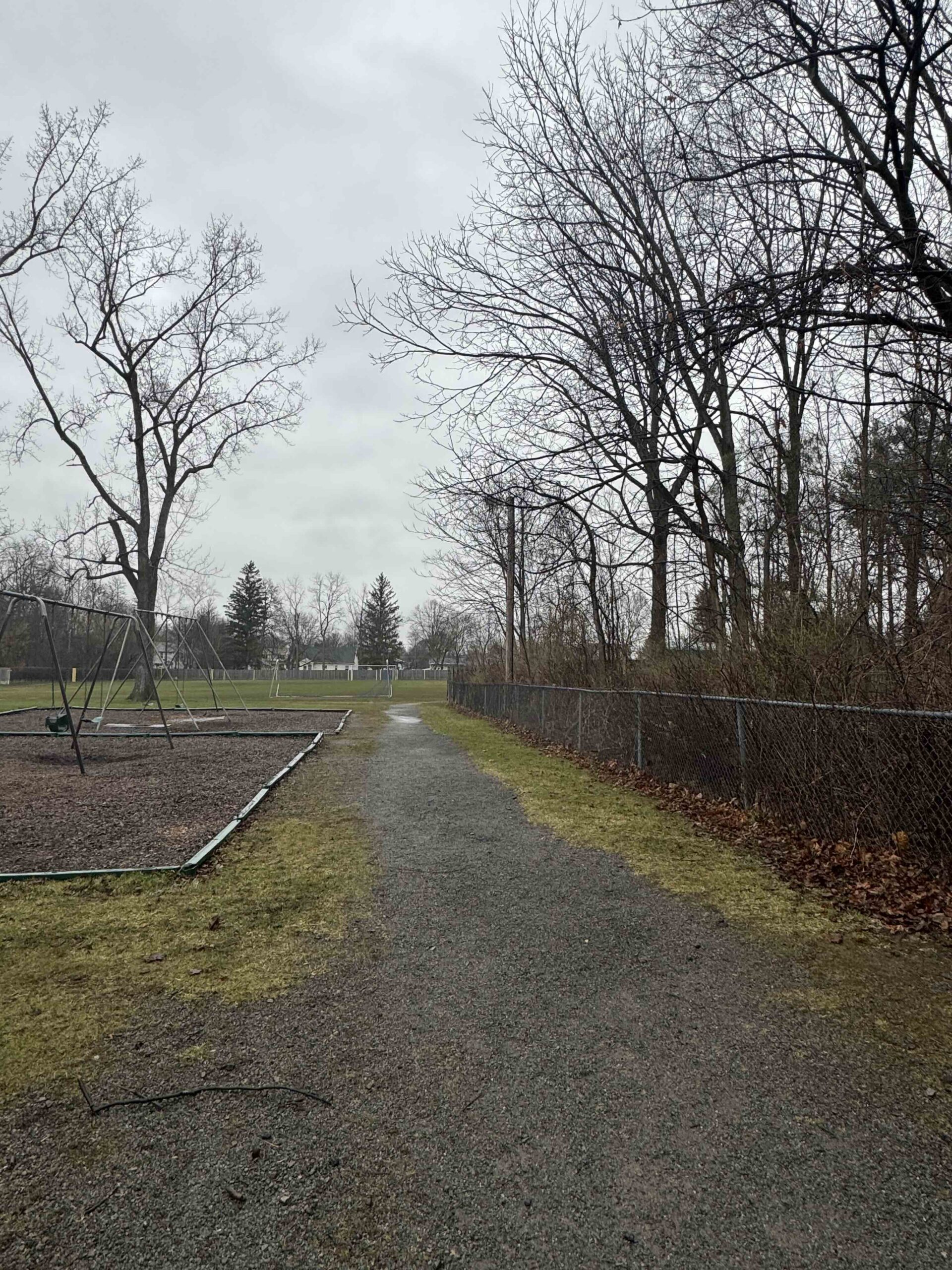
I chose to observe Highland Park in Geneseo for a little while on a rainy day. Rainy days at the park are something I have always felt were underappreciated. Some of Earth’s finest pieces of nature are highlighted when it rains. Rainbows, that is, are a symbol of the rain coming to a close. The rain had to step in the way for a minute, then the rainbow acts as a message that the rain has stopped. If rainbows could talk, they would say, “Sorry about that, hope this makes up for it!”.

I heard the sound of the rain hit different objects. The rain landed on the leaves quietly and gently, then landed on the playground slide a bit more harshly, and the rain was heard even louder when it hit the metal fenced batting cage. The park was quiet, nobody was there except for myself. No kids wanted to play in the rain that time of day. Weather around 40 degrees, and a light breeze, the sound of the wind taking the leaves from their original spots, the rustling of wet branches swaying back and forth. In a distance, robins flying around, trying to find some shelter. The flutter of a bird startled me, as I thought I was alone.

Rain brings a unique smell to the air, it smells clean and natural. The air was thick, released a fragrance of wet leaves and fresh mulch and soil just put down. The rain gently fell, weaving a soft veil over the park. Even though the rain soaked through my jacket, the gray sky, quiet surroundings, were peaceful and comforting. It was almost as if the park reserved this time just for me to be there. Each step I took in the grass felt heavy, as my shoe sunk into the wet ground, it took energy and force to pick my foot up from the muddy pathway.

As far as genAI used in this experience, I did use Ai to help me come up with the title, since I am not entirely creative. I wanted to emphasize how spring has started a bit later this year, unlike last year where I was wearing shorts in march, and using sunscreen. This spring is a bit different, which is why I wanted a unique title, to emphasize how my experience was. I also used Ai for a bit of assistance when trying to write my blog post like Henry David Thoreau. Although I have been reading and looking over Thoreau’s texts for quite some time now, I wanted some ideas to brainstorm how to word my experience at the park in the best possible way.

IMG_6307-scaled

The Power of a Lake

Vitale Park

I took a trip to Vitale Park which is about 10 minutes from our campus. This park is on Conesus Lake. There were not many people at the park with me, just some dogs on walks with their owners. It was serene and still. The sun was shining over the calm waters, casting a golden glow that dances on the lake’s surface. Along the shoreline are houses and tall trees that stand like guardians. The air is filled with a delightful blend of natural fragrances. Imagine the fresh, crisp scent of the lake itself, mingling with the earthy aroma of damp soil. The breeze brings hints of cedar from the surrounding trees. The clouds drift lazily across sky, their white, cotton-like forms casting soft shadows on the lake.

A Symphony of Ducks

Only ducks gliding gently, their quacks had a cheerful sound. The mother watched as her children bathed and played in the water. The mother duck stands vigilant, her eyes are scanning the surroundings as her ducklings frolic in the shallow waters. I am reminded of the delicate balance of life and the protective instincts that bind us all. The quiet beauty of the lake invites reflection and appreciation of nature’s resilience. Besides the birds, ducks were mainly what I observed. It was very intresting to see how these ducks acted. They would go beak first into the water and their feet would stick up. Their social interactions, marked by a variety of quacks and calls, added to the serene atmosphere. The little ducks, with their feathers and tiny webbed feet, paddle around energetically, exploring their watery playground.

Colors

As I stand on the waters edge, I observe the colors. Instead of the vibrant green you’d expect, the grass has taken on a more subdued, brownish hue. The earthy tone adds a different kind of beauty to the landscape. The blades of grass, though not as lush, still sway gently in the breeze, creating a soft rustling sound that complements the peaceful ambiance of the lake. It is a place where I can escape the hustle of daily life and find solace in the simplicity and beauty of nature. I image myself journaling here in the summer and I enjoy the suns rays. The gentle sounds of the water moving and the rustling of the grass will create a soothing backdrop for my thoughts. I will allow my thoughts to flow freely onto the pages of my journal. I am so glad that this lake is just a short drive away. The atmosphere, reminiscent of Thoreau’s cherished retreats, offers a profound sense of peace.

People and Computers

Wednesday, March 12, 2025

Terminal & Visual Studio Code

Both Terminal and Visual Studio Code were foreign to me before this class. Terminal is automatically installed and yet I never thought to look at it, albeit if I had I would have had no clue where to start. It turns out it is really less scary and complicated than it looks as you learn the commands and the language to use it properly. We learned simple commands to begin navigating our Graphical User Interface and file system easier and faster. Terminal allows you to quickly create, organize, and view folders and files. In combination with Visual Studio Code, this allows for a cohesive and organized way to keep notes in class and to keep up with the computer science of it all. Terminal commands are all about memorization or having good command notes. Here is a list of commands we have learned thus far:

  • cd
  • pwd → to get into the home directory
  • cd ~/Folder/ to change directories
  • ls to get the contents
  • ls -l to get a list view of contents
  • cd ~ to get back home
  • up arrow to go back to commands → goes through in reverse order
  • mkdir – to create a folder
  • name file press enter
  • cd ~/folder name?
  • touch file name → add file to folder

Women in Computer Science/ Broadband

Reading from Broadband also brought some really interesting, and important information about the history of technology and computer science. Broadband focuses heavily on women’s involvement in technology and the technological benefits we reap today. The origin of computers in general lies almost exclusively in the hands of women. Originally “computers” were just people who computed complex math equations using these machines. Early computers were incredibly different from the sleek and efficient models we see today. Then, they were large bulky machines that these women had to individually plug equations into. This was time-consuming and precise work. I felt it was unsurprising and yet fascinating to learn about the role of women in technology and the importance of women in the field. It is disappointing that this is not more mainstream history as we use technology in many aspects of our lives today. Due to gender disparity women’s contributions in the field were often overshadowed by men with more power and influence. Even despite their great work on computers and technology, women were pushed out of the way as men returned home from war. A field originally thought to be for women because of its attention to detail and intricate workings, became a job prioritized for men.

Computers & the Humanities

The humanities and computers intersect in a variety of ways. Computers are an essential tool in compiling and organizing collections of literature or pieces of history. Digital archives place tons of primary sources, research, analyses, and whatever other scholarly works you wish to read. The internet and computers make it possible for far more people to access history and literature through sources associated with libraries, schools, and colleges. This is important because it preserves history on a grander scale. It allows everyone to be able to research topics of their choice, read history they take an interest in, and seek outside points of view on a piece of literature they love. I think this is important to bolster curiosity and encourage people to understand and seek out information relating to the humanities.

Discoveries

How my brain processes

Throughout this class, I’ve learned how to understand my computer more easily. However, I have figured out that my brain doesn’t process things that don’t make sense to me as quickly as something that does. So, it takes me a lot longer to understand the commands and what I’m typing into the terminal. The commands also don’t stick in my head, so something I just heard will go in one ear and out the other which makes it difficult for me to focus

What I have discovered

It has taught me to discover how to do things by myself and a way in which I have changed is not being afraid to ask for help. I struggled throughout my college career and within this class to ask for help as I fear that I will be the dumb one in class . However, I have realized that it’s probably not just me who feels that way and it’s better if I ask for everyone as someone may have the same question even if it’s dumb.

History of computers

Another thing I’ve learned that I hadn’t ever thought of before this class is how many people go into creating one item such as computers or the systems that had to be created in order to get to the point of the computers we use now. I never really considered how complicated the systems would’ve been back when Grace Hopper or the Eniac 6 were designing and running the programs all by themselves. I find myself wanting to be in their world and seeing how they worked and created the systems. I would love to see each of their systems because I would imagine they didn’t all have the same way in which they designed the programs. They were all different and therefore able to work together. So, I would love to pick all of their brains and maybe understand how they used to do things and how that was able to translate into the computer systems we have today.

What I have overall learned

Overall, I do think that what I have learned from this class, my peers and my friends is to be more confident in what I’m doing in this class and not diminish how smart I am because once I know how to do it, I feel on top of the world. If I ever feel lost, it’s not because I’m not smart or able to catch up. It’s because I’m tired or I lose interest as It’s not coding is not something that has ever interested me. However, I’ve learned how to do different things with my computer that I didn’t think I would be able to accomplish and not only has that increased my confidence and how I go about learning, it’s also given me the confidence to help my peers or teach others on how to code your computer.

Broadened horizions

Women’s role in the development of Computer Science as a discipline

After reading most of “Broad Band” by Claire. L. Evans, I learned about women’s large role in the history of computers and the internet. First, I learned how women were accidentally placed at the forefront of computer science because computing and programming were originally viewed as secretarial, feminine jobs. Additionally, women were put in these roles because they could be paid less than men for the same work. However, as the importance of computation and then programming were realized, women were pushed out of the field; their accomplishments were largely unmentioned. Learning about the all-women teams of programmers that greatly advanced computer science who were then ignored bothered me. I imagined my mother or sisters going unappreciated in their careers and made me think everyone who uses a computer should have to read Broad Band. Currently, the computer science discpline is male-dominated and most people assume it has always been male-dominated. The role that women like Grace Hopper played in creating computers and the internet, as we know it, is unreplacable. Much of what I knew about the development of Computer Science as a discipline came from a intro to philosophy class I took over intercession; specifically the AI unit our professor taught. In that class we read the Turing Paper and Searle’s response, the Chinese Box Arguement, and these two papers made me think that men had always been at the forefront of computer science. I will say though that Ada Lovelace: collaborater of Charles Babbage, is mentioned with an admonishing tone in the Turing Paper, but only so Turing can refute her. Otherwise, I was left completely ignorant of women’s role in Computer Science.

The development of the internet

The general history of computer science and the internet was also a mystery to me before taking Lit and Lit Study in the Digital Age. I did not realize the affect the countercultural movement had on the development of the internet.Although it makes sense that a cultural movement emphasizing a collectivist lifestyle would create networks of communication to help others in their community. It was interesting to learn about the tech-commune in San Fransisco that created their own network of communication, using computers, between social service groups in the area. While the internet is largely commercialized now, in the beginning it was supported by the government and academia, e.g, “.net”, “.edu”, “.gov”. I was very surprised to learn that the internet as we know it, was first viewed as a flawed, antequated approach to networking. The internet we rely on today uses one way links, that if changed at all become unusable.

Computer Software and how to navigate my computer

I have also learned how computers are organzied and how they store information. I grew up familiar with computer hardware, e.g, cpu, gpu, ram, ssd, etc, but knew nothing about software or coding. This course has taught me how to navigate my computer through the terminal line. I know how to create files manually and edit them using Visual Studio Code. The way that computers store information also was beyond my understanding before taking this course. Computers store information hierarchically, “users/michaelcrowley/journal/my-blog-post”. The name of the file is also its location, which reminds me of how libraries are organized by number: each respective genre to its own number. As someone who grew up enjoying video games: the product of massive coding projects, it is really interesting to advance my own understanding of computers.

Moving from Self-Taught to Formal Computer Education

Introduction

To understand where one has come from, one must first know where one began. I have almost a decade of experience in programming (JavaScript, HTML/CSS, SQL, Python, Twinery Harlowe, and Twinery Sugarcube, among other, shorter ventures) and just as long in computer science classes. I’ve participated in robotics and coding competitions; I’ve made my own hypertext games from scratch and I maintain my own webpage, which I programmed from scratch in HTML. I’m familiar with my device down to the root level and often offer tech support to my less techy friends. In short: I started off already a computer nerd with a decent background in the history of computing.

Part I: Mismatched Experience

While I do have quite a background in computer science, almost all of my programming knowledge is self-taught, and that poses a problem. None of my code follows style guides, and it is almost never done in an efficient way (Python users would call my code “non-pythonic”, which is to say “not aligned with the core values of Python despite being written in Python”). It was only last week I learned what a dictionary was or how to use lists, and those were only learned after I had bodged together a program using recursive if loops that had a decent chance of dumping the entire output and restarting itself due to a validity check. Every discussion I’ve had with someone who’s had even a modicum of formal experinence ends with them in terrified awe of my bodges.

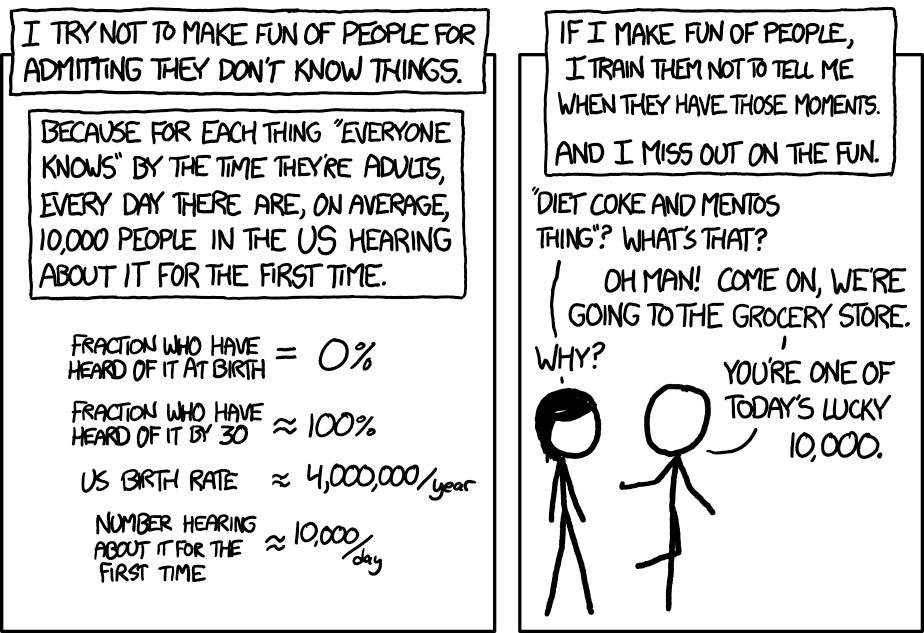
This is my first formal computer science class in years, despite its ENGL prefix, and therefore my first brush with formal computer science in years. What have I learned? Well… patience, first and foremost. No matter how obvious something seems, there will always be someone who does not know it.

A black-and-white comic strip showing math that roughly 10,000 people per day learn something "everyone knows" by age thirty, then two stick figures discussing the "diet coke and mentos thing" and agreeing to go to the grocery store

Fig. 1. “Ten Thousand”. Digital comic by Randall Munroe, 2012. XKCD.

Because I taught myself, I’m prone to the impulse to feel everyone should know what I know, but that isn’t how it works; I had to learn this, and so too does every one of my classmates. I learned HTML when I was nine, sure; they might have learned how to tackle or fish or pirouette instead. I don’t know how to tackle/fish/pirouette and it would be unfair for someone to assume I would even if they taught themselves; likewise, it is rude for me to assume they ought to know code just because I learned it.

It may be an unintended consequence, but it’s a happy one.

Works Cited

Fig. 1. “Ten Thousand”. Digital comic by Randall Munroe, 2012. XKCD, https://xkcd.com/1053/.

The Impact of Computers

Changed and Grown

Signing up for this class I was not sure what to expect. After the first few classes I realized we were going to be using code. I took a coding class my sophmore year of highschool but I was never good at it. I did not feel comfortable at the beginning of this class. Over the last few months, I have learned so much not only about coding, but about my computer. I also have gained a new appreciation for Ada Lovelace, the first person to publish an algorithm intended to be executed by the first modern computer.

My eyes have opened to aspects of my computer that I haven’t noticed before this class. I had never heard of creating my own journal files on Visual Studios code. I had always used google docs to create journals and download them as PDF’s to submit my work. I love seeing how using differnt apps on my computer can create a journal file for me with a simple code. From what I’ve learned so far in our class with coding, I feel more confident in my computer skills.

Relation to My Major: Education

Manuscripts allow students to study the original drafts of literary works. Manuscripts also serve as primary sources, allowing students to engage directly with original materials and develop skills in primary source analysis. This realtes to my Education class Curr 317: Teaching social studies. In this class we are learning about primary sources and how to find/use them in a lesson. As an Education major, I go to my placement every Friday and am working on a Social Studies Unit Plan to teach to fourth graders that involves primary sources. We have learned how to find a true primary source and how it can increase involvement in a lesson plan. It is very interesting to see how my classes cross paths.

Another one of English classes I am taking this semester, English 366 Lit: Chaucer to Milton, we have started to talk about manuscipts. Throughout our class in English 340, we have learned about manuscripts and how to read them. I now feel more comfortable in my other English class when we talk about them. Although these are both English classes, it is interesting to see how they cross paths and how I can use my knowledge from one class to help me in another.

Digital Archives

Something I found interesting is how digital archives of historical records, artwork, and other cultural objects are created and stored by computers. Researchers and the general public may more easily access and examine these materials thanks to these online collections. Digital archives and primary sources are protected from physical degradation by digitization. Digital copies can be kept forever, while original records, images, and artifacts can deteriorate over time.

ENGL 340: The Practical Concepts I’ve Learned

Throughout the semester I feel like I’ve learned a great amount of information about computers, the history behind the invention of the internet, and AI. At the beginning of the semester, I was very skeptical of this class because I am not very knowledgeable with computers beyond saving to Google Drive. I didn’t know if I would enjoy the class, however, I have thoroughly enjoyed this class and the different concepts we’ve learned so far. I’m also excited about what’s to come later in the semester.

I think the most practical thing I’ve learned for my job field, education, is the information about Henry D. Thoreau. I had never read much of his work before this class, and our readings and analysis of Walden have been the easiest part of this class for me so far. I think especially seeing the many different drafts of Walden and reading the various manuscripts has been useful to me for seeing the editing process. I’ve learned that even the slightest change to the manuscript can have a big impact on the meaning of a text after seeing how the manuscript changes over time.

Learning about the history behind the invention of the Internet has been eye-opening for me. I had watched the movie Hidden Figures which details the involvement of women in America’s journey to space, so I knew we, as a country, had a history of asking women to solve problems and then denying them the credit they deserved. However, I didn’t know this same system is what was used to create the Internet. Learning about this has reinforced the idea of the importance of representation in all fields of work. Giving credit where it’s due is definitely important for creating an equal playing field for job fields such as computing/technology.

I think the most valuable information I’ve learned that I will be able to apply to my personal life is the knowledge of the terminology and the use of things like Git Bash, PowerShell, the GUI, and other such components. My boyfriend is a Masters student at RIT in Information Technology and Analytics, and I have thoroughly enjoyed talking with him about what we’ve done during this class. Admittedly he has helped me to better understand some of our class concepts better if I’m having trouble with something we learned during the week. I feel like after only a few weeks of this class, I can actually understand what he does during his day to day life at school, and what he aspires to do outside of college. I’m thankful for that understanding so I don’t have to make guesses anymore as to what he does.

My Life: A Series of Unlocked and Re-Opened Doors

Unlocked Doors

Everyone’s life goes through changes via opening, closing, or sometimes re-opening imaginary doors. These could be events such as high school graduation, to reminiscing about a time gone by. Throughout this semester, I have done the same, by learning things that otherwise I never would have known, and applying what I’ve learned and read in high school to my new college life. For instance, snce the start of the semester, I have learned how to code, and have been reminded of a book I read during senior year through our in-class discussions.

Reading textbooks

One of the many things that I’ve realized while taking this class is that it is easier for me to concentrate on what I’m reading if I can visualize the words in my head. Most of the books I read, or write, outside of class are fantasy novels with pages of description, like Lord of the Rings for instance. The author wants to immerse their reader in their made-up world through descriptions, so while reading, one can visualize the palace walls and the tapestries hanging from them. However, nonfiction books, while some do have descriptions and/or footnotes explaining what they’re talking about, don’t need to rely as heavily on them as fictional books. This is because they are talking about real events, objects, people, and/or animals that have illustrations and/or photographs of them.

In one of my other classes, we are reading a book that is focused more on facts and the author’s opinions with a few detailed descriptions to go along with them. This is a completely different reality from Walden. In the section titled “The Village,” Thoreau spends the entire first paragraph describing his daily routine, the shops and buildings within it. He also explained the shops’ signs beckoning one to enter the store to buy their products were like the sirens in Greek Mythology; leading sailors astray with their hauntingly beautiful voices, and so on. These enthralling descriptions really helped me focus on what I’m reading.

Working with computers

I started this class very nervous about messing with my computer, especially since the syllabus stated that “we will write code!” The last time that I did something remotely close to that was during fifth grade when I took a typing class. We would sit in a giant computer lab to learn how to type properly. I had no idea what “VS Code,” “Git Bash,” or “a Graphic User Interface (GUI)” was. The differences between terms “xml”, “html”, and “tei” files were also completely foreign subjects to me. However, every time that I’ve been asked to mess around with the GUI, download something, or create something in Git Bash, I’ve been able to do it almost instantly provided I was given step-by-step directions. It felt as if a part of me that was previously locked is now accessible. I would like to learn more about what my computer can do and get skilled enough so I no longer need to rely as heavily on my professor’s step-by-step instructions.

Fahrenheit-451 Allusions

Fahrenheit-451 by Ray Bradbury is a dystopian novel describing a world in which books are completely banned from society, and if anyone is caught with them, their entire house would be burned with the owners inside it. The protagonist, Guy Montag, is a fireman with this harrowing job and at first, he is completely on-board with society’s view on these collections of paper. However, it isn’t until he meets a book-reader that he starts to see the world for what it really is, and how valuable books are. Instead of reading books, people consumed advertisements, podcasts, screens, and even have their own versions of ear-buds called “seashells.” Additionally, the city in which they resided in believed that it was the best in the world. No one, aside from a small band of outcasts, Montag, and Clarisse MaClennan, thinks differently about their world. Nor do they see the flaws in trying to consume pleasure by being the biggest, best, and shallowest city in the land.

When I first read this book, I was in my senior year of High School and it was one of the most striking readings from my college-level English class. A lot of what we have discussed in class has reminded me of this thought-provoking book; especially our in-class discussions about how fast-paced our lives are now with AI, the internet, and screens being almost everywhere.

This issue, while relevant, is not new. In his manuscript, written at least 100 years prior to Bradbury’s novel, Thoreau explained that “Our inventions are wont to be pretty toys, which distract our attention from serious things. They are but improved means to an unimproved end, an end which it was already too easy to arrive at; as railroads lead to Boston or New York. We are in great haste to construct a magnetic telegraph from Maine to Texas; but Maine and Texas, it may be, have nothing important to communicate.” (Thoreau; Economy, paragraph 73) Even though these two works were written ninety-nine years apart, they both have a fear of, and warn against, a world where people act without thinking, seek pleasure, and want to make the biggest possible mark on the world without really comprehending the motives and thoughts behind their actions.

AI is one example of this. Yes, it does have its uses, such as being able to create outlines, come up with prompts for essays, as well as creating beautiful pieces of art with ease. However, their problem lies in their inability to create anything from their own “minds.” Everything that AI comes up with heavily relies on information that gets feeded into its programming. It also takes away from the process of creating things that could take weeks at a time. As great as it is to have things fed to us, it is crucial that we retain the ability to think critically.

As this semester has passed, I have had classes that have taught me things about myself that I otherwise never would have never would have known, such as how to code properly. I have also made the discovery that reading descriptions and imagining scenes in my head as I read is a crucial part of how I understand what I’m reading. Doors have also been re-opened, as I have begun to apply what I’ve learned in high school to the new information being provided to me.