House-Warming 5a, Seven Years Apart: From Version A to Version G

Olivia Gaj, Aiden McConnell, Mykayla McCarthy, & Archer Maduro

Our group chose to analyze chapter thirteen of Walden, “House-Warming”, by comparing Versions A and G of paragraph 5a. Version A was written in 1847, and Version G was written in 1854. The original plan was to analyze paragraphs 5-7, but it was suggested that we narrow our selection down because there was so much content to go through. We focused on 5a by itself because this paragraph went through significant revision in the seven years Thoreau was writing it. Not only is the final paragraph significantly longer than the original draft, but Version G expands heavily on metaphorically connecting Thoreau’s chimney bricks to past civilizations.

The most notable revisions of paragraph 5a are the change in length and the thematic focus. Version A contains three sentences and 128 words, whereas Version G has seven sentences and 230 words. In Version A, Thoreau focuses on the physical bricks and the preparation behind them: he describes cleaning the bricks and making new mortar while emphasizing the strength of the aged mortar and steel. It’s a well-written paragraph, but it does more “telling” than “showing”. Version G connects the physical bricks to the ancient civilizations of Babylon and Mesopotamia. Thoreau sees his chimney as a personal, modern take on Mesopotamian utilizing second-hand bricks from Babylon; the bricks he uses have a rich history already within them, and they’re continuing to serve their purpose years later.

Paragraph 5a, Version A

Paragraph 5a, Version A

Paragraph 5a, Version G

Paragraph 5a, Version G

The first sentence of 5a receives a short addition by 1854, “I studied masonry.” It acts as a stronger, more complete introductory sentence that gives the reader a little more context on why Thorau is focusing this paragraph on the physical process behind preparing the bricks and building his chimney. This also ties into “I learned more than is usual of the qualities of bricks” in the second sentence by providing more foundation for this line, so it doesn’t seem like it’s coming out of nowhere. There’s a similar context change in the second sentence of Version A, with the line “manufacture of art of making,” replacing “art of making” with “qualities of” in Version G. This change shows that Thoreau is looking at this project from a more knowledgeable perspective now that he understands more about masonry by building this chimney.

The line “my bricks were old ones” in the second sentence is changed in Version G to instead refer to the bricks as “being second-hand ones.” This is significant to Thoreau shifting this paragraph to focus on the bricks’ thematic connection to ancient civilization. Using “second-hand” as a more specific descriptor subtly tells the reader that these bricks were something else before they were part of Thoreau’s chimney. This distinction is important to Thoreau, and it’s important to him that the reader sees this distinction as well.

The first half of sentence two in Version A (ending at the semicolon) has heavy additions and becomes sentences three to five in Version G. This is where he picks up the comparison of his bricks to ancient civilizations, telling the reader that “many of the villages of Mesopotamia are said to be built of second-hand bricks of a very good quality, obtained from the ruins of Babylon.” Thoreau isn’t saying that his bricks are literally the same ones that built the former foundations of Babylon or Mesopotamia. Instead, he’s thinking about the thematic similarities between his use of second-hand materials and the Mesopotamians’ use of second-hand materials. In both scenarios, the bricks carry the past civilization’s/peoples’ existence and history in their material, and they carry this existence into the structure of whatever its new purpose is. From there, these bricks now hold the history of their past and current use, and if used again in another structure, they will continue to carry those histories with them.

The second half of sentence 2 from Version A to Version G has little change in comparison to the first half. “However that may be” is added as a transitional phrase at the beginning of what becomes sentence seven of Version G. It shifts the focus away from the comparisons to Babylonian mortar and returns to describing his modern-day materials.

“As my bricks had been in a chimney before, though I did not read the name of Nebuchadnezzar [king of Babylon] on them” is added to the start of sentence three of Version A (which is now sentence seven of Version G). This brings the reader back to the link between Thoreau and ancient Mesopotamia. He is once again saying that his bricks haven’t literally come from Babylon, but thematically continues the same train of thought he used earlier when describing the “second-hand” Mesopotamian bricks in the second sentence.

The line “instead of the usual rubbish” in sentence three of Version A is removed in sentence seven of Version G. Our group debated Thoreau’s reasons for removing this line so late in the revision process when it was included in every draft up to Version G. It’s possible that Thoreau felt it no longer necessary to describe the bricks and stones he used as “rubbish”. Perhaps he felt more respect for his materials after reflecting on their history and his previously mentioned thematic connections to Mesopotamia and Babylon. He also could’ve decided it was unnecessary now that he had greater knowledge and experience with masonry. Thoreau also may have simply decided that this line no longer suited the tone of the paragraph. Another group member suggested that this was Thorau’s way of cutting the sentence short and cutting himself off from going on another metaphorical tangent.

Growing Pains

Niia Conklin, Maggie Kennell, Juli Mora, Aubrey Stout Peters, Adanna Wolf

Have you ever looked at someone’s handwriting and thought, “Can he, himself, even read that?” Well, after attempting to read Thoreau’s handwriting on the Walden manuscripts, you will definitely be considering this question. Thoreau wrote many versions of Walden, editing each one before settling on the final copy. As a result, numerous manuscript pages exist from Walden. Through a class project, my group studied a couple of his manuscripts from “Sounds,” with help from the fluid text edition of Walden, and concluded that Thoreau ultimately edits his work for clarity, meaning he tries to weed out all unnecessary passages. First, we examined the lengthy first sentence of “Sounds” in Version A where Thoreau is trying to gather his thoughts. Afterwards, we moved on to comparing Version A to Version D where we noticed Thoreau paring down the first section for readability and clarity. Our story begins with Version A.

Version A

First Sentence

Version A Sounds First Sentence Showing Thoreau's Additions and Deletions to the Text

The first sentence of “Sounds” in Version A, shown above, is significantly long and–partly due to its length–has numerous edits throughout, including deletions and additions as Thoreau was figuring out what he wanted to say. Since the deletions are the most noticeable, let’s begin there.

Deletions

The first deletion is easy to understand. “Or rather the expression” is removed from “we are apt to forget the language, or rather the expression….” Simply put, using the word “language” implies communication, which is how people express themselves. Because of this, using “language” and “expression” becomes repetitive, making one unnecessary. At the bottom of the manuscript, is the second deletion: “and speech itself is partial.” This phrase is unclear and underdeveloped. The original piece reads, “for the tongue is only an accidental organ of speech even of this written language which it has helped to establish serving equally the palate, and speech itself is partial….” Adding “and speech itself is partial” does not connect to or develop the previous discussion surrounding the tongue. Instead, the phrase introduces a new point that feels out of place, so Thoreau decided to take it out. In addition, on the manuscript page the word “uttering” only has two little pencil marks at the end of it instead of a blatant strike-through, as recorded in the fluid-text version. It is hard to determine Thoreau’s intentions. When the passage is read with the word “uttering,” it reiterates the act of talking, which does fit in with the “tongue” section since “uttering” emphasizes Thoreau’s point that speaking is the precursor to writing. However, when reading the passage without the word “uttering,” the transition into the next section is more abrupt. While “and still lips” continues to fit into the mouth imagery Thoreau is writing, “uttering” serves as a reminder to that image before moving on. To continue, the next set of changes to explore are Thoreau’s pencil additions.

Pencil Additions

The pencil additions in the first sentence tend to be small changes here and there. In fact, the first three occur in the very beginning of the sentence: “Yet after all, while we are confined to books though the most select & classic and study only particular written languages which are themselves but dialects or provincialisms, we are apt to forget the language….” Based on sequential order, “select &” is the first pencil addition in the text. By affixing “select &” to “classic,” Thoreau creates a more distinguished and sophisticated feeling. This is because “select” narrows the definition of what written works are considered classics by implying that age does not automatically secure classic status. Similarly, the addition of “written” to describe “languages” simply specifies what Thoreau is talking about. Because the word languages usually refer to spoken languages, Thoreau needed to specify that he was talking about written languages here. Furthermore, adding “which are themselves but dialects” goes hand-in-hand with Thoreau’s commentary of how verbal language preceded written language. For one thing, dialects vary by region and simply demonstrate how to say the same thing but in different ways, as alluded to by Thoreau writing “dialects or provincialisms.” Essentially, Thoreau is arguing that everyone has a different writing style, meaning that their language is the same in theory but different in practice. To end, the last pencil addition is whithin this section: “which only is copious, for the tongue is only an accidental organ of speech even of this written language which it has helped to establish serving equally the palate.” Again, it appears that Thoreau is purposely stressing the written language through the pencil addition “even of this written language which it has helped to establish.” If we read the full passage without the addition, it would only imply verbal communication as it mentions “an accidental organ of speech” and “the palate.” Thus, “even of this written language which it has helped to establish” is needed for clarification. While the pencil additions tend to be small, they are plentiful and powerful in changing the meaning of Thoreau’s writing. On the flip side, there is only one pen addition in the entire first sentence.

The Pen Addition

In pen, Thoreau added a section that can stand by itself: “and still lips were the methods which it had established necessary or sufficient for the silent expression of truth by instilling us.” By including this section, Thoreau is extending his mouth imagery, written just before, by going beyond the tongue to the lips. Instead of reporting that “silence is mirrored in closed lips,” Thoreau explains this concept in a longer, more flowery section to match the tone of the mouth part. Ultimately, by putting these two sections together, Thoreau is contrasting the difference between speaking and staying silent as demonstrated by the tongue being “an accidental organ of speech” while the lips are “the silent expression of truth by instilling us.” In the end, this pen part is added to contrast the mouth section, helping Thoreau to explore this concept between written and spoken language.

Therefore, we believe that the extensive first sentence of “Sounds” in Version A has numerous deletions and additions as Thoreau was trying to figure out what to say.

However, while the changes Thoreau makes in Version A make logical sense, Version D changes dramatically–-especially considering its length–-when comparing it to Versions A, B, and C. The first example of this is the “still lips” section.

Version D

Still Lips

Version A Close-Up of Still Lips Section Scrunched inbetween Lines

Nevertheless, before examining “still lips” in Version D, it must be looked at in Version A, shown above, since it is one of the largest revisions on that page. In addition, this line, which is in the middle of the first paragraph, carries over several versions: “…and still lips were the methods which it had established necessary or sufficient for the silent expression of the truth by instilling us.” Because this section is written tinily and messily, it is possibly the most difficult line to read on the physical manuscript page, which, in turn, makes it difficult to transcribe and understand what Thoreau is trying to convey. Even more confusing, he carried over this section from Version A to B to C, and finally, in Version D, this line was removed completely. Throughout “Sounds” Thoreau edits a lot; however, the jump from Version C to D shows the deletion of a large portion of material, including the omission of the “still lips” section. Furthermore, in Version D, there are no physical deletion marks of the “still lips” portion. In fact, that particualr part does not show up in this manuscript version at all. To explain this, we believe Thoreau’s goal was to make this chapter more concise and understandible for other readers, and this is why he outright deletes so much material. Replacing flowery language for straightfoward language automatically aids readers’ overall comprehension. As mentioned previously, the words “still lips” adds to the mouth imagery Thoreau was using, specifically the part where the tongue is described as an “organ of speech.” The “still lips” portion expanded on that idea artistically. Despite this, once Thoreau revised this paragraph of “Sounds” to create Version D, his goal shifted towards succinctness and clarity. Although his imagery is expressive, like “the language which the soul of a man hears rather than his ears,” in Version D Thoreau focuses more on how he can accurately portray his thoughts to his audience.

With a More Copious

“Sounds” Version A

Version A With a More Copious Section Written Sideways on the Right-Side Margin

“Sounds” Version D

Version D With a More Copious Section in a Box with Wavy Lines Crossing it Out

This mindset definitely carried over to his subsequent changes. One of the most important changes between Version A and Version D of “Sounds” is this sentence from Version A: “With a more copious hearing or understanding of what is published, the views ever fresh which the breezes waft to us, and all things exhale the present languages and all that they express or can express will be forgotten.” There are many times throughout Thoreau’s writing that he uses verbose language. After tweaking this part in previous versions, he deleted it in Version D by surrounding the section in a box with wavy lines down it as pictured above. On the Version D manuscript, there is no indication that the section was moved or reused in a different way. Be that as it may, it appears that Thoreau could delete this section so assuredly because he already touched upon these points earlier in the passage in a way that is more to the point and easier to understand. Here is that previous passage: “Which alone is copious and standard, and an adequate expression of the meaning with which the universe is fraught.” As a result, the Version A and Version D passages explain the importance of reading comprehension, but the passage in Version D is shorter and more seriously explained. Because Thoreau already discussed the points in the “with a more copious…” section, he could confidently delete the sentence in Version D. That way his overall writing would be more understandable to his readers.

Final Thoughts

Over the course of examining Versions A and D of “Sounds” it becomes clear that Thoreau edits his writing a lot. Just by looking at the first sentence in Version A demonstrates this as Thoreau was trying to figure out what he wanted to say. Then, when comparing Versions A and D with each other, specifically the “still lips” and “with a more copious” sections, Thoreau’s editing appears to have shifted from editing ideas to editing for clarity. Therefore, throughout Thoreau’s manuscripts, it becomes clear that he ultimately edits for succinctness and clarity by deleting unnecessary passages. While completing this project, the most important takeaway for our group were the obstacles and triumphs we encountered. The first challenge was finding the chapter we wanted to focus on. Originally, we considered working on a passage from “Reading,” but “Sounds” ended up being a better fit since it had the most changes of the two, which we discovered by looking at the fluid-text edition of Walden. All in all, transcribing Thoreau’s handwriting was the hardest obstacle to overcome because his handwriting is loopy cursive that is not commonly used today. In addition, Thoreau would add sections inbetween lines, making them cluttered. From working on the transcription, we ran into another problem–the TEI file. Since we were not accustomed to its specific formatting and how to properly record Thoreau’s edits, it was difficult to complete. However, the first triumph we had was determining how to record the box with wavy lines in the TEI file, as suggested by our professor. Over everything else, our most significant triumph is how we were able to work together smoothly. To our relief we worked well together in our respective jobs, and everyone was willing to help others with any extra tasks. In this way, we were able to manage the different aspects of the project efficiently despite the growing pains along the way.

There’s So Much Life on the Trail

During a morning walk around her neighborhood, my partner and I find ourselves roaming a nature trail. The easiest path down there is to follow the cul-de-sac driveway. If you stick to the edge of the loop, eventually the pavement stops at a half-hill/half-stepping-stone slope that bleeds into a path of dirt and woodchips.

We turn left at the fork in the path and come to a bridge crossing over a stream. Crumbling concrete pillars jut out of the water on either side of the bridge, from where another stood before it. She says the eroding mound of mud and twigs just below the wooden planks used to be larger. Her sisters often leapt from the railing onto the little island when they were young, skipping from muddy stone to muddy stone to reach a tiny island in the middle of the rushing current. Tangled in the weeds of the former isle is an empty bottle of Fireball.

A sleek, waterlogged mat of hair glides through the water beneath us. My partner and I debate back and forth what this creature could be. We consider the possibility of a rat when its thick, scaly tail waves through the water behind it. Our camera’s view is obscured by drooping branches when the creature crawls ashore. From this spot on the bridge, I see a flash of brown and black scurry through the brush for just a moment before it vanishes. We watch the clip three times over as we walk, and her father later confirms it: a muskrat.

Dandelions occasionally dot the trail. They’re tiny, not big enough to spill pollen when plucked; somewhere in between peeking their neon petals out and shedding them for florets. We smear the buds along our arms like we used to as children, laughing at the bright lemons and honeys that stain our skin.

At the bottom of a soggy slope, we find a respite beside a more lively edge of the river. A tree stretches its branches nearly halfway across the water, and holding tight to a thicker limb is a wooden swing. The rotting plank is knotted in place by two fat, fraying ropes and looks as though it would collapse should a child in the summertime become a bit too daring. If you tuck your foot under just the right tree root and stretch a loose branch as far as you can reach, the tip can brush against the fraying rope. If you stretch the tiniest bit further, you can successfully hook the rope and bring the swing into arm’s reach.

Amidst the cattails and scummy water, the bones of the bones of a rotting hut appear when we turn back and cross the bridge again. Her finger in the air traces the caving roof and the blackhole of what could have once been a window pane. Maybe it was a hermit’s den or a children’s hideout ravaged by storms and sunstroke. If the marsh had a stronger carpeting, I might have suggested wading out to the bones.

Spring is in Bloom

Snow Melts

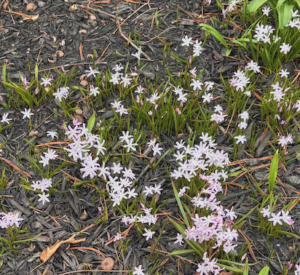
After what feels like months and months of wind, snow, and ice, finally, the green begins to show through. Green is just the start, as spring progresses, the flowers, weeds, or wild, planted, or infiltrated poke through the soil. This feels like hope embodied to me. As the weather warms and the flowers bloom, the world is restored to bright and warm. During the winter, even when blinded by light on snow, it feels like the sun is in hiding. The joy of the sun does not wash over my face nearly as well when there is no warmth to accompany it. Today I walked around Geneseo, letting the warm sun crawl deep in my bones as I took in the nature it was finally allowing to grow up into the world. This feeling is something to hold onto as this comfort and inspiration carry me through the colder months to come again. The warm breeze begins to overpower the icy winds, and the green grass begins to show through the melting snow. Eventually, we are left with a cleaner slate. No snow, grass ready to grow, flowers ready to blossom. Today I let the breeze boss me around, I walked at its whims on a journey to connect with the natural world around me.

Screenshot 2025-04-15 at 2.01.39 PM
Flowers on Campus

Melodies & Windy Walks

Walking around campus when it is warm reminds me of why I chose Geneseo. The green and the flowers and the way you do not need to go far to disconnect from the humanity surrounding you. While I do love listening to the sounds the natural world sends our way, I find that music is often a great augmenter to experiencing the natural world. I tend to walk around with an earbud in or headphones on. I feel that a good song that represents the light and growth of spring makes it that much more enjoyable. Today, my song of choice was “Memory Band” by Minnie Ripperton. I think the grand instrumentals and her light yet clear voice mirrored the way I felt about the grandness and the warmth associated with spring. The soft breeze agreed with her rhythms, and the sun was jealous of the warmth flowing through her voice. It felt like reminiscing about adventures and springs before.

()

Back in Time

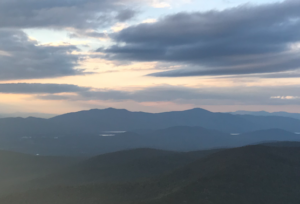
The newly pleasant elements took me back to different experiences I’ve had in nature. It was easy to imagine myself at the peak of a mountain, letting the breeze cool me as I look out at the untouched land for miles ahead. Walking up and down the hills of Geneseo’s campus evoked memories of hiking through the woods, staring at the tree cover above me, the dappled sunlight on the root-permeated dirt. Watching the sunset over the fields and hills was a fine substitution for doing so on the highest point of a mountain. While it could never emulate the same exact feeling, connecting with the hills and the grass, watching the sunset and the clouds, brings a sense of peace to you. I feel that this is similar to the absolute serenity of the peaceful views and sounds of the Adirondack Mountains. Feeling the spring temperament, or watching life bloom on the ground and in the trees, brings stillness to a nonstop life. I feel that watching the flowers push through the dirt, or the leaves return to the trees, re-centers me with the balance that nature possesses. It allows me a sense of balance I forget in the winter.

Screenshot 2025-04-15 at 2.06.24 PM
Cascade Mountain

My Oasis

Paradise

Although this place doesn’t have sand or water, it will always be my oasis. As long as I’ve known how to breathe, the fresh air filling my lungs has been intertwined with the sound of birds singing. When the robins, cardinals, chickadees, and mourning doves sing their songs, I find myself at home. Lying under the hundred year old locust tree, even before it blooms, is an ethereal experience. The branches sway, I hear the birds chirp, and I know then that I’m home.

The Pond

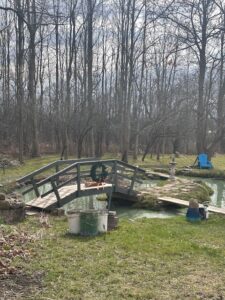
No more than 100 feet west of the locust tree is the pond that I’ve spent endless summer mornings sitting at, mesmerized by the frogs, koi, and goldfish cohabitating with each other. Today is one of the first days of the year that the aquatic creatures perform their routine for us. After my mother throws a fistful of fish food, they all swim to the surface, eager to get fed first. The beautiful koi fish glimmer in the sunlight just before the clouds come to dull the pastel colors of spring. My beautiful blonde kitty saunters over to the pond, crossing the wooden bridge while hunting the first dozen frogs to appear this season. The frogs have gorgeous green speckles and sit patiently waiting. I could never know what they were waiting for, but I could sense their calm patience, and it washed over me. The dead and brittle remnants of last year’s lily pads and reeds fill my family with anticipation for springtime.

This is the pond I describe in my writing-- The Pond

A Walk Around the Grounds

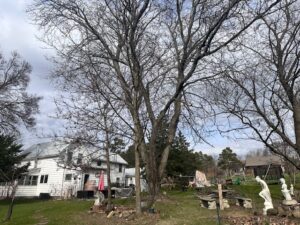
Once I’ve exhausted our examination of the pond, I take Dolly’s lead, my cat, and begin to walk to the front patio of my house. Who knew just an acre of land could hold so much value for a family, and so much beauty, even in the death of winter’s last moments. I’ve never felt more privileged to live here than when I get to watch the land turn over and gain a new life once a year. I sit on the front patio with my mother and let her tell me which birds are singing and which ones are her favorite. As we listen to the birds, I look up towards the sky and see the perfect shade of baby blue, with heather gray clouds passing by. I imagine where the sun is and how it shines down on the Earth, allowing my house to be dimly lit in the late afternoon in the most perfect way.

These are the grounds I describe in my writing
The Grounds

Conclusions

I feel such peace surrounded by Mother Nature; though some could dub me a tree-hugger, I’d much rather be known for my loving attitude towards the place we call home. I’ve walked every inch of this property, I know where every tulip will come up and where the deer will cross into the woods. It’s undeniable that during spring, I feel most connected to this land.

To Leave (Un)Changed: Revisiting the Walnut Trees

Returning

On the south side of campus, past my freshman-year dorm, is the Arboretum. The walk there is relatively the same as it was 2 years ago, walking around Onondaga Hall and cutting across the parking lot to the entrance of the Arboretum, being welcomed by the plaque that I’ve never stopped to read. I walked past the lonely bench and the large, old walnut tree with a huge burl. I was a bit shocked to see they’d cut the longest branch of the wide tree. It was roughly three or four times my height in length and sloped down and away from the trunk, nearly touching the ground. One of the first things I’d done while at Geneseo was climb that branch, the only way to reach the rest of the tree. All that remains of that branch is the clean cut—presumably accomplished by some power tool—that had exposed the circular rings and revealed its age.

Trodding Further

I continued to make my way around the Arboretum, veering right once I reached the gazebo and down the slimmer, lesser-known path. The absence of grass leads me to where I intend to go. There are a few twigs, leaves, and wayward bush branches in areas of the path, but it’s relatively clear. The ground was a bit slick with the rain from the day prior, and the air was still tainted with the residual cold, but all things considered, it probably didn’t warrant the winter jacket I’d brought with me.

I watched some squirrels run between the trees, jumping from one branch to another, and how they ruffled the dense layer of leaves that hid the ground below the bushes. A few cardinals and some similarly sized brown birds—maybe chickadees—flew about the area.

The path was short, and I could hear the nearby road on the lower slope of the half-hazard oval trail. The brushing of car tires and the occasional bombardment of a 16-wheeler would drown out the sound of the birds and rustling of wind. It was an odd reminder that this small patch of woods was exactly that—’a small patch’ enclosed by paved roads that have imposed themselves on either side. Even though they were probably hundreds of feet away, the noise of engines still disturbed this apparently ‘untouched’ piece of nature.

The Walnut Tree

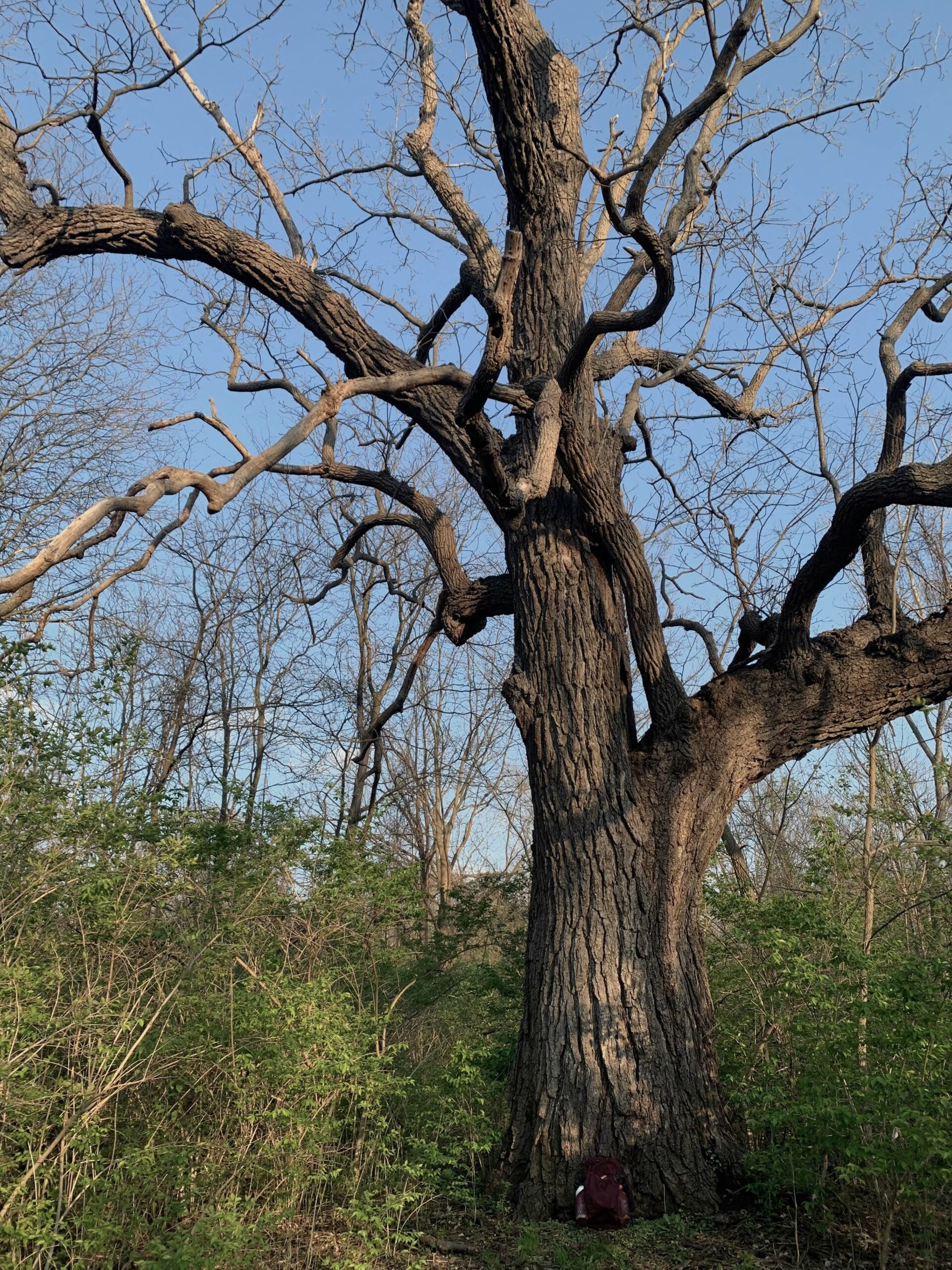
I made my way up the rest of the trail. Towards the very end, just before you can see the exit that spits you out on the other side of the gazebo, was an obscenely tall black walnut tree. It was probably the largest in the entire Arboretum. Unlike the ones that greeted me at the entrance, this one has remained untouched, allowed to keep all of its branches.

It’s probably the biggest tree I’ve ever seen. It must have been at least 35-40 feet tall, probably more. I tried to see how far I could wrap my arms around it (a rather uncomfortable task considering the rather deep, dry ridges of the bark, which caught on the cotton of my sweatshirt). At best, I couldn’t even wrap my arms halfway around the trunk.

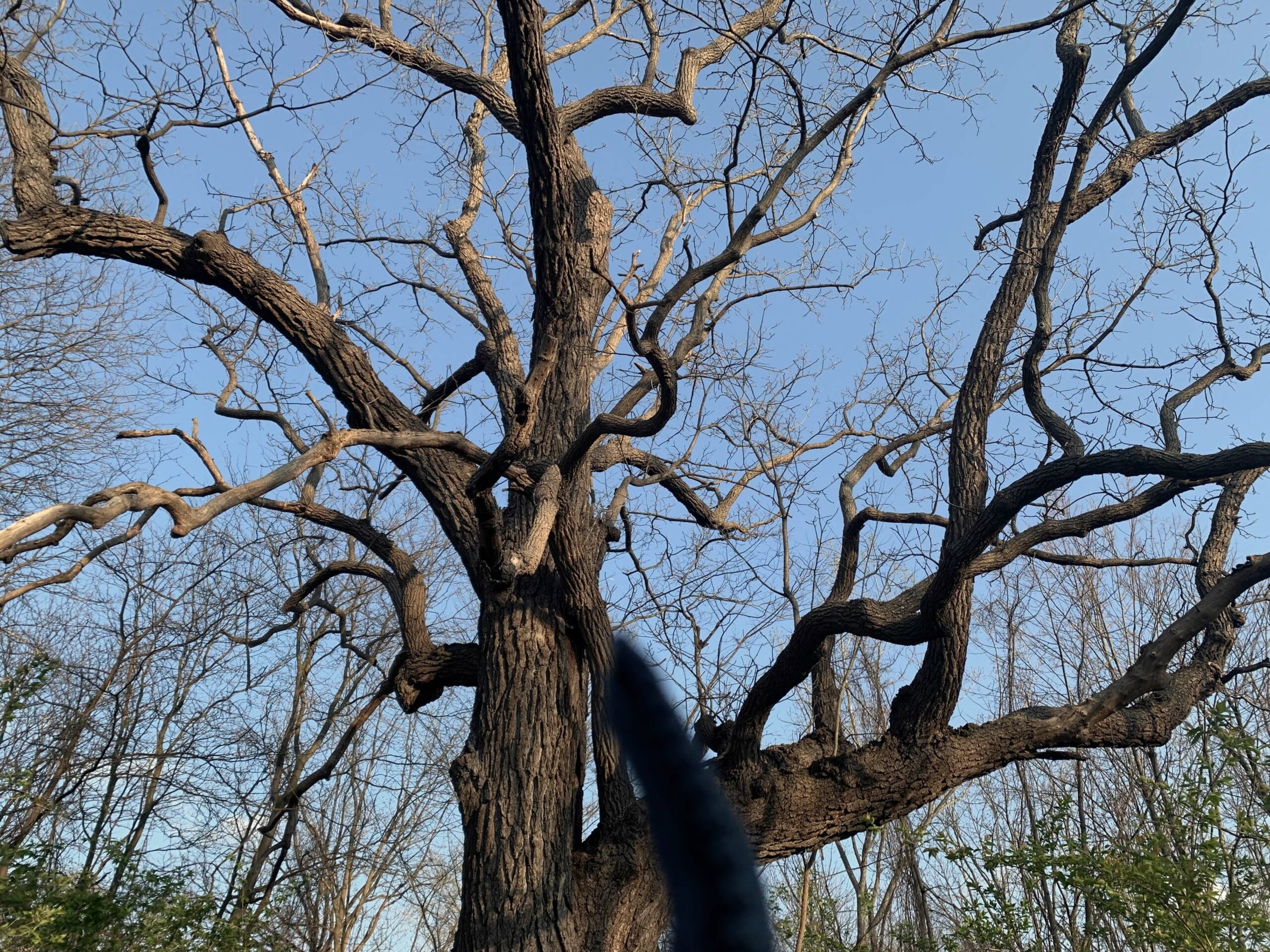
The tree split into two main branches, both of which split again. The smaller limbs that branched off were curled and hitched in an almost gnarly way. The ends of many of the branches were bare, bark gone. The absence of leaves would probably be cause for concern if it were a few months warmer. Yet, the other walnut tree, the welcoming one that greets visitors before the gazebo, had a giant burl—sometimes indicative of disease. It’s an odd and somewhat solemn reminder that even those giant, imposing branched figures die; they’re susceptible to disease just like we are, even though they don’t show it the same way.

Extremely tall black walnut tree with backpack for scale -- Extremely tall black walnut tree with backpack for scale

Wide photo of the branches of the black walnut tree -- A wider view of the branches of the black walnut tree

Movement

From this side of the trail, I can hear the other road that eventually leads past Main Street. It’s the same howling of tires and the same reminder, mirroring the sounds heard at the other end of the trail. No matter how large the forest, there’s usually some kind of path that will cut through it, whether it be a paved road or a trodden trail. As a group, humans don’t tend to leave a place unchanged; as an individual, the changes I left were minimal—footprints in dirt, microscopic cotton fibers on bark, and a few twigs crunched underfoot—but they’re changes all the same.

As I left the Arboretum and began the rather long walk back home, I reflected on a quote from Aristotle that one of my professors mentioned a few days before, “there is no time without change.” Drawing from this, I’d like to contradict the common poetic sentiment that time seems to stop or slow when you encounter nature. Regardless of perception, time doesn’t stop or slow. There will always be constant movement and change—the cutting of branches, the flying of birds, the trodding of trails, the losing of bark, and the building of roads—there will always be the constant passing of time.

The Duality of Night and Day

My Time in Nature

The times in which I observed nature were both night and day. Taking in the fact that the same earth can look, sound, smell, and feel so different with a simple twelve hour difference. Day is full of energy and movement. The sun is out, people are working, going places, and making things happen. It feels active and productive, with noise, light, and hustle. Night, on the other hand, is quiet and calm. The world slows down, the stars come out, and there’s a sense of peace. It’s a time to rest, reflect, or just enjoy the stillness that daytime doesn’t always allow. While there is such a great duality between the two times of day, there is the common threds between the two that I observed. Even in their busiest moments, both day and night have space for pause — for silence, reflection, and calm. Stillness doesn’t belong to one or the other. It’s tucked into both, if you know where to look.

In the Light of Day

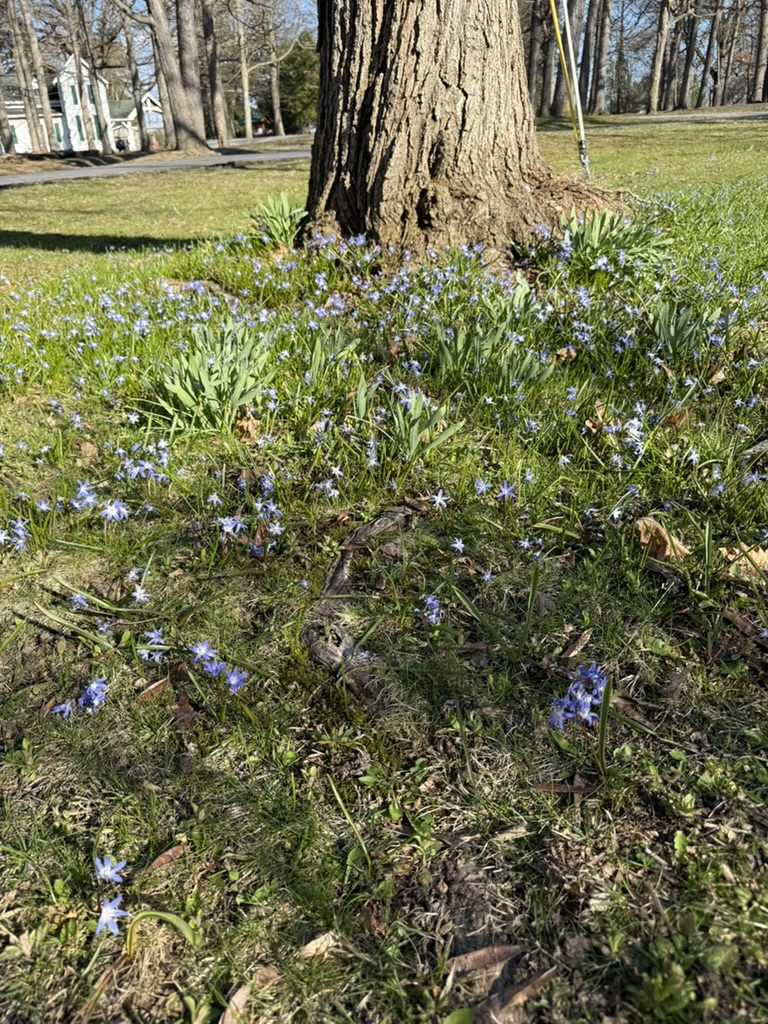
I chose to turn one of walks that I take daily, into an opporunity to observe all that was around me. This was was simply taken within the streets of gorgerous Geneseo. Typically one of these walks is taken for physical activity and is brisk, rushed, and rapid meaning observation and nature is lost within. Music is usually blasting, thought are elsewhere, senses are turned off only to notice the hustle and bustle of others. This walk however, was taken on a Sunday afternoon, sun shining, ears free of headphones, senses turned on. The sights, the smells, the sounds or lack there of, and the feeling of cool sunny air on my skin. Much to take in. I noticed that much of the hustle and bustle of the day time is human made, the loud music, and lack of appreciation, the lingering stress in the air. Something that particularly caught my eye within this time spent in nature was the simple beauty of a patch of purple flowers, one may consider them weeds, others may consider them a sign of hope for their day. Stopping at the patch, I observed, took in the beauty, took a deep breath, and had a relization. This patch exists all of the time, day and night. What changes is the environment around it, darkness, humans sleeping, the stillness of the world, and the flowers stay put, watching it all happen. I was then inclined to observe the night as well. https://dh.sunygeneseoenglish.org/wp-content/uploads/sites/8/2025/04/E359A105-1754-41AD-9630-129E0B725A1D_1_105_c.jpeg

The Still of Night

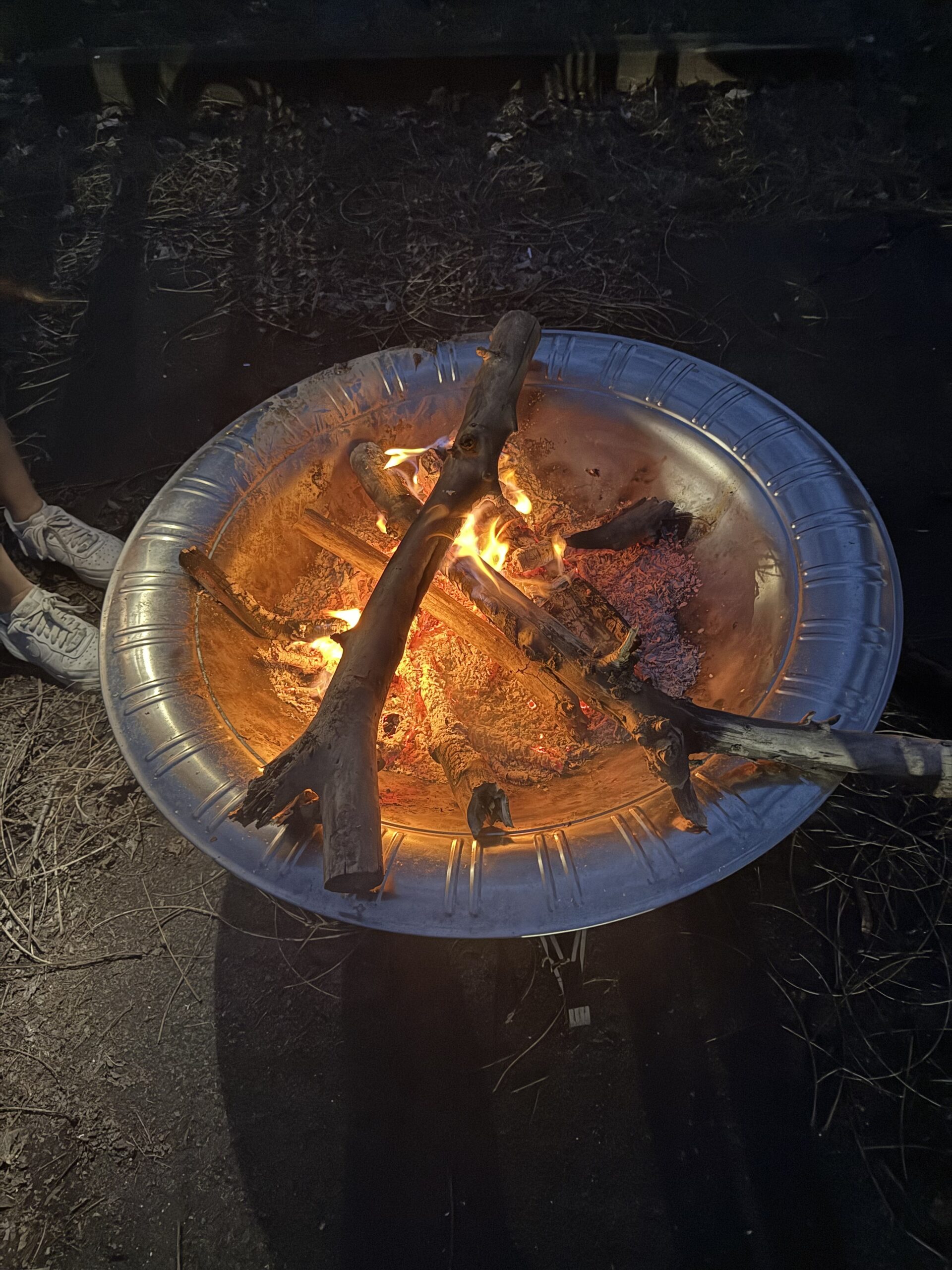
The night is quiet, serene, full of reflection, and hope for the next day. This particular night held space for a fire outside with eight tired girls wanting to unwind and breathe after a day in the light. As the sun set, sky got darker, and the world more still, the minds of myself and my seven roomates also stilled. I took it in. The glow of the fire, bats above our heads, the occasional gust of wind through our hair, potent smell of fire we all love to hate. The whole world slowed down. However, it is not the world that slows down, it’s the humans in the earth that slow down. This observation of duality reminds me to stop, think, look, listen, breathe, no matter what time of the day it is. https://dh.sunygeneseoenglish.org/wp-content/uploads/sites/8/2025/04/IMG_1886-scaled.jpeg

Use of AI

In this blog post, I did use AI for the creation of the titles of my paragraphs. Something I would like to try next time would be to write the paragraph first and then ask AI to title the paragraph based on the content rather than asking it prior to the writing of the paragraph.

Animals in Geneseo’s Arboretum

Mother Nature is always around us even if we are blind to it, and she can take on multiple forms. These include, but are not limited to, trees scattered randomly around a city block, birds singing songs in someone’s backyard, a local park with bike trails, or an entire national park that fills tourists in awe with each visit. In our seemingly rapid-paced and money-chasing society, it can be easy to forget to slow down and appreciate her beauty. Spending time in nature allows us to relax and process the world around them, both externally and internally, as well as learn new things about ourselves and the natural world.

The Arboretum

I made my own nature-based observations while traipsing through Geneseo’s Arboretum, which was located just beyond the residence halls on the south side of campus. Upon entry the trails were all hidden from view, but next to a wooden bench, I found the entrance to a trail marked by yellow arrows. I attempted to follow the trail completely, but about a quarter of the way down, the path was covered in mud. My shoes, lacking the proper traction, made it hard to continue, until I found a drier trail at an intersection. Despite this, it was a very quiet and peaceful escape from college.

The majority of my observations were of animals, especially birds. I found it surprising that, although the nature trail itself was not too far away from civilization, there was quite an abundance of wildlife. Watching them required me to focus inward on my immediate surroundings and ignore the road just beyond the trails. Every time a truck drove by, producing a cacophony of sound, or I took out my phone to take a picture, the animals would disappear entirely and I would lose track of them. These animals were: three turkey vultures circling above the tree canopy, a goldfinch, with winter plumage, flying from one tree to another, two crows ducking in an out of the trees following each other, a rather adorable and small garter snake from underneath a wooden bridge, and two 2 robins hopping in the shrubbery with near perfect camouflage.

Specific (and fascinating) animal obervations

The two crows were probably the most fascinating to watch. They were following each other through the treetops silently, twisting and turning through the branches. If I was really quiet, I could hear the flapping of their obsidian wings, which only added to the wonderful display. It was truly mesmerizing to watch these black birds carry out their airborne ritual, though I was unable to record it. Unfortunately, the experience was cut short by a truck thundering along on the road behind me, which distracted me completely from the birds. When I looked back at the trees, I could not find them at all. However, I heard the calls of crows throughout my hour-long nature-walk, and I wouldn’t be surprised if they were hiding somewhere in the trees, talking to each other.

Entrance to Arboretum
Entrance to Arboretum located near Suffolk Hall

While wandering around, and seeing where the path led, I found another entrance to the Arboretum down the road near Suffolk Hall. It was located on a downhill path that curved towards the bottom, before leading to a small bridge made of wooden planks flowing over a small stream, as shown above. When I re-entered, after seeing what lay beyond the exit, I crossed the same bridge to return to the trails. When I was halfway across, I heard a strange rustling sound from beneath me. What greeted me, or crept away from me, was a little garter snake fleeing from the noise my feet made. I’ll admit that I found it adorable to watch the tiny snake, who was probably afraid of the two-legged giant, slither towards the jungle of dead leaves and tree-roots that surrounded the stream. However, after looking away to open the camera app on my cell phone to snap a picture of the small creature, I completely lost sight of it, unsurprisingly.

In conclusion

If there is one thing I’ve learned from this hour-and-fifteen minute excursion, it is to live in the moment. It is so easy to be distracted by loud noises, or do actions that unintentionally pull one away from their surroundings. That said, it is nearly impossible to be in complete control of one’s surroundings and any given moment; I had no control over the loud truck driving behind me and producing a loud noise that disrupted my observance of the two crows. However, the memory of that experience and the serenity I felt while taking time to relax and watch the natural world go by is one I will not soon forget.

A Walk on a Cloudy Day

It was a very cloudy afternoon when going for this walk, immersing myself in the environment as it felt very still and quiet. Noticing how the sky was, I felt led to the nature around being so quiet. You could feel the slight presence of a peaking sun but felt the cold wind whistle through. The environment felt still, peaceful as though all the stress from the day I felt just vanished while walking. Looking at the grey sky, it made walking around feel more sad without the sun but in a way it was nice as though you had to focus on the sound you heard around you.

The view of the tail, the cloudy sky can be seen along with a peaking sunny sky
The view of my walk, with a bench in the middle of the trail

Starting my walk up this slight hill, you could feel the damp ground from the rain the night before. I started to look more closely at the ground, as I was looking for worms and if they were crawling around the damn, muddy ground. I seemed not to find very many but as I was getting halfway through my walk and there was a peaking sun that was bringing warmth to the ground and clearing up the dampness of the ground. You could see the birds in the distance ahead hopping around through the muddy and damp paths.

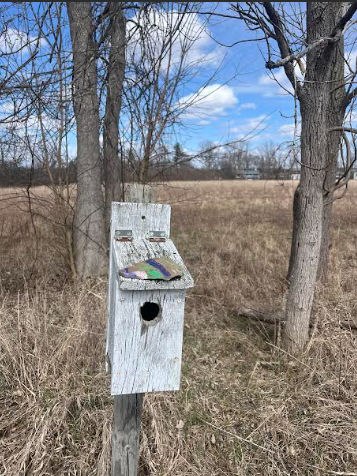
Bird House on trail, can see a painted rock on top of it.
Lots of birds in the area, nice little home for them

Even on this more quiet and less spectacular day, you feel everything closer and notice the noises around you. From the wind whistling through the trees, or the rustles that the wind brought to the brittle and dead grass and leaves around. Hearing these more clearly, made me feel as though I was noticing the sounds of nature around me. I think sometimes in society, especially nowadays, we forget to really listen to the things around us and appreciate the sounds of nature. As I even got to listen to the birds chirping in the trees, and hearing their wings flutter as they fly around.

The silence of the sky and earth around me is what made this walk enjoyable, more at one with nature and noticing the things around me. As I couldn’t hear the very busy daily life that goes on around all the cars and people but enjoy this silence and peaceful walk in the woods. I felt like I really immersed myself and saw all these pretty things and heard all the sounds that we don’t notice on a daily basis as a society.

Nature Walk

Modern Day Distractions

For this project, my friend and I started to go on a walk in the Arboretum. There were many dirt paths to walk on. A few days before we went on a walk it rained, leading the trails to be muddy. The mud was thick, pasty, and hard to walk through. During our walk, we heard birds whistling a beautiful melody. The beautiful melody was soft and sweet. We also heard the rumbling of cars from the road nearby. As we got closer to the road it was harder to hear the animals that surrounded us. This led me to think about how busy our society has become, and it can be distracting. Nature is a beautiful thing that can get destroyed from things such as roads and houses. So often I get distracted by my phone or my headphones, that I miss seeing and hearing all the things that nature has to offer.

Wild Garlic

As we continued walking, she was able to find some wild garlic. Before this walk I would have never known that the plant I was looking at was garlic. The wild garlic was long and thin like a blade of grass. As I was waking, I was not able to smell the aroma of the plant. Once my friend plucked the plant from the ground, we could smell it and make sure it was garlic. When I smelt the wild garlic, I was surprised at how strong and overwhelming the smell was. Looking around at where we were at, I could see an abundant amount of this wild garlic. If she had not shown me this plant, I would have thought they were just normal weeds, and I would have overlooked them. This walk has taught me what they look like in case I ever wanted to find wild garlic again.

Blooming Flowers

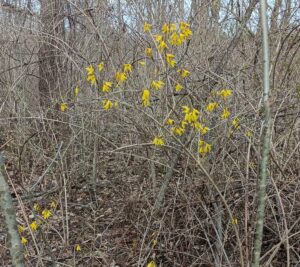
While walking we were able to see the juxtaposition of the living and the dead plants. The beginning of spring revealed itself. There were many trees without leaves that have not bloomed yet. However, there were some trees that have blossomed. Many plants and flowers have started to grow, too. There was a cluster of flowers that caught my eye because it made a pop of color in the mist of what seemed to be a forest of dead branches. It is surprising to see some plants growing when the other plants around them are still dead. Walking down the path made me excited about the warm weather to come and the flowers that would follow. I love spring and summer because I allows me to go on more walks.

20250409_172040
Yellow Flowers

Appreciation of Nature

Overall, I had I good time taking a walk in nature with my friend. Explored the wild and took in the beautiful scenery. Animals like squirrels climbed up trees and birds flew overhead. There were sounds like the wind and the trees swaying. We touched the plants and the wild garlic that we found. I am glad that we went out on that beautiful day because I missed seeing the plants and animals during the cold winter season. This walk taught me not to overlook the little things and to appreciate the nature around us.

20250409_172134
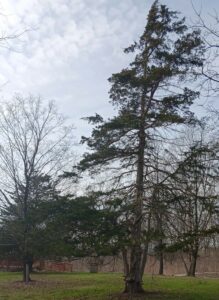
Trees
The Use of AI in my Post

For my Blog Post, I did not use any AI to formulate my writing. I did use the spell check on Word to make sure I did not spell anything wrong.